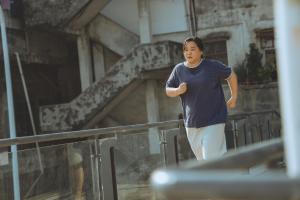
My friend said it's a motivational weight-loss film, and the focus of her boyfriend and male friends is also on weight loss and motivation, as well as regretting not winning the final boxing match. However, the theme of this movie is definitely not weight loss, and winning or losing doesn't depend on a boxing match. For example, when the protagonist Leying decided to participate in the boxing match and told the gym owner, "I want to participate in a boxing match," the owner said, "Oh, you want to lose weight." Leying firmly said, "No, I want to participate in a boxing match." Another example is when Leying, after slimming down from boxing, had dinner with her father. Her father looked at her and said, "You seem different." Leying said, "I lost weight." Her father replied, "No, you've changed." These two dialogues clearly show that the protagonist's goal is not weight loss but bravely pursuing her passion, such as boxing. In the process of loving her life, she learns to love herself, gains strength, and it's not about her appearance changing but about her inner spirit growing. Another part that shows this is not a weight-loss themed movie, and it's also the first scene that brought tears to my eyes, is when Leying walks past the mirror before going on stage for the competition, seeing her past, larger self gently looking at her current self. Then Leying smiles brightly at her past self, this being the first time the protagonist genuinely smiles in the movie. Also, when watching the behind-the-scenes footage at the end, Jia Ling, who directed the film, cried during the filming of this scene. If this were a weight-loss themed movie, most of it would show the protagonist self-loathing her past overweight self. However, this is a movie about "loving oneself" Whether it's the past or present self, both can provide self-power and deserve to be loved. This is the touching aspect of self-identification and self-growth.


 لامحدود فلمیں اور شوز دیکھیں
 اپنا پسندیدہ مواد ڈاؤن لوڈ کریں اور آف لائن دیکھیں
 آسان انٹرفیس اور ہموار کارکردگی
























'%3e%3cpath%20id='Vector'%20d='M17.3996%2025.7999C17.3996%2025.9838%2017.3634%2026.1658%2017.293%2026.3357C17.2227%2026.5055%2017.1196%2026.6598%2016.9896%2026.7899C16.8596%2026.9199%2016.7052%2027.023%2016.5354%2027.0933C16.3655%2027.1637%2016.1835%2027.1999%2015.9996%2027.1999C15.8158%2027.1999%2015.6337%2027.1637%2015.4639%2027.0933C15.294%2027.023%2015.1397%2026.9199%2015.0097%2026.7899C14.8797%2026.6598%2014.7765%2026.5055%2014.7062%2026.3357C14.6358%2026.1658%2014.5996%2025.9838%2014.5996%2025.7999C14.5996%2025.4286%2014.7471%2025.0725%2015.0097%2024.81C15.2722%2024.5474%2015.6283%2024.3999%2015.9996%2024.3999C16.3709%2024.3999%2016.727%2024.5474%2016.9896%2024.81C17.2521%2025.0725%2017.3996%2025.4286%2017.3996%2025.7999Z'%20fill='white'/%3e%3cpath%20id='Union'%20fill-rule='evenodd'%20clip-rule='evenodd'%20d='M8.5%204H23.5C24.0523%204%2024.5%204.44772%2024.5%205V21.5H7.5V5C7.5%204.44772%207.94772%204%208.5%204ZM5.5%2022.5V5C5.5%203.34315%206.84315%202%208.5%202H23.5C25.1569%202%2026.5%203.34315%2026.5%205V22.5V27C26.5%2028.6569%2025.1569%2030%2023.5%2030H8.5C6.84315%2030%205.5%2028.6569%205.5%2027V22.5ZM24.5%2023.5V27C24.5%2027.5523%2024.0523%2028%2023.5%2028H8.5C7.94772%2028%207.5%2027.5523%207.5%2027V23.5H24.5Z'%20fill='white'/%3e%3cpath%20id='Union_2'%20fill-rule='evenodd'%20clip-rule='evenodd'%20d='M17%209C17%208.44772%2016.5523%208%2016%208C15.4477%208%2015%208.44772%2015%209V13.8258L13.1508%2012.2407C12.7315%2011.8813%2012.1002%2011.9299%2011.7408%2012.3492C11.3813%2012.7685%2011.4299%2013.3998%2011.8492%2013.7593L15.345%2016.7556C15.5205%2016.9079%2015.7495%2017%2016%2017C16.2506%2017%2016.4796%2016.9079%2016.6551%2016.7556L20.1508%2013.7593C20.5701%2013.3998%2020.6187%2012.7685%2020.2593%2012.3492C19.8999%2011.9299%2019.2686%2011.8813%2018.8492%2012.2407L17%2013.8258V9Z'%20fill='white'/%3e%3c/g%3e%3c/svg%3e)