Thirty-three metres below London’s Clapham High Street is the world’s first underground farm. It’s a green revolution and it’s powered by data. Tunnels originally built to shelter Londoners from the bombing in WW2 sprouted new life when Growing Underground co-founders Richard Ballard and Steve Dring decided it was a perfect site to grow food while reducing the carbon footprint of transport and supply. Down in the tunnels, a team of engineers and data specialists has been helping the farmers to optimise crop performance and reduce energy use. They are led by Dr Ruchi Choudhary from the Centre for Smart Infrastructure and Construction at the University of Cambridge and the Data-centric Engineering Programme at the Alan Turing Institute. Together, they’ve reduced the time it takes to grow some crops by 50% and all crops by an average of 7%, as well as increasing yields. Meanwhile, the crops are grown using less space and water than conventional greenhouse growing, no pesticides and 100% r
Mayorkun
03/11/2025 04:00
Researchers from Cambridge University’s Centre for Natural Material Innovation based at the Department of Architecture are working with PLP Architecture and engineers Smith and Wallwork on the future development of timber skyscrapers. Various teams around the world are hoping to produce the tallest wooden skyscraper, the research team from Cambridge have completed holistic work on three proposals for timber skyscrapers in London, Chicago, and the Hague. All three will be on show to the public at the Royal Society’s Summer Science Exhibition 2019, freely open from July 1–7. The team’s exhibit—Timber Towers of Tomorrow—is the culmination of a five year research project. The use of timber as a structural material in tall buildings has a variety of potential benefits; it is a renewable resource, unlike concrete and steel, it has reduced costs, improved construction timescales, increased fire resistance, significant reduction in the weight of buildings, and gives enormous psychological well
Raashi Khanna
03/11/2025 04:00
Manta rays are threatened worldwide and we still know little about their reproductive strategies. The ability to scan pregnant individuals will be invaluable in the quest to protect them. A team of researchers from the University of Cambridge and the Manta Trust has successfully scanned a pregnant wild reef manta ray underwater to obtain clear ultrasound images of her foetus, using the world’s first contactless underwater ultrasound scanner. #WorldOceansDay
Anita Gordon
03/11/2025 04:00
Scientists have created the first ever large-scale map of microscopic algae as they bloomed across the surface of snow along the Antarctic Peninsula coast. Results indicate that this ‘green snow’ is likely to spread as global temperatures increase.
chancelviembidi
03/11/2025 04:00
Plastic has become a malevolent symbol of our wasteful society. It’s also one of the most successful materials ever invented: it’s cheap, durable, flexible, waterproof, versatile, lightweight, protective and hygienic. During the coronavirus pandemic, plastic visors, goggles, gloves and aprons have been fundamental for protecting healthcare workers from the virus. But what about the effects on the environment of throwing away huge numbers of single-use medical protection equipment? How are we to balance our need for plastic with protecting the environment? Delayed as a result of the pandemic, the film is being released now because it considers how society might ‘reset the clock’ when it comes to living better with a vital material. We hear how Cambridge University's Cambridge Creative Circular Plastics Centre (CirPlas) aims to eliminate plastic waste by combining blue-sky thinking with practical measures – from turning waste plastic into hydrogen fuel, to manufacturing more sustainable
Ansyla Honny.
03/11/2025 04:00
Forests burn, glaciers melt and one million species face extinction. Can we humans save the planet from ourselves? In a new film, alumni Sir David Attenborough and Dr Jane Goodall DBE, and leading Cambridge University researchers, talk about the urgency of the climate crisis – and some of the solutions that will take us towards zero carbon. If we are to avoid climate disaster we must sharply reduce our carbon dioxide emissions starting today – but how? Cambridge researchers describe their work on generating and storing renewable energy, reducing energy consumption, understanding the impact of climate policies, and probing how we can each reduce our environmental impact. We hear how the ambitious new programme Cambridge Zero is bringing together ideas and innovations to tackle the global challenge of climate catastrophe – and inspiring a generation of future leaders – and how the University is looking at its own operations to develop a zero carbon pathway for the future. Explore more: C
Ashish Chanchlani
03/11/2025 04:00
Dr Jane Goodall DBE talks about the environmental crisis and her reasons for hope. “Every single day that we live, we make some impact on the planet. We have a choice as to what kind of impact that is.” At the age of 26, Jane Goodall travelled from England to what is now Tanzania, Africa, and ventured into the little-known world of wild chimpanzees. Among her many discoveries, perhaps the greatest was that chimpanzees make and use tools. She completed a PhD at Newnham College in Cambridge in 1966, and subsequently founded the Jane Goodall Institute in 1977 to continue her conservation work and the youth service programme Roots & Shoots in 1991. She now travels the world as a UN Messenger of Peace. “The human spirit is indomitable. Throughout my life, I’ve met so many incredible people – men and women who tackle what seems impossible and won’t give up until they succeed. With our intellect and our determined spirit, and with the tools that we have now, we can find a way to a better futu
vahetilbian
03/11/2025 04:00
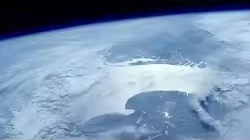
Cambridge Zero, the University's ambitious new climate initiative, will generate ideas and innovations to help shape a sustainable future - and equip future generations of leaders with the skills to navigate the global challenges of the coming decades. With thanks to our narrator Dr Emma Liu. Image credit NASA
— No more content —
صارف کا جائزہ
Gigi PN
03/11/2025 04:00
Thirty-three metres below London’s Clapham High Street is the world’s first underground farm. It’s a green revolution and it’s powered by data. Tunnels originally built to shelter Londoners from the bombing in WW2 sprouted new life when Growing Underground co-founders Richard Ballard and Steve Dring decided it was a perfect site to grow food while reducing the carbon footprint of transport and supply. Down in the tunnels, a team of engineers and data specialists has been helping the farmers to optimise crop performance and reduce energy use. They are led by Dr Ruchi Choudhary from the Centre for Smart Infrastructure and Construction at the University of Cambridge and the Data-centric Engineering Programme at the Alan Turing Institute. Together, they’ve reduced the time it takes to grow some crops by 50% and all crops by an average of 7%, as well as increasing yields. Meanwhile, the crops are grown using less space and water than conventional greenhouse growing, no pesticides and 100% r
Mayorkun
03/11/2025 04:00
Researchers from Cambridge University’s Centre for Natural Material Innovation based at the Department of Architecture are working with PLP Architecture and engineers Smith and Wallwork on the future development of timber skyscrapers. Various teams around the world are hoping to produce the tallest wooden skyscraper, the research team from Cambridge have completed holistic work on three proposals for timber skyscrapers in London, Chicago, and the Hague. All three will be on show to the public at the Royal Society’s Summer Science Exhibition 2019, freely open from July 1–7. The team’s exhibit—Timber Towers of Tomorrow—is the culmination of a five year research project. The use of timber as a structural material in tall buildings has a variety of potential benefits; it is a renewable resource, unlike concrete and steel, it has reduced costs, improved construction timescales, increased fire resistance, significant reduction in the weight of buildings, and gives enormous psychological well
Raashi Khanna
03/11/2025 04:00
Manta rays are threatened worldwide and we still know little about their reproductive strategies. The ability to scan pregnant individuals will be invaluable in the quest to protect them. A team of researchers from the University of Cambridge and the Manta Trust has successfully scanned a pregnant wild reef manta ray underwater to obtain clear ultrasound images of her foetus, using the world’s first contactless underwater ultrasound scanner. #WorldOceansDay
Anita Gordon
03/11/2025 04:00
Scientists have created the first ever large-scale map of microscopic algae as they bloomed across the surface of snow along the Antarctic Peninsula coast. Results indicate that this ‘green snow’ is likely to spread as global temperatures increase.
chancelviembidi
03/11/2025 04:00
Plastic has become a malevolent symbol of our wasteful society. It’s also one of the most successful materials ever invented: it’s cheap, durable, flexible, waterproof, versatile, lightweight, protective and hygienic. During the coronavirus pandemic, plastic visors, goggles, gloves and aprons have been fundamental for protecting healthcare workers from the virus. But what about the effects on the environment of throwing away huge numbers of single-use medical protection equipment? How are we to balance our need for plastic with protecting the environment? Delayed as a result of the pandemic, the film is being released now because it considers how society might ‘reset the clock’ when it comes to living better with a vital material. We hear how Cambridge University's Cambridge Creative Circular Plastics Centre (CirPlas) aims to eliminate plastic waste by combining blue-sky thinking with practical measures – from turning waste plastic into hydrogen fuel, to manufacturing more sustainable
Ansyla Honny.
03/11/2025 04:00
Forests burn, glaciers melt and one million species face extinction. Can we humans save the planet from ourselves? In a new film, alumni Sir David Attenborough and Dr Jane Goodall DBE, and leading Cambridge University researchers, talk about the urgency of the climate crisis – and some of the solutions that will take us towards zero carbon. If we are to avoid climate disaster we must sharply reduce our carbon dioxide emissions starting today – but how? Cambridge researchers describe their work on generating and storing renewable energy, reducing energy consumption, understanding the impact of climate policies, and probing how we can each reduce our environmental impact. We hear how the ambitious new programme Cambridge Zero is bringing together ideas and innovations to tackle the global challenge of climate catastrophe – and inspiring a generation of future leaders – and how the University is looking at its own operations to develop a zero carbon pathway for the future. Explore more: C
Ashish Chanchlani
03/11/2025 04:00
Dr Jane Goodall DBE talks about the environmental crisis and her reasons for hope. “Every single day that we live, we make some impact on the planet. We have a choice as to what kind of impact that is.” At the age of 26, Jane Goodall travelled from England to what is now Tanzania, Africa, and ventured into the little-known world of wild chimpanzees. Among her many discoveries, perhaps the greatest was that chimpanzees make and use tools. She completed a PhD at Newnham College in Cambridge in 1966, and subsequently founded the Jane Goodall Institute in 1977 to continue her conservation work and the youth service programme Roots & Shoots in 1991. She now travels the world as a UN Messenger of Peace. “The human spirit is indomitable. Throughout my life, I’ve met so many incredible people – men and women who tackle what seems impossible and won’t give up until they succeed. With our intellect and our determined spirit, and with the tools that we have now, we can find a way to a better futu
vahetilbian
03/11/2025 04:00
Cambridge Zero, the University's ambitious new climate initiative, will generate ideas and innovations to help shape a sustainable future - and equip future generations of leaders with the skills to navigate the global challenges of the coming decades. With thanks to our narrator Dr Emma Liu. Image credit NASA
— No more content —
Disclaimer: All videos and pictures on MovieBox are from the Internet, and their copyrights belong to the original creators. We only provide webpage services and do not store, record, or upload any content.


 لامحدود فلمیں اور شوز دیکھیں
 اپنا پسندیدہ مواد ڈاؤن لوڈ کریں اور آف لائن دیکھیں
 آسان انٹرفیس اور ہموار کارکردگی














'%3e%3cpath%20id='Vector'%20d='M17.3996%2025.7999C17.3996%2025.9838%2017.3634%2026.1658%2017.293%2026.3357C17.2227%2026.5055%2017.1196%2026.6598%2016.9896%2026.7899C16.8596%2026.9199%2016.7052%2027.023%2016.5354%2027.0933C16.3655%2027.1637%2016.1835%2027.1999%2015.9996%2027.1999C15.8158%2027.1999%2015.6337%2027.1637%2015.4639%2027.0933C15.294%2027.023%2015.1397%2026.9199%2015.0097%2026.7899C14.8797%2026.6598%2014.7765%2026.5055%2014.7062%2026.3357C14.6358%2026.1658%2014.5996%2025.9838%2014.5996%2025.7999C14.5996%2025.4286%2014.7471%2025.0725%2015.0097%2024.81C15.2722%2024.5474%2015.6283%2024.3999%2015.9996%2024.3999C16.3709%2024.3999%2016.727%2024.5474%2016.9896%2024.81C17.2521%2025.0725%2017.3996%2025.4286%2017.3996%2025.7999Z'%20fill='white'/%3e%3cpath%20id='Union'%20fill-rule='evenodd'%20clip-rule='evenodd'%20d='M8.5%204H23.5C24.0523%204%2024.5%204.44772%2024.5%205V21.5H7.5V5C7.5%204.44772%207.94772%204%208.5%204ZM5.5%2022.5V5C5.5%203.34315%206.84315%202%208.5%202H23.5C25.1569%202%2026.5%203.34315%2026.5%205V22.5V27C26.5%2028.6569%2025.1569%2030%2023.5%2030H8.5C6.84315%2030%205.5%2028.6569%205.5%2027V22.5ZM24.5%2023.5V27C24.5%2027.5523%2024.0523%2028%2023.5%2028H8.5C7.94772%2028%207.5%2027.5523%207.5%2027V23.5H24.5Z'%20fill='white'/%3e%3cpath%20id='Union_2'%20fill-rule='evenodd'%20clip-rule='evenodd'%20d='M17%209C17%208.44772%2016.5523%208%2016%208C15.4477%208%2015%208.44772%2015%209V13.8258L13.1508%2012.2407C12.7315%2011.8813%2012.1002%2011.9299%2011.7408%2012.3492C11.3813%2012.7685%2011.4299%2013.3998%2011.8492%2013.7593L15.345%2016.7556C15.5205%2016.9079%2015.7495%2017%2016%2017C16.2506%2017%2016.4796%2016.9079%2016.6551%2016.7556L20.1508%2013.7593C20.5701%2013.3998%2020.6187%2012.7685%2020.2593%2012.3492C19.8999%2011.9299%2019.2686%2011.8813%2018.8492%2012.2407L17%2013.8258V9Z'%20fill='white'/%3e%3c/g%3e%3c/svg%3e)