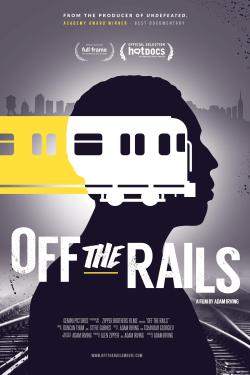
Indianapolis, October 26, 2016: Whenever I watch a documentary that grab my emotions, I suspect propaganda. Off the Rails, the story of Darius McCollum's lifelong battle with Asberger's, is such a story. Darius was bullied as a kid in New York's schools, actually being stabbed at the age of twelve. After that, he retreated into "things more than people," finding solace in the subway system, where he absorbed everything he could about how the trains worked. He learned enthusiastically from the MTA employees, who were more than happy to share their knowledge with such a bright kid. He even rode along in the cab, learning all about the trains as he went, to the point where some of the pilots allowed him to actually take the controls a few times. He was so good, in fact, that one pilot actually put 15-year-old Darius in charge of his train, while the older man visited his girlfriend. He ran the route, picking up and dropping off passengers, following all signals – a perfect ride to the World Trade Center. When Darius was later spotted by a passenger and the Transit Police picked him up, his life's path seemed set. So, Darius applied to work for the MTA when he was seventeen – too young – and he was rejected. When he reapplied at eighteen, he was rejected again. Through his life, he has tried to legitimately wear one of the several uniforms he stole over the years, but as his felonies piled up, his chances of landing a job with the MTA fell to zero. Had circumstances been different, who knows what could have happened? Maybe he could have become a student of the MTA, taken under its wing and integrated into the culture that fascinated him. Maybe the police could have merely called his folks. Maybe
But that isn't what happened. Darius went into the system, never to really exit. Decades later, after he had served multiple prison terms and his parents moved to North Carolina, he was forced, as a parolee, to remain in New York. Without a job, support, or anything different in his life, he stole another bus, and went again to prison. Darius has been arrested nearly thirty times for crimes related to his obsession – trespassing on MTA property, theft of vehicles, transporting passengers without endorsements, reckless endangerment -- and is currently awaiting trial in New York, for driving off in a Greyhound bus. As a multiple, habitual recidivist, he faces a 15 years to life sentence. But this is also a story of how those with power love to exercise it, a story of how closed-mindedness can ruin potential; and how habits are hard to break. Darius has found peace in his life only when he's involved with transit – he, implied in the film, has never injured a passenger or damaged equipment; he's never, apparently, even missed a stop. He has walked picket lines with the Transit Workers Union members, though he has never worked for the MTA, or for any other transit-related business. Even with what had by then become a lengthy criminal record, Darius tried to get near his beloved trains. He volunteered at the Transit Museum, but soon was dismissed after an unidentified patron recognized him and complained. He had a crooked "celebrity" lawyer early in his criminal career, and wound up in prison, a lot. When a dedicated new lawyer tried her best to explain Asperger's to the judge, the jurist thwarted that tactic, saying she (the judge) had Googled Asperger's, and Darius didn't fit the classic symptoms. Through the movie, we're treated to a vision of Darius as a victim of everything and everyone – his Asperger's, the system, his lawyers, the judge, mean MTA officials, a nasty District Attorney. Never, except for a brief clip of a letter from his mother, does the responsibility for taking over some self-admitted 500 buses and trains enter the picture on the other side of the ledger. While Off the Rails is a compelling story of a sympathetic subject, a look at that ledger may raise my eyebrow.


 لامحدود فلمیں اور شوز دیکھیں
 اپنا پسندیدہ مواد ڈاؤن لوڈ کریں اور آف لائن دیکھیں
 آسان انٹرفیس اور ہموار کارکردگی














'%3e%3cpath%20id='Vector'%20d='M17.3996%2025.7999C17.3996%2025.9838%2017.3634%2026.1658%2017.293%2026.3357C17.2227%2026.5055%2017.1196%2026.6598%2016.9896%2026.7899C16.8596%2026.9199%2016.7052%2027.023%2016.5354%2027.0933C16.3655%2027.1637%2016.1835%2027.1999%2015.9996%2027.1999C15.8158%2027.1999%2015.6337%2027.1637%2015.4639%2027.0933C15.294%2027.023%2015.1397%2026.9199%2015.0097%2026.7899C14.8797%2026.6598%2014.7765%2026.5055%2014.7062%2026.3357C14.6358%2026.1658%2014.5996%2025.9838%2014.5996%2025.7999C14.5996%2025.4286%2014.7471%2025.0725%2015.0097%2024.81C15.2722%2024.5474%2015.6283%2024.3999%2015.9996%2024.3999C16.3709%2024.3999%2016.727%2024.5474%2016.9896%2024.81C17.2521%2025.0725%2017.3996%2025.4286%2017.3996%2025.7999Z'%20fill='white'/%3e%3cpath%20id='Union'%20fill-rule='evenodd'%20clip-rule='evenodd'%20d='M8.5%204H23.5C24.0523%204%2024.5%204.44772%2024.5%205V21.5H7.5V5C7.5%204.44772%207.94772%204%208.5%204ZM5.5%2022.5V5C5.5%203.34315%206.84315%202%208.5%202H23.5C25.1569%202%2026.5%203.34315%2026.5%205V22.5V27C26.5%2028.6569%2025.1569%2030%2023.5%2030H8.5C6.84315%2030%205.5%2028.6569%205.5%2027V22.5ZM24.5%2023.5V27C24.5%2027.5523%2024.0523%2028%2023.5%2028H8.5C7.94772%2028%207.5%2027.5523%207.5%2027V23.5H24.5Z'%20fill='white'/%3e%3cpath%20id='Union_2'%20fill-rule='evenodd'%20clip-rule='evenodd'%20d='M17%209C17%208.44772%2016.5523%208%2016%208C15.4477%208%2015%208.44772%2015%209V13.8258L13.1508%2012.2407C12.7315%2011.8813%2012.1002%2011.9299%2011.7408%2012.3492C11.3813%2012.7685%2011.4299%2013.3998%2011.8492%2013.7593L15.345%2016.7556C15.5205%2016.9079%2015.7495%2017%2016%2017C16.2506%2017%2016.4796%2016.9079%2016.6551%2016.7556L20.1508%2013.7593C20.5701%2013.3998%2020.6187%2012.7685%2020.2593%2012.3492C19.8999%2011.9299%2019.2686%2011.8813%2018.8492%2012.2407L17%2013.8258V9Z'%20fill='white'/%3e%3c/g%3e%3c/svg%3e)