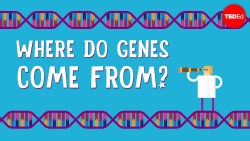
View full lesson: When life emerged on Earth about 4 billion years ago, the earliest microbes had a set of basic genes that succeeded in keeping them alive. In the age of humans and other large organisms, there are a lot more genes to go around. Where did all of those new genes come from? Carl Zimmer examines the mutation and multiplication of genes. Lesson by Carl Zimmer, animation by TOGETHER.
More
0 /10
0 people rated
Understanding genetics
2019
R
1 h 4 m
United Kingdom
TED
View full lesson: When life emerged on Earth about 4 billion years ago, the earliest microbes had a set of basic genes that succeeded in keeping them alive. In the age of humans and other large organisms, there are a lot more genes to go around. Where did all of those new genes come from? Carl Zimmer examines the mutation and multiplication of genes. Lesson by Carl Zimmer, animation by TOGETHER.
More
0 /10
0 people rated
Watch Online
Watch in App
Episodes
Top Cast
User Review
Episodes
Top Cast
User Review
Episodes
film
lklk
Netflix
Plex
User Review
Djubi carimo
22/10/2025 08:13
Dig into why ethnic diversity is so important to medical research when creating new treatments and medicines for diseases. -- While all humans share 99.9% of our DNA, differences in the remaining 0.1% hold important clues about the causes of diseases—and their potential treatments. The problem is, the genetics that researchers are combing through are heavily biased to those of people from European descent, and often overlook other ethnicities. Greg Foot explains the importance of ethnic diversity in medical research. Lesson by Greg Foot, directed by Kirk Zamieroski. This video was produced for TED-Ed by NIHR, the National Institute for Health and Care Research Learn more about how TED-Ed partnerships work: Support Our Non-Profit Mission ---------------------------------------------- Support us on Patreon: Check out our merch: ---------------------------------------------- Connect With Us ---------------------------------------------- Sign up for our newsletter: Follow us on Facebook: F
user3189685302168
22/10/2025 08:13
Dig into why ethnic diversity is so important to medical research when creating new treatments and medicines for diseases. -- While all humans share 99.9% of our DNA, differences in the remaining 0.1% hold important clues about the causes of diseases—and their potential treatments. The problem is, the genetics that researchers are combing through are heavily biased to those of people from European descent, and often overlook other ethnicities. Greg Foot explains the importance of ethnic diversity in medical research. Lesson by Greg Foot, directed by Kirk Zamieroski. This video was produced for TED-Ed by NIHR, the National Institute for Health and Care Research Learn more about how TED-Ed partnerships work: Support Our Non-Profit Mission ---------------------------------------------- Support us on Patreon: Check out our merch: ---------------------------------------------- Connect With Us ---------------------------------------------- Sign up for our newsletter: Follow us on Facebook: F
Darey
22/10/2025 08:13
Dig into the science of how a single genetic mutation alters the structure of hemoglobin and leads to sickle-cell disease. -- What shape are your cells? Squishy cylinders? Jagged zig-zags? You might not spend a lot of time thinking about the bodies of these building blocks, but microscopically, small variations can have huge consequences. And while some adaptations change these shapes for the better, others can spark debilitating complications. Amber Yates dives into the science of the malignant sickle-cell mutation. Lesson by Amber M. Yates, directed by Axon Animation LLC. Sign up for our newsletter: Support us on Patreon: Follow us on Facebook: Find us on Twitter: Peep us on Instagram: View full lesson: Thank you so much to our patrons for your support! Without you this video would not be possible! Rodrigo Carballo, Boytsov Ilya, EdoKun, Misaki Sato, Craig Sheldon, Andrew Bosco, Catherine Sverko, Nik Maier, Mark Morris, Adi V, Peter Liu, Leora Allen, Hiroshi Uchiyama, Michal Salman,
Babylatifah
22/10/2025 08:13
Dig into the science of how a single genetic mutation alters the structure of hemoglobin and leads to sickle-cell disease. -- What shape are your cells? Squishy cylinders? Jagged zig-zags? You might not spend a lot of time thinking about the bodies of these building blocks, but microscopically, small variations can have huge consequences. And while some adaptations change these shapes for the better, others can spark debilitating complications. Amber Yates dives into the science of the malignant sickle-cell mutation. Lesson by Amber M. Yates, directed by Axon Animation LLC. Sign up for our newsletter: Support us on Patreon: Follow us on Facebook: Find us on Twitter: Peep us on Instagram: View full lesson: Thank you so much to our patrons for your support! Without you this video would not be possible! Rodrigo Carballo, Boytsov Ilya, EdoKun, Misaki Sato, Craig Sheldon, Andrew Bosco, Catherine Sverko, Nik Maier, Mark Morris, Adi V, Peter Liu, Leora Allen, Hiroshi Uchiyama, Michal Salman,
faiz_khan2409
22/10/2025 08:13
Check out the science of biohacking, where biologists go into a patient’s genetic code and reprogram their immune system to recognize and fight cancer cells. -- The human body is made up of about 30 trillion cells that carry a code which has been duplicated over and over for billions of years - with varying degrees of accuracy. So what happens when the system breaks down and the machinery turns on itself, leading to cancer? Greg Foot dives into the science of how biologists are biohacking the human body to try to fix the seemingly unfixable. Lesson by Greg Foot, directed by Pierangelo Pirak. Produced for TED-Ed by and NIHR University College London Hospitals Biomedical Research Centre. Sign up for our newsletter: Support us on Patreon: Follow us on Facebook: Find us on Twitter: Peep us on Instagram: View full lesson: Thank you so much to our patrons for your support! Without you this video would not be possible! Dan Paterniti, Jerome Froelich, Tyler Yoshizumi, Martin Stephen, Justin Ca
eijayfrimpong
22/10/2025 08:13
Check out the science of biohacking, where biologists go into a patient’s genetic code and reprogram their immune system to recognize and fight cancer cells. -- The human body is made up of about 30 trillion cells that carry a code which has been duplicated over and over for billions of years - with varying degrees of accuracy. So what happens when the system breaks down and the machinery turns on itself, leading to cancer? Greg Foot dives into the science of how biologists are biohacking the human body to try to fix the seemingly unfixable. Lesson by Greg Foot, directed by Pierangelo Pirak. Produced for TED-Ed by and NIHR University College London Hospitals Biomedical Research Centre. Sign up for our newsletter: Support us on Patreon: Follow us on Facebook: Find us on Twitter: Peep us on Instagram: View full lesson: Thank you so much to our patrons for your support! Without you this video would not be possible! Dan Paterniti, Jerome Froelich, Tyler Yoshizumi, Martin Stephen, Justin Ca
Iam_molamin
22/10/2025 08:13
View full lesson: Imagine something small enough to float on a particle of dust that holds the keys to understanding cancer, virology, and genetics. Luckily for us, such a thing exists in the form of trillions upon trillions of human, lab-grown cells called HeLa. But where did we get these cells? Robin Bulleri tells the story of Henrietta Lacks, a woman whose DNA led to countless cures, patents, and discoveries. Lesson by Robin Bulleri, animation by Brandon Denmark.
Suhaib Lord Mgaren
22/10/2025 08:13
View full lesson: Imagine something small enough to float on a particle of dust that holds the keys to understanding cancer, virology, and genetics. Luckily for us, such a thing exists in the form of trillions upon trillions of human, lab-grown cells called HeLa. But where did we get these cells? Robin Bulleri tells the story of Henrietta Lacks, a woman whose DNA led to countless cures, patents, and discoveries. Lesson by Robin Bulleri, animation by Brandon Denmark.
mo_abdelrahman
22/10/2025 08:13
View full lesson: Your genome, every human's genome, consists of a unique DNA sequence of A's, T's, C's and G's that tell your cells how to operate. Thanks to technological advances, scientists are now able to know the sequence of letters that makes up an individual genome relatively quickly and inexpensively. Mark J. Kiel takes an in-depth look at the science behind the sequence. Lesson by Mark J. Kiel, animation by Marc Christoforidis.
مشاري راشد العفاسي
22/10/2025 08:13
View full lesson: Your genome, every human's genome, consists of a unique DNA sequence of A's, T's, C's and G's that tell your cells how to operate. Thanks to technological advances, scientists are now able to know the sequence of letters that makes up an individual genome relatively quickly and inexpensively. Mark J. Kiel takes an in-depth look at the science behind the sequence. Lesson by Mark J. Kiel, animation by Marc Christoforidis.
User Review
Djubi carimo
22/10/2025 08:13
Dig into why ethnic diversity is so important to medical research when creating new treatments and medicines for diseases. -- While all humans share 99.9% of our DNA, differences in the remaining 0.1% hold important clues about the causes of diseases—and their potential treatments. The problem is, the genetics that researchers are combing through are heavily biased to those of people from European descent, and often overlook other ethnicities. Greg Foot explains the importance of ethnic diversity in medical research. Lesson by Greg Foot, directed by Kirk Zamieroski. This video was produced for TED-Ed by NIHR, the National Institute for Health and Care Research Learn more about how TED-Ed partnerships work: Support Our Non-Profit Mission ---------------------------------------------- Support us on Patreon: Check out our merch: ---------------------------------------------- Connect With Us ---------------------------------------------- Sign up for our newsletter: Follow us on Facebook: F
user3189685302168
22/10/2025 08:13
Dig into why ethnic diversity is so important to medical research when creating new treatments and medicines for diseases. -- While all humans share 99.9% of our DNA, differences in the remaining 0.1% hold important clues about the causes of diseases—and their potential treatments. The problem is, the genetics that researchers are combing through are heavily biased to those of people from European descent, and often overlook other ethnicities. Greg Foot explains the importance of ethnic diversity in medical research. Lesson by Greg Foot, directed by Kirk Zamieroski. This video was produced for TED-Ed by NIHR, the National Institute for Health and Care Research Learn more about how TED-Ed partnerships work: Support Our Non-Profit Mission ---------------------------------------------- Support us on Patreon: Check out our merch: ---------------------------------------------- Connect With Us ---------------------------------------------- Sign up for our newsletter: Follow us on Facebook: F
Darey
22/10/2025 08:13
Dig into the science of how a single genetic mutation alters the structure of hemoglobin and leads to sickle-cell disease. -- What shape are your cells? Squishy cylinders? Jagged zig-zags? You might not spend a lot of time thinking about the bodies of these building blocks, but microscopically, small variations can have huge consequences. And while some adaptations change these shapes for the better, others can spark debilitating complications. Amber Yates dives into the science of the malignant sickle-cell mutation. Lesson by Amber M. Yates, directed by Axon Animation LLC. Sign up for our newsletter: Support us on Patreon: Follow us on Facebook: Find us on Twitter: Peep us on Instagram: View full lesson: Thank you so much to our patrons for your support! Without you this video would not be possible! Rodrigo Carballo, Boytsov Ilya, EdoKun, Misaki Sato, Craig Sheldon, Andrew Bosco, Catherine Sverko, Nik Maier, Mark Morris, Adi V, Peter Liu, Leora Allen, Hiroshi Uchiyama, Michal Salman,
Babylatifah
22/10/2025 08:13
Dig into the science of how a single genetic mutation alters the structure of hemoglobin and leads to sickle-cell disease. -- What shape are your cells? Squishy cylinders? Jagged zig-zags? You might not spend a lot of time thinking about the bodies of these building blocks, but microscopically, small variations can have huge consequences. And while some adaptations change these shapes for the better, others can spark debilitating complications. Amber Yates dives into the science of the malignant sickle-cell mutation. Lesson by Amber M. Yates, directed by Axon Animation LLC. Sign up for our newsletter: Support us on Patreon: Follow us on Facebook: Find us on Twitter: Peep us on Instagram: View full lesson: Thank you so much to our patrons for your support! Without you this video would not be possible! Rodrigo Carballo, Boytsov Ilya, EdoKun, Misaki Sato, Craig Sheldon, Andrew Bosco, Catherine Sverko, Nik Maier, Mark Morris, Adi V, Peter Liu, Leora Allen, Hiroshi Uchiyama, Michal Salman,
faiz_khan2409
22/10/2025 08:13
Check out the science of biohacking, where biologists go into a patient’s genetic code and reprogram their immune system to recognize and fight cancer cells. -- The human body is made up of about 30 trillion cells that carry a code which has been duplicated over and over for billions of years - with varying degrees of accuracy. So what happens when the system breaks down and the machinery turns on itself, leading to cancer? Greg Foot dives into the science of how biologists are biohacking the human body to try to fix the seemingly unfixable. Lesson by Greg Foot, directed by Pierangelo Pirak. Produced for TED-Ed by and NIHR University College London Hospitals Biomedical Research Centre. Sign up for our newsletter: Support us on Patreon: Follow us on Facebook: Find us on Twitter: Peep us on Instagram: View full lesson: Thank you so much to our patrons for your support! Without you this video would not be possible! Dan Paterniti, Jerome Froelich, Tyler Yoshizumi, Martin Stephen, Justin Ca
eijayfrimpong
22/10/2025 08:13
Check out the science of biohacking, where biologists go into a patient’s genetic code and reprogram their immune system to recognize and fight cancer cells. -- The human body is made up of about 30 trillion cells that carry a code which has been duplicated over and over for billions of years - with varying degrees of accuracy. So what happens when the system breaks down and the machinery turns on itself, leading to cancer? Greg Foot dives into the science of how biologists are biohacking the human body to try to fix the seemingly unfixable. Lesson by Greg Foot, directed by Pierangelo Pirak. Produced for TED-Ed by and NIHR University College London Hospitals Biomedical Research Centre. Sign up for our newsletter: Support us on Patreon: Follow us on Facebook: Find us on Twitter: Peep us on Instagram: View full lesson: Thank you so much to our patrons for your support! Without you this video would not be possible! Dan Paterniti, Jerome Froelich, Tyler Yoshizumi, Martin Stephen, Justin Ca
Iam_molamin
22/10/2025 08:13
View full lesson: Imagine something small enough to float on a particle of dust that holds the keys to understanding cancer, virology, and genetics. Luckily for us, such a thing exists in the form of trillions upon trillions of human, lab-grown cells called HeLa. But where did we get these cells? Robin Bulleri tells the story of Henrietta Lacks, a woman whose DNA led to countless cures, patents, and discoveries. Lesson by Robin Bulleri, animation by Brandon Denmark.
Suhaib Lord Mgaren
22/10/2025 08:13
View full lesson: Imagine something small enough to float on a particle of dust that holds the keys to understanding cancer, virology, and genetics. Luckily for us, such a thing exists in the form of trillions upon trillions of human, lab-grown cells called HeLa. But where did we get these cells? Robin Bulleri tells the story of Henrietta Lacks, a woman whose DNA led to countless cures, patents, and discoveries. Lesson by Robin Bulleri, animation by Brandon Denmark.
mo_abdelrahman
22/10/2025 08:13
View full lesson: Your genome, every human's genome, consists of a unique DNA sequence of A's, T's, C's and G's that tell your cells how to operate. Thanks to technological advances, scientists are now able to know the sequence of letters that makes up an individual genome relatively quickly and inexpensively. Mark J. Kiel takes an in-depth look at the science behind the sequence. Lesson by Mark J. Kiel, animation by Marc Christoforidis.
مشاري راشد العفاسي
22/10/2025 08:13
View full lesson: Your genome, every human's genome, consists of a unique DNA sequence of A's, T's, C's and G's that tell your cells how to operate. Thanks to technological advances, scientists are now able to know the sequence of letters that makes up an individual genome relatively quickly and inexpensively. Mark J. Kiel takes an in-depth look at the science behind the sequence. Lesson by Mark J. Kiel, animation by Marc Christoforidis.
Disclaimer: All videos and pictures on MovieBox are from the Internet, and their copyrights belong to the original creators. We only provide webpage services and do not store, record, or upload any content.


 Enjoy unlimited movies and shows
 Download your favorite content to watch offline
 Simple interface & smooth performance




'%3e%3cpath%20id='Vector'%20d='M17.3996%2025.7999C17.3996%2025.9838%2017.3634%2026.1658%2017.293%2026.3357C17.2227%2026.5055%2017.1196%2026.6598%2016.9896%2026.7899C16.8596%2026.9199%2016.7052%2027.023%2016.5354%2027.0933C16.3655%2027.1637%2016.1835%2027.1999%2015.9996%2027.1999C15.8158%2027.1999%2015.6337%2027.1637%2015.4639%2027.0933C15.294%2027.023%2015.1397%2026.9199%2015.0097%2026.7899C14.8797%2026.6598%2014.7765%2026.5055%2014.7062%2026.3357C14.6358%2026.1658%2014.5996%2025.9838%2014.5996%2025.7999C14.5996%2025.4286%2014.7471%2025.0725%2015.0097%2024.81C15.2722%2024.5474%2015.6283%2024.3999%2015.9996%2024.3999C16.3709%2024.3999%2016.727%2024.5474%2016.9896%2024.81C17.2521%2025.0725%2017.3996%2025.4286%2017.3996%2025.7999Z'%20fill='white'/%3e%3cpath%20id='Union'%20fill-rule='evenodd'%20clip-rule='evenodd'%20d='M8.5%204H23.5C24.0523%204%2024.5%204.44772%2024.5%205V21.5H7.5V5C7.5%204.44772%207.94772%204%208.5%204ZM5.5%2022.5V5C5.5%203.34315%206.84315%202%208.5%202H23.5C25.1569%202%2026.5%203.34315%2026.5%205V22.5V27C26.5%2028.6569%2025.1569%2030%2023.5%2030H8.5C6.84315%2030%205.5%2028.6569%205.5%2027V22.5ZM24.5%2023.5V27C24.5%2027.5523%2024.0523%2028%2023.5%2028H8.5C7.94772%2028%207.5%2027.5523%207.5%2027V23.5H24.5Z'%20fill='white'/%3e%3cpath%20id='Union_2'%20fill-rule='evenodd'%20clip-rule='evenodd'%20d='M17%209C17%208.44772%2016.5523%208%2016%208C15.4477%208%2015%208.44772%2015%209V13.8258L13.1508%2012.2407C12.7315%2011.8813%2012.1002%2011.9299%2011.7408%2012.3492C11.3813%2012.7685%2011.4299%2013.3998%2011.8492%2013.7593L15.345%2016.7556C15.5205%2016.9079%2015.7495%2017%2016%2017C16.2506%2017%2016.4796%2016.9079%2016.6551%2016.7556L20.1508%2013.7593C20.5701%2013.3998%2020.6187%2012.7685%2020.2593%2012.3492C19.8999%2011.9299%2019.2686%2011.8813%2018.8492%2012.2407L17%2013.8258V9Z'%20fill='white'/%3e%3c/g%3e%3c/svg%3e)