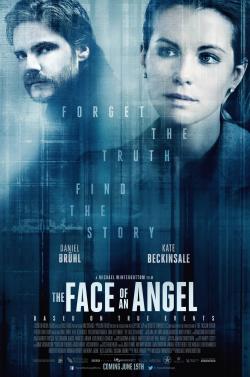
The Face of an Angel, is first of all, not a very great film. It has its flaws, the pacing for example, is not griping enough for one to keep on watching even for a pretending-to-be crime thriller. But undeniably, it is unique kind of a film, and like Walter Raleigh says, "it is adulterated, sanded poetry that makes the best lectures". I never read the book though, so I only feel what the film lead me to. and i have to admit, it is pretty remarkable, give or take.
The story is centered around a crime solving: two roommates, Elizabeth the good angelic one is murdered and the public incensed by the media blames the naughty girl Jessica , making guilty and jail of her, which is a typical analogy for the biblical Eva-Lilith situation. The film goes through three genre changes till it ends. The crime thriller is only a pretend, that part is made clear as we are a quarter in the film where the writer-hero warns us that his film would be one of the exceptions of crime thrillers, which means there would be no crime-solving in the end, surely there is none as the film ends. The writer hero actually spends the entire time trying to figure out how to make sense of what he is now telling, constantly explaining his topology and originality in story-making, which can be quite tiresome and irritating to watch sometimes, i have to admit. But the suspense of the film at the same time shifts from a crime solving to a genre figuring: we wonder how the writer-hero is going to make out of this story-telling after all. In the process, the cinematic style changes as he teases us with the structure of Dante's Infernal, taking its semi- Gothic elements, making parallels of the plot: Beatrice guides Dante ascending from hell, as Melanie (Cara's character) guides the writer hero out of his gloom. Then Melanie lead the hero to read"La Vita Nuova", which promises another possible genre change.
By now, if any audience haven't abandon the film, they are about to witness the strong ending the film presents. It is strong not in the sense of plot, 'cause apparently nothing happened or is solved: Elizabeth is dead with no one to be blamed, Jessica is set free, but still not free from the blame of the public; it is strong ending shot in a series of melancholic montage, linking the hero's child Beatrice, the adolescent Melanie, and the deceased Elizabeth together, forcing the audience to see the inevitable affiliations between the three: apparitions of the same angel, in her different embodiment of ages. Thus, the film is eventually about a lamentation of beauty passing away, just like the father laments her daughter Elizabeth in her funeral, quoting Dante's lamentation on his beloved Beatrice, the same way the writer hero tries to get hold of her daughter via Skype, through image, but never does for real. It hints in the end, Melanie could be a figurative character out of the writer hero's creation, to let show the beauty's mysterious ways in the world before its passing, the imaginative figure that in reality passes without anyone sees, who also helps him work through his trauma to its lost, similarly as Beatrice to Dante in the inferno.
The great thing about this ending metaphor is that it is not explicitly showed,which makes sense given the main tone of the film is still realistic despite monsters appears occasionally in hero's nightmares, breaking the genre for a bit of a sec. The ambiguity of the real and fantastic in this film turns out a big win for me. It's subtle, and definitely requires some patience and overall working-through on the audience's part. When one does figure it out , it leaves you with this lingering sense, a sense of love as well as a reminiscence of the beauty in a general sense, as Dante's La Vita Nuova promises us.
Of course, that just might be the original novel telling, not so much about the movie itself. Might as well read the book.


 Enjoy unlimited movies and shows
 Download your favorite content to watch offline
 Simple interface & smooth performance
















'%3e%3cpath%20id='Vector'%20d='M17.3996%2025.7999C17.3996%2025.9838%2017.3634%2026.1658%2017.293%2026.3357C17.2227%2026.5055%2017.1196%2026.6598%2016.9896%2026.7899C16.8596%2026.9199%2016.7052%2027.023%2016.5354%2027.0933C16.3655%2027.1637%2016.1835%2027.1999%2015.9996%2027.1999C15.8158%2027.1999%2015.6337%2027.1637%2015.4639%2027.0933C15.294%2027.023%2015.1397%2026.9199%2015.0097%2026.7899C14.8797%2026.6598%2014.7765%2026.5055%2014.7062%2026.3357C14.6358%2026.1658%2014.5996%2025.9838%2014.5996%2025.7999C14.5996%2025.4286%2014.7471%2025.0725%2015.0097%2024.81C15.2722%2024.5474%2015.6283%2024.3999%2015.9996%2024.3999C16.3709%2024.3999%2016.727%2024.5474%2016.9896%2024.81C17.2521%2025.0725%2017.3996%2025.4286%2017.3996%2025.7999Z'%20fill='white'/%3e%3cpath%20id='Union'%20fill-rule='evenodd'%20clip-rule='evenodd'%20d='M8.5%204H23.5C24.0523%204%2024.5%204.44772%2024.5%205V21.5H7.5V5C7.5%204.44772%207.94772%204%208.5%204ZM5.5%2022.5V5C5.5%203.34315%206.84315%202%208.5%202H23.5C25.1569%202%2026.5%203.34315%2026.5%205V22.5V27C26.5%2028.6569%2025.1569%2030%2023.5%2030H8.5C6.84315%2030%205.5%2028.6569%205.5%2027V22.5ZM24.5%2023.5V27C24.5%2027.5523%2024.0523%2028%2023.5%2028H8.5C7.94772%2028%207.5%2027.5523%207.5%2027V23.5H24.5Z'%20fill='white'/%3e%3cpath%20id='Union_2'%20fill-rule='evenodd'%20clip-rule='evenodd'%20d='M17%209C17%208.44772%2016.5523%208%2016%208C15.4477%208%2015%208.44772%2015%209V13.8258L13.1508%2012.2407C12.7315%2011.8813%2012.1002%2011.9299%2011.7408%2012.3492C11.3813%2012.7685%2011.4299%2013.3998%2011.8492%2013.7593L15.345%2016.7556C15.5205%2016.9079%2015.7495%2017%2016%2017C16.2506%2017%2016.4796%2016.9079%2016.6551%2016.7556L20.1508%2013.7593C20.5701%2013.3998%2020.6187%2012.7685%2020.2593%2012.3492C19.8999%2011.9299%2019.2686%2011.8813%2018.8492%2012.2407L17%2013.8258V9Z'%20fill='white'/%3e%3c/g%3e%3c/svg%3e)