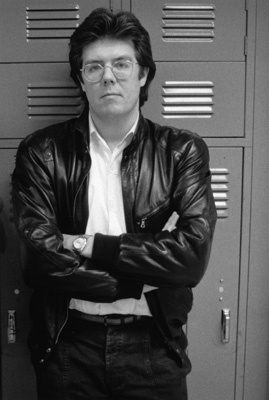
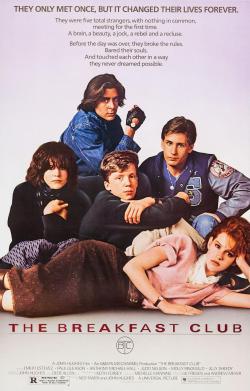
John Hughes is in my opinions the "king of teens." Each of his teen films is great, from "Sixteen Candles", "Pretty in Pink" (which he co-wrote and produced), and "Ferris Bueller's Day Off." They all have funny and serious moments and are classics. By the same token, "The Breakfast Club" is no exception. However, it stands out as doing the best job of the above films at portraying 80s teen life (and perhaps even teen life today) as it really was (is). Hence the familiar plot: Five high school students from different crowds in school (a nerd, a jock, a prom queen, a delinquent, and a loner) are thrown together for a Saturday detention in their school library for various reasons. Detention is supervised by the gruff and demeaning principal Richard Vernon, believably portrayed by Paul Gleason. As the day progresses, each member tells the story of why they are in detention, and by day's end they realize they have more in common than they ever imagined.
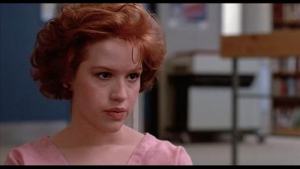
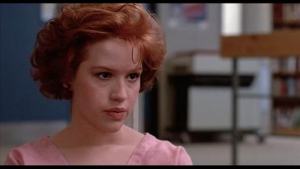
What makes the film unique is that each character tells his or her own story with credibility and persistence. Jock Andrew Clark (Emilio Estevez) is under pressure from his father to perform up to high standards, which Mr. Clark believes will add to his (dad's) lost youth. Nerd Brian Johnson (Anthony Michael Hall) excels academically, but is failing shop class. Neither he nor his family can accept an F. Delinquent John Bender (Judd Nelson), while tough on the exterior, masks a difficult home life. Prom queen Claire(Molly Ringwald) has pressure to conform from her friends, as well as issues with her parental unit. Loner Allison (Ally Sheedy) has few if any friends, wears all black, and has similar problems at home. Can the emotional bonding they share in detention hold true beyond the library, and can stereotypes be broken?
"The Breakfast Club" presents no-doubt stereotypical characters, and every member represents countless real-life examples. But what makes it so enjoyable is that applies a variety of themes to its context: prejudice/discrimination, acceptance/tolerance, diversity, class/status differences, family matters, group dynamics, etc. It also encourages us to look at others and ourselves beyond surface-level appearances. Finally, "The Breakfast Club" has great 1980s pop culture and societal integrations, from the soundtrack with Simple Minds "Don't You (Forget about Me), to wealthy, surburban American life (haves and have nots), and superficial values of the "me" decade. It reminds us that there truly is diversity in all of us. We are different, but we are all "the same" in one way or another.


 Enjoy unlimited movies and shows
 Download your favorite content to watch offline
 Simple interface & smooth performance




















'%3e%3cpath%20id='Vector'%20d='M17.3996%2025.7999C17.3996%2025.9838%2017.3634%2026.1658%2017.293%2026.3357C17.2227%2026.5055%2017.1196%2026.6598%2016.9896%2026.7899C16.8596%2026.9199%2016.7052%2027.023%2016.5354%2027.0933C16.3655%2027.1637%2016.1835%2027.1999%2015.9996%2027.1999C15.8158%2027.1999%2015.6337%2027.1637%2015.4639%2027.0933C15.294%2027.023%2015.1397%2026.9199%2015.0097%2026.7899C14.8797%2026.6598%2014.7765%2026.5055%2014.7062%2026.3357C14.6358%2026.1658%2014.5996%2025.9838%2014.5996%2025.7999C14.5996%2025.4286%2014.7471%2025.0725%2015.0097%2024.81C15.2722%2024.5474%2015.6283%2024.3999%2015.9996%2024.3999C16.3709%2024.3999%2016.727%2024.5474%2016.9896%2024.81C17.2521%2025.0725%2017.3996%2025.4286%2017.3996%2025.7999Z'%20fill='white'/%3e%3cpath%20id='Union'%20fill-rule='evenodd'%20clip-rule='evenodd'%20d='M8.5%204H23.5C24.0523%204%2024.5%204.44772%2024.5%205V21.5H7.5V5C7.5%204.44772%207.94772%204%208.5%204ZM5.5%2022.5V5C5.5%203.34315%206.84315%202%208.5%202H23.5C25.1569%202%2026.5%203.34315%2026.5%205V22.5V27C26.5%2028.6569%2025.1569%2030%2023.5%2030H8.5C6.84315%2030%205.5%2028.6569%205.5%2027V22.5ZM24.5%2023.5V27C24.5%2027.5523%2024.0523%2028%2023.5%2028H8.5C7.94772%2028%207.5%2027.5523%207.5%2027V23.5H24.5Z'%20fill='white'/%3e%3cpath%20id='Union_2'%20fill-rule='evenodd'%20clip-rule='evenodd'%20d='M17%209C17%208.44772%2016.5523%208%2016%208C15.4477%208%2015%208.44772%2015%209V13.8258L13.1508%2012.2407C12.7315%2011.8813%2012.1002%2011.9299%2011.7408%2012.3492C11.3813%2012.7685%2011.4299%2013.3998%2011.8492%2013.7593L15.345%2016.7556C15.5205%2016.9079%2015.7495%2017%2016%2017C16.2506%2017%2016.4796%2016.9079%2016.6551%2016.7556L20.1508%2013.7593C20.5701%2013.3998%2020.6187%2012.7685%2020.2593%2012.3492C19.8999%2011.9299%2019.2686%2011.8813%2018.8492%2012.2407L17%2013.8258V9Z'%20fill='white'/%3e%3c/g%3e%3c/svg%3e)