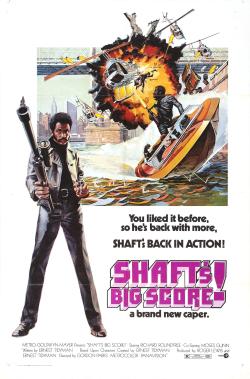
It's a shame to see the Shaft series turning to self-parody so early in it's run, but after the low-key and surprisingly effective original this first sequel sees elements of mockery creeping into the format. Shaft, he of maroon leather trenchcoat and green rollneck, is now the ultimate supersleuth; a man who screws better than any other man, a man who fights better than any other man (he does get beaten in this film, but it takes three men to do it); a man who outwits any other man; a man who can outrun a helicopter and dodge machine-gun fire. This is a Shaft who does his detective work by hiding in coffins and posing as a window cleaner. And while he gets to sleep with the black girlfriend of one of the gangland bosses he opposes, he doesn't get to do the same to the white girlfriend of another criminal. Now that would have been groundbreaking.
There's a moment early on where a gangland boss spends several moments playing a classical piece on an clarinet. The sequence runs for too long, not just for the film's style, but also the pacing. Which, in some incongruous kind of way, makes it a work of unique genius. Imagine Woody Allen playing a slow jazz number in the middle of "Boyz n the Hood" and you'll get the idea. Truly bizarre.
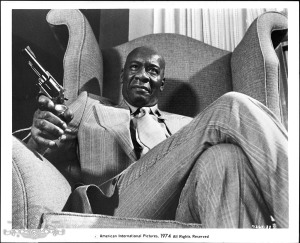
The rest of the film's opening is like this: scenes are overlong and flabby, not possessing the required focus and dramatic effect. In fact, it's only until the last forty minutes or so that the movie really gets going. It's nice to see Tee-Hee from "Live and Let Die" (Julius W.Harris) as a police captain, though he fails to connect with Roundtree in the same way that Laurence Pressman did in the original.
An increased budget is also evident: Shaft ends the film bedecked in black leather like a '68 Elvis comeback special, toting a machine-gun (as Prince would say). From hereon follows an increasingly silly chase sequence that sees a red Chevy/helicopter chase, then a speedboat/helicopter chase, and finally a Shaft/helicopter chase. Shaft takes on both chopper and rival car while on foot, limping from a bruised leg.
Worst bit? Isaac Hayes, for some reason demoted in favour of the lesser O.C. Smith, only getting one mid-film song. Dreary and not of the high standard of Shaft's score (especially Soulsville), it drones on over a sex scene, shown through those curious 70s-style corrugated mirrors. The shot blends and obscures, twisting over the distorted reflections, producing in the viewer a dizzy sensation and making you feel sick.
Best bit? A genteel pensioner, when spoken to rudely by Willy (Drew Bundini Brown), responding: "You don't talk to an old lady that way where's your f****** manners, anyway?"
If Big Score! lacks the pace and structure of it's former, then it is still an entertaining, if far-fetched, vehicle. Though its seeming need to create a black James Bond not through equality or empowerment, but via send-up, is worrying.


 Enjoy unlimited movies and shows
 Download your favorite content to watch offline
 Simple interface & smooth performance


















'%3e%3cpath%20id='Vector'%20d='M17.3996%2025.7999C17.3996%2025.9838%2017.3634%2026.1658%2017.293%2026.3357C17.2227%2026.5055%2017.1196%2026.6598%2016.9896%2026.7899C16.8596%2026.9199%2016.7052%2027.023%2016.5354%2027.0933C16.3655%2027.1637%2016.1835%2027.1999%2015.9996%2027.1999C15.8158%2027.1999%2015.6337%2027.1637%2015.4639%2027.0933C15.294%2027.023%2015.1397%2026.9199%2015.0097%2026.7899C14.8797%2026.6598%2014.7765%2026.5055%2014.7062%2026.3357C14.6358%2026.1658%2014.5996%2025.9838%2014.5996%2025.7999C14.5996%2025.4286%2014.7471%2025.0725%2015.0097%2024.81C15.2722%2024.5474%2015.6283%2024.3999%2015.9996%2024.3999C16.3709%2024.3999%2016.727%2024.5474%2016.9896%2024.81C17.2521%2025.0725%2017.3996%2025.4286%2017.3996%2025.7999Z'%20fill='white'/%3e%3cpath%20id='Union'%20fill-rule='evenodd'%20clip-rule='evenodd'%20d='M8.5%204H23.5C24.0523%204%2024.5%204.44772%2024.5%205V21.5H7.5V5C7.5%204.44772%207.94772%204%208.5%204ZM5.5%2022.5V5C5.5%203.34315%206.84315%202%208.5%202H23.5C25.1569%202%2026.5%203.34315%2026.5%205V22.5V27C26.5%2028.6569%2025.1569%2030%2023.5%2030H8.5C6.84315%2030%205.5%2028.6569%205.5%2027V22.5ZM24.5%2023.5V27C24.5%2027.5523%2024.0523%2028%2023.5%2028H8.5C7.94772%2028%207.5%2027.5523%207.5%2027V23.5H24.5Z'%20fill='white'/%3e%3cpath%20id='Union_2'%20fill-rule='evenodd'%20clip-rule='evenodd'%20d='M17%209C17%208.44772%2016.5523%208%2016%208C15.4477%208%2015%208.44772%2015%209V13.8258L13.1508%2012.2407C12.7315%2011.8813%2012.1002%2011.9299%2011.7408%2012.3492C11.3813%2012.7685%2011.4299%2013.3998%2011.8492%2013.7593L15.345%2016.7556C15.5205%2016.9079%2015.7495%2017%2016%2017C16.2506%2017%2016.4796%2016.9079%2016.6551%2016.7556L20.1508%2013.7593C20.5701%2013.3998%2020.6187%2012.7685%2020.2593%2012.3492C19.8999%2011.9299%2019.2686%2011.8813%2018.8492%2012.2407L17%2013.8258V9Z'%20fill='white'/%3e%3c/g%3e%3c/svg%3e)