I have always been a big fan of the story of the Mutiny on the Bounty, and I've tried to read nearly every account and version of the story that I can find. When I watch a "Bounty" movie, however, I toss aside my own perspectives on which version of the story is correct, and instead settle in for what I hope is a wonderful, period piece, set on an 18th century vessel. This type of movie, if it succeeds, draws us into that world gone by for an hour or two, we come back at the end, refreshed, with a little salt on our face, and maybe a minor case of scurvy.
This version is my least favorite, and not because it isn't a pleasure to watch. The problem for a Bounty aficionado, is, that the next version includes Marlon Brando, Trevor Howard and Richard Harris (need I say more), and the last version of our time (so far), goes big, big budget, with gorgeous sets, Mel Gibson, Sir Anthony Hopkins and Sir Laurence Olivier (cameo).
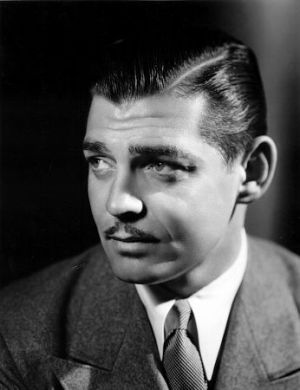
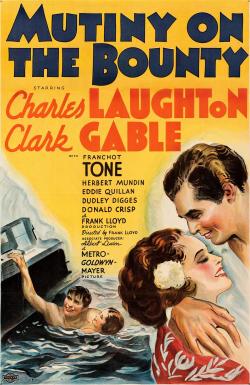
Since this was the first, I will stay away from comparisons and stick to its strengths and weaknesses. By far, this earlier version is far more realistic in the crass, bitter nature of Captain Bligh. We learn, right from the start, that he is a tough, near ruthless, man driven to advancement, at the cost of his men's comfort, or possibly lives. The dashing Fletcher Christian (Clark Gable) is at times no match for the senior, hard nosed Bligh.
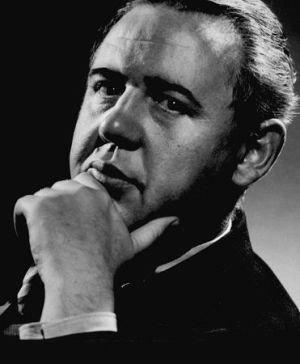
Repeated, to a large extent in the next big screen version, the dynamic between Christian, a rich playboy, at sea mostly because his parents want to "put some hair on his chest" versus the working man made good, through hard laborious study and drudgery, Captain Bligh (Trevor Howard). Trevor's character takes an immediate dislike to Gable's character, seeing him as a nearly worthless "woman of a man", to preoccupied with his fancy clothes and elevated societal station to be bothered with the day to day problems of the ship.
This tension develops slowly, but clearly as the Bounty leaves England, bound for the West Indies. Fantastic character development, including the quick friendships established by Gable with the rough and tumble crew, in direct conflict with Bligh's management style of discipline in favor of praise.
Clearly neither is entirely correct, and the effective officer of that time would have been the one capable of equitably balancing the two. This is where Frank LLoyd does an excellent job of allowing these two disparate shipmates, bump into each other, lock horns, and enter into lengthy intellectual debates over dinner. All of which is fueling the powder keg that will soon erupt.
This excellently made and acted film, does not show its age, and stands up to its two descendants. Keep in mind that it was filmed in 1935, and was truly the first of its kind.
Heroism, Cowardess, Fear, Lust, Rage, Vengeance, Anguish and world class seamanship worthy of the Navy's highest award, combine in this maritime flick, surrounding a very long trip to the grocery store to but a large quantity of vegetables that nobody wants to eat.
For those who enjoy the "Bounty" series of films, I highly recommend you visit the Pitcarine Island website, to learn more about Fletcher Christian's descendants, as well as those of several of the other "mutineer".
http://www.nic.pn/ The Island currently has approximately 75 year round residents, most of which are direct descendants of the mutineers, Fletcher Christian, John Adams, Edward Young, William McCoy, and Matthew Quintal. You can get there, but its VERY, VERY hard. You'll need to come via New Zealand, and wait for a passing cargo ship, with plans to stop at Pitcairn Island. The vessel "Bounty" was burned at anchor in Bounty Bay on Pitcairn (to avoid detection), bits and pieces of charred wood remain as keepsakes.


 Enjoy unlimited movies and shows
 Download your favorite content to watch offline
 Simple interface & smooth performance

















'%3e%3cpath%20id='Vector'%20d='M17.3996%2025.7999C17.3996%2025.9838%2017.3634%2026.1658%2017.293%2026.3357C17.2227%2026.5055%2017.1196%2026.6598%2016.9896%2026.7899C16.8596%2026.9199%2016.7052%2027.023%2016.5354%2027.0933C16.3655%2027.1637%2016.1835%2027.1999%2015.9996%2027.1999C15.8158%2027.1999%2015.6337%2027.1637%2015.4639%2027.0933C15.294%2027.023%2015.1397%2026.9199%2015.0097%2026.7899C14.8797%2026.6598%2014.7765%2026.5055%2014.7062%2026.3357C14.6358%2026.1658%2014.5996%2025.9838%2014.5996%2025.7999C14.5996%2025.4286%2014.7471%2025.0725%2015.0097%2024.81C15.2722%2024.5474%2015.6283%2024.3999%2015.9996%2024.3999C16.3709%2024.3999%2016.727%2024.5474%2016.9896%2024.81C17.2521%2025.0725%2017.3996%2025.4286%2017.3996%2025.7999Z'%20fill='white'/%3e%3cpath%20id='Union'%20fill-rule='evenodd'%20clip-rule='evenodd'%20d='M8.5%204H23.5C24.0523%204%2024.5%204.44772%2024.5%205V21.5H7.5V5C7.5%204.44772%207.94772%204%208.5%204ZM5.5%2022.5V5C5.5%203.34315%206.84315%202%208.5%202H23.5C25.1569%202%2026.5%203.34315%2026.5%205V22.5V27C26.5%2028.6569%2025.1569%2030%2023.5%2030H8.5C6.84315%2030%205.5%2028.6569%205.5%2027V22.5ZM24.5%2023.5V27C24.5%2027.5523%2024.0523%2028%2023.5%2028H8.5C7.94772%2028%207.5%2027.5523%207.5%2027V23.5H24.5Z'%20fill='white'/%3e%3cpath%20id='Union_2'%20fill-rule='evenodd'%20clip-rule='evenodd'%20d='M17%209C17%208.44772%2016.5523%208%2016%208C15.4477%208%2015%208.44772%2015%209V13.8258L13.1508%2012.2407C12.7315%2011.8813%2012.1002%2011.9299%2011.7408%2012.3492C11.3813%2012.7685%2011.4299%2013.3998%2011.8492%2013.7593L15.345%2016.7556C15.5205%2016.9079%2015.7495%2017%2016%2017C16.2506%2017%2016.4796%2016.9079%2016.6551%2016.7556L20.1508%2013.7593C20.5701%2013.3998%2020.6187%2012.7685%2020.2593%2012.3492C19.8999%2011.9299%2019.2686%2011.8813%2018.8492%2012.2407L17%2013.8258V9Z'%20fill='white'/%3e%3c/g%3e%3c/svg%3e)