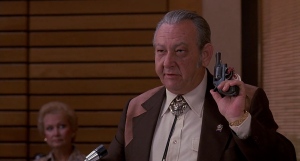
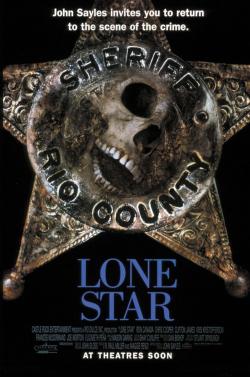
John Sayles wrote the original screenplay for, and directed, "Lone Star." If his script fails to portray the development and intersection of ethnic relations, marital relations, migration, cultural assimilation, politics, education, big business, and even the army in the southern and western United States, from the Treaty of Payne's Landing and eviction of the Seminoles from Florida in 1832 to the cross-border migration of Mexicans to south Texas in the 1990's, it's not for lack of trying. The sweep of his screenplay aspires to be nothing less than multi-generational, multi-ethnic, multi-class, multi-marriage -- in a word, epic. . . . Alas, the script does ultimately fail. It fails because the screenwriter spends too much time having characters lecture each other for the benefit of the audience and too little time creating dramatic incidents through which the audience might see important issues articulated, developed, and resolved. As Laura Miller puts it in her Salon review, "The independent filmmaker John Sayles reminds me of Gertrude Stein's description of Ezra Pound: 'He is a village explainer. All very well if you happen to be a village. If not, not.'" More simply, Sayles is not Chekhov, and his movie is not "The Ox-Bow Incident" or "To Kill a Mockingbird." . . . The acting, or perhaps it is the direction of the acting, is a problem here too. Character actor Chris Cooper plays a rural sheriff faced with two cold cases -- a 40-year-old homicide and a father he never knew -- with such lack of affect that you want to kick some life into the guy. (I saw him as Sheriff Deeds, all right, but kept hearing the same dull voice he would later bring to FBI operative Robert Hanssen in "Breach.") Comely Elizabeth Peña plays his romantic interest with a ground-down-by-life monotone and an accent that sounds more South Bronx than South Texas. Miriam Colon, as Peña's restaurateur mother, is given almost nothing but acerbic, if not hateful, lines to deliver. Even the wonderful Frances McDormand, who received the Academy Award for her role in "Fargo" the same year that "Lone Star" came out, is over-the-top in a comic turn as Sheriff Deeds' ex-wife Bunny. Only Kris Kristofferson, as the heavy Charlie Wade, and Joe Morton, as an Army colonel who's all spit, vinegar, and heart, are consistently fun to watch. . . . One final cavil: the plot, such as it is, moves forward through luck and happenstance, not through the logic of real life.


 Enjoy unlimited movies and shows
 Download your favorite content to watch offline
 Simple interface & smooth performance
























'%3e%3cpath%20id='Vector'%20d='M17.3996%2025.7999C17.3996%2025.9838%2017.3634%2026.1658%2017.293%2026.3357C17.2227%2026.5055%2017.1196%2026.6598%2016.9896%2026.7899C16.8596%2026.9199%2016.7052%2027.023%2016.5354%2027.0933C16.3655%2027.1637%2016.1835%2027.1999%2015.9996%2027.1999C15.8158%2027.1999%2015.6337%2027.1637%2015.4639%2027.0933C15.294%2027.023%2015.1397%2026.9199%2015.0097%2026.7899C14.8797%2026.6598%2014.7765%2026.5055%2014.7062%2026.3357C14.6358%2026.1658%2014.5996%2025.9838%2014.5996%2025.7999C14.5996%2025.4286%2014.7471%2025.0725%2015.0097%2024.81C15.2722%2024.5474%2015.6283%2024.3999%2015.9996%2024.3999C16.3709%2024.3999%2016.727%2024.5474%2016.9896%2024.81C17.2521%2025.0725%2017.3996%2025.4286%2017.3996%2025.7999Z'%20fill='white'/%3e%3cpath%20id='Union'%20fill-rule='evenodd'%20clip-rule='evenodd'%20d='M8.5%204H23.5C24.0523%204%2024.5%204.44772%2024.5%205V21.5H7.5V5C7.5%204.44772%207.94772%204%208.5%204ZM5.5%2022.5V5C5.5%203.34315%206.84315%202%208.5%202H23.5C25.1569%202%2026.5%203.34315%2026.5%205V22.5V27C26.5%2028.6569%2025.1569%2030%2023.5%2030H8.5C6.84315%2030%205.5%2028.6569%205.5%2027V22.5ZM24.5%2023.5V27C24.5%2027.5523%2024.0523%2028%2023.5%2028H8.5C7.94772%2028%207.5%2027.5523%207.5%2027V23.5H24.5Z'%20fill='white'/%3e%3cpath%20id='Union_2'%20fill-rule='evenodd'%20clip-rule='evenodd'%20d='M17%209C17%208.44772%2016.5523%208%2016%208C15.4477%208%2015%208.44772%2015%209V13.8258L13.1508%2012.2407C12.7315%2011.8813%2012.1002%2011.9299%2011.7408%2012.3492C11.3813%2012.7685%2011.4299%2013.3998%2011.8492%2013.7593L15.345%2016.7556C15.5205%2016.9079%2015.7495%2017%2016%2017C16.2506%2017%2016.4796%2016.9079%2016.6551%2016.7556L20.1508%2013.7593C20.5701%2013.3998%2020.6187%2012.7685%2020.2593%2012.3492C19.8999%2011.9299%2019.2686%2011.8813%2018.8492%2012.2407L17%2013.8258V9Z'%20fill='white'/%3e%3c/g%3e%3c/svg%3e)