Oftentimes, when discussing more artful films, a general audience member may feel that the slower pace actually hinders their experience because "nothing is going on". In good movies, sometimes this complaint is disproven by the subtler details of a film, like an interaction between characters that holds a lot of depth beyond simply the narrow perception of what the characters are saying. A director has a specific vision for what they're attempting to accomplish and feels as though they can take their time to really develop it.
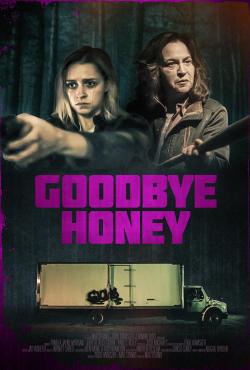
Goodbye Honey (2020) is not one of those films.
The direction is very bland and basic, showing a fundamental understanding of the core mechanics of filmmaking and nothing beyond that. The acting from the two principle characters is serviceable, while all the other actors are subpar. The soundtrack is a grating, thin John Carpenter-esque synthesizer loop that simply plays over and over throughout the whole movie in a way that's supposed to convince the audience what they're seeing is intense when it's really just a flaccid attempt to thrill. However, the biggest problem with this movie is the script and how frequently it wastes the audience's precious time on Earth.
Dawn is a trucker that, while attempting to sleep in a state park overnight, is interrupted by Phoebe, who is desperately attempting to flee her captor. Phoebe and Dawn waste time for about 20 minutes in attempting to discern whether they can trust one another enough in a repetitive sequence of scenes that mean fighting over the most minute details. Then, once that plot point has been exhausted, there's a banging at the cargo door of Dawn's truck. Phoebe hides, Dawn opens it up to attempt to ward off kidnappers and phone 911 (Phoebe accidentally broke Dawn's phone for convoluted reasons), and bartering for a phone call takes 20 minutes and goes nowhere, with the only development in the plot being that Dawn's hair is now soaked in Mountain Dew.
But wait, weren't those Phoebe's kidnappers? Well, evidently not, as once this scene ends, Phoebe reveals the two idiotic young men Dawn spoke with for 20 minutes weren't her kidnappers.
So my question is, like many other sequences: what is the narrative point in including these scenes? Nothing happens, we don't learn anything meaningful about our characters. There is no theme that is developed or spoken on. It's just scenes of our characters experiencing trauma with nothing more added.
Then Phoebe tells the story of her kidnapping in a hilariously-terrible sequence where a judge attempts to argue Castle Doctrine in shooting his own daughter and traps Phoebe in his basement ("I WAS WITHIN MY RIGHTS!"). The editing in these scenes is particularly obnoxious, reminding me more of Saw III than Room. After this overly-long flashback sequence is over, it's revealed that Phoebe's captor is actually the client Dawn is helping to move houses. (Cue canned audience gasping.)
Then, in the final minutes of the movie, Dawn and Phoebe kill the kidnapper by trapping him in the back of the truck and lighting him on fire with a molotov cocktail. This scene accounts for the *1* star I would give this movie, as it was the only moment where I felt my synapses firing at all.
Rarely does a movie actually make me angry, even terrible movies can be fun to laugh at. Plan 9 from Outer Space is a terrible film made by a terrible director, but at least that movie had a theme and a purpose for existing. Goodbye Honey doesn't, so what does that make it? Don't bother.


 Enjoy unlimited movies and shows
 Download your favorite content to watch offline
 Simple interface & smooth performance




'%3e%3cpath%20id='Vector'%20d='M17.3996%2025.7999C17.3996%2025.9838%2017.3634%2026.1658%2017.293%2026.3357C17.2227%2026.5055%2017.1196%2026.6598%2016.9896%2026.7899C16.8596%2026.9199%2016.7052%2027.023%2016.5354%2027.0933C16.3655%2027.1637%2016.1835%2027.1999%2015.9996%2027.1999C15.8158%2027.1999%2015.6337%2027.1637%2015.4639%2027.0933C15.294%2027.023%2015.1397%2026.9199%2015.0097%2026.7899C14.8797%2026.6598%2014.7765%2026.5055%2014.7062%2026.3357C14.6358%2026.1658%2014.5996%2025.9838%2014.5996%2025.7999C14.5996%2025.4286%2014.7471%2025.0725%2015.0097%2024.81C15.2722%2024.5474%2015.6283%2024.3999%2015.9996%2024.3999C16.3709%2024.3999%2016.727%2024.5474%2016.9896%2024.81C17.2521%2025.0725%2017.3996%2025.4286%2017.3996%2025.7999Z'%20fill='white'/%3e%3cpath%20id='Union'%20fill-rule='evenodd'%20clip-rule='evenodd'%20d='M8.5%204H23.5C24.0523%204%2024.5%204.44772%2024.5%205V21.5H7.5V5C7.5%204.44772%207.94772%204%208.5%204ZM5.5%2022.5V5C5.5%203.34315%206.84315%202%208.5%202H23.5C25.1569%202%2026.5%203.34315%2026.5%205V22.5V27C26.5%2028.6569%2025.1569%2030%2023.5%2030H8.5C6.84315%2030%205.5%2028.6569%205.5%2027V22.5ZM24.5%2023.5V27C24.5%2027.5523%2024.0523%2028%2023.5%2028H8.5C7.94772%2028%207.5%2027.5523%207.5%2027V23.5H24.5Z'%20fill='white'/%3e%3cpath%20id='Union_2'%20fill-rule='evenodd'%20clip-rule='evenodd'%20d='M17%209C17%208.44772%2016.5523%208%2016%208C15.4477%208%2015%208.44772%2015%209V13.8258L13.1508%2012.2407C12.7315%2011.8813%2012.1002%2011.9299%2011.7408%2012.3492C11.3813%2012.7685%2011.4299%2013.3998%2011.8492%2013.7593L15.345%2016.7556C15.5205%2016.9079%2015.7495%2017%2016%2017C16.2506%2017%2016.4796%2016.9079%2016.6551%2016.7556L20.1508%2013.7593C20.5701%2013.3998%2020.6187%2012.7685%2020.2593%2012.3492C19.8999%2011.9299%2019.2686%2011.8813%2018.8492%2012.2407L17%2013.8258V9Z'%20fill='white'/%3e%3c/g%3e%3c/svg%3e)