moviebox header nav
moviebox search icon

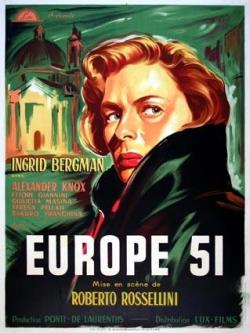
Europe '51

1954

R

1 h 58 m

Italy

Drama

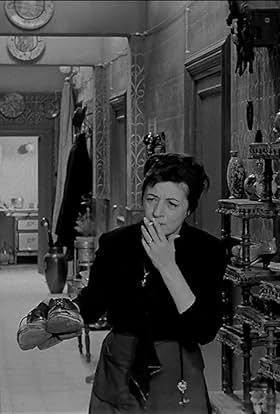
A wealthy woman becomes obsessed with humanitarianism when her young son dies after committing suicide.
More

7.4 /10

5333 people rated

Watch Online

Watch in App

Episodes

Top Cast

User Review

Episodes
Top Cast
User Review

Episodes

film
lklk
Netflix
Plex
Top Cast(15)
starring avatar
Ingrid Bergman
Irene Girard
starring avatar
Alexander Knox
George Girard
default avatar
Ettore Giannini
Andrea Casatti
starring avatar
Giulietta Masina
Giulietta, detta Passerotto
default avatar
Teresa Pellati
Ines
starring avatar
Marcella Rovena
Signora Puglisi
default avatar
Tina Perna
Cesira
default avatar
Sandro Franchina
Michele Girard
starring avatar
Maria Zanoli
Signora Galli
default avatar
William Tubbs
Professor Alessandrini
default avatar
Alberto Plebani
Signor Puglisi
default avatar
Alfred Browne
Prete
default avatar
Carlo Hintermann
Extra
starring avatar
Antonio Pietrangeli
Psichiatra
starring avatar
Rossana Rory
Infermiera della casa di cura

User Review

author avatar

Richardene Samuels

29/07/2024 16:05
source: Europe '51
author avatar

🥀

24/07/2024 16:04
source: Europe '51
author avatar

Kendji Officiel

24/07/2024 16:04
EUROPA 51 is an odd film. Irene (Bergman) is the wife and mother in a rich family, in affluent surroundings. Hers seems a perfect world, but she is too self-centered to realize that her son needs attention and love. EUROPA 51 reflects the situation in Europe in 1951, six years after the end of WW II. Work is scarce. poverty is rife, the impersonality of industry is overwhelming society, but against this general background some personal problems stick out: Irene focuses on being an adroit host and having her house spotlessly clean; her husband wrongly fears that she is cheating on him with a journalist; and their son feels ignored and throws himself down a staircase, with fatal consequences. Irene feels very guilty about losing her son, moves away from home, and descends into the underworld of poverty, helping people in the process. This is where a memorable performance surfaces, by Giuletta Masina, the wife of famous Italian director Federico Fellini, who injects life into the whole movie, in contrast with Irene's increasingly quiet soul. The fact that her own husband and circle of friends see her as approaching madness reflects the tragedy that tends to pursue the individual who dares to show feelings and concerns in relation to his/her fellow neighbor. In this case, Irene helps a number of people, takes genuine interest in their predicaments, but her reward is questionable: she sees her husband leave her behind the bars of a psychiatric ward, feeling intolerably lonely, but common people see her as a saint. Ultimately, it is a film in equal measure wise and wayward. Perhaps I cannot avoid looking at it with 21st Century eyes, and I lack knowledge about the mindset of Italian society in the early 1950s. Still, I had a problem attaching credibility to this film. That said, Bergman was never more physically stunning than in this film, and her acting is first class. Director Rossellini shows steely determination driving forward this unusual film. Photography is quite good. Script is generally competent. Acting by Bergman and Masina is excellent, the rest of the cast, Knox included, does not shine so much. The film's main flaw is that it is overlong by some 20 minutes, but any Rossellini-Bergman collaboration deserves attentive watching.
author avatar

Melody💜

24/07/2024 16:04
I watched the Americanized version last night on TCM. It was a bit choppy, and the dialog didn't match up very well with the actors' mouths, but overall the story was very moving. I like the analogy of St. Francis of Assisi or Mother Theresa, except they weren't locked up. But I think maybe that was also a commentary on the repressive social regimes of the times. The TCM commentator mentioned an interesting side-note, that during the making of this film, Ms. Bergman discovered that she was expecting twins. I think that was very much reflected in her interaction with the children in this story. Hopefully TCM will show the Italian version one day.
author avatar

Ivan Cortês

24/07/2024 16:04
Europa 51 has a big heart, this much is clear. It's a story where Rossellini and his collaborators want to pose a basic question: what does someone have to do, like literally do with their own hands and wills and TIME, actually taking time and energy out of their days, to make a difference for people? The question may be surrounded by an, arguably, heavy-handed set-up, where Ingrid Bergman plays an ambassador's wife in Italy, and their son, a bit of a spoiled mama's boy (or, no, maybe he's just the sensitive sort, you pick, but either way not dubbed particularly well), dies accidentally. Bergman's Irene can't stand herself for what has happened - all her time being a dilettante and not spending enough time with her son made this happen - and she can barely go on. Someone, a friend who has Communist ties, tries to convince her that perhaps it's time to make a change amid this time of Societal Upheaval (in caps) as political sides are being more sharply drawn. She sees how people suffer, and a day at a factory basically makes her completely light-headed (a montage of images, if memory serves, makes this clear). She wants to help. Maybe if she puts her energies to positive use, to help others, she can... what, find some solace? Alleviate her guilt? Or that now she can't be a mother to her son - and there's not much effort between her and her husband to find love again - so why not be a Mother to others? It's a little more difficult than that, of course, which is the riding factor of conflict in the narrative. Bergman plays this character with all of the beats just right. Early on in those first scenes with her and her son you might wonder whether the writing isn't totally clear - IS she being a bad mother, or is he just whining, or is it a little 'much' determining either, who knows - but she plays it just right, this woman in her life who has it all and doesn't have to worry about much. This includes hearing conversations about class struggles (this before she sees them first hand) and can barely comprehend it. How Bergman channels grief is even better, showing us a face that has the life totally drained out, and she is always *listening* as an actress too to what's around her, and is a strong listener which is key. Ironic then that many of these, almost all of them, are speaking Italian and are dubbed over - this includes Giuletta Masina, who plays a local housewife. Not all of the writing is superb here, at least for me. It's surprisingly melodramatic in its last quarter as Irene is looked at as being completely crazy (possibly, borderline, criminal) in how she's helping these people, which includes keeping one man evading prosecution in her home. I have to wonder if this story could work today, though a filmmaker like Scorsese, one of Rossellini's disciples, sort of made his version with Bringing Out the Dead - a protagonist who is haunted by death and wants to make a difference. It is a very hard thing to be saintly, or just be a decent person when there are many, many indecent things and people that go about in this world, certainly in this context post-war, post-fascist-*-Communist Italy. There's a lot to digest here, even if some of it may come off as dated or simplistic. But, once again as with Stromboli, the combination of a director with a clear, very moral message, and an actress giving it her ALL (and it's a case where Bergman does give one of her best performances from this period, even if the film isn't), that you can watch it and be wrapped up in this woman's drama.
author avatar

@I_m Phatbintou🇬🇲🤍

24/07/2024 16:04
Irene (Ingrid Bergman) is a socialite married to George Girard (Alexander Knox). She neglects her son Michele and ignores his pleads. After his death, she suffers from guilt and starts helping people in need. Her communist cousin Andrea Casatti takes her to the other half of Rome. George is annoyed about her absences and accuses her of having an affair. She tries to help a young man and his parents. He had committed armed robbery and she pushes him to turn himself in. The police accuses her of helping him escape. George puts her in a mental asylum and abandons her. Her need to help others is declared insanity. I like the idea of a saint in the modern world. The main drawback is that it's a little melodramatic at times. Ingrid Bergman is a glamorous star but her acting can sometimes be a little old school. This is a compelling story. The melodramatic touches may be better served with some simple grittiness. I rather she not break down in the asylum which would make her imprisonment more unjust.
author avatar

Bradpitt Jr & Bradpitt

24/07/2024 16:04
Having read several glowing reviews of this film, I am not sure that I just watched the same movie. Did the enraptured authors see the same, disastrously dubbed version that I did or something else? At least three post-World War II Italian films are among my all-time favorites, including De Sica's "Umberto D" and "Bicycle Thieves" and Fellini's "La Strada", which starred his amazing spouse, Giulietta Masina, who happens to appear here in the most bizarre cinematic circumstances. Whatever director Rosselini wanted to accomplish here was totally destroyed by some of the worst English dubbing that I have ever witnessed in more than seven decades of movie viewing. Did Ms. Masina realize how mutilated her role would be when it was recited in pure Brooklynese by one of the bimbos "hosted" in "The Apartment" rented by Jack Lemmon? In fact, all of the Italian actors, which were most of them, spoke in the horribly dubbed English words of mechanical, robotic voices that very offensively rendered totally ludicrous a very serious movie on a very compelling subject. That, by itself, is very sad and very annoying. As to the plot, why did guilt-ridden Irene (Bergman) agree to her transfer to an insane asylum? That, by itself, seriously weakened her character. While she was free of police custody and apparently a foreign citizen, she should have fled from her totally obtuse husband and from the entire country. True, this essential act would have eliminated the film from its existence, but would that have been a bad thing? Alexander Knox as the totally unsympathetic husband appeared in nearly 100 films over a span of more than 50 years and surely deserved much more than this awful role, which will never influence my high opinion of him. Disastrous English dubbing, poor character development, overwrought, melodramatic dialogue, and tedious discourse of political and religious nature aside, what was the resolution in the end? Not that there needs to be a resolution to every story, but the entire presentation seemed pointless to me. Who did Irene help? Herself? Anyone else? What did she accomplish for the dying prostitute? When I suffered from a near fatal case of pneumonia, I barely had the energy to open my mouth, let alone shriek, seemingly without end, about the thieves in my awful neighborhood. At the time, the whereabouts of my wallet was the last thing on my exhausted, fever-ridden mind. In honor of the much valued talent of Ingrid Bergman and Giulietta Masina, I gave this an extra star.
author avatar

M1・ʚPRO

24/07/2024 16:04
This film should make you think. As children (and even as adults), we are constantly being told to love our fellow man, that the least among us is the greatest in God's eye, that faith without acts is worthless, etc. But try to put these principles into practice, and you will be considered eccentric at best, and a lunatic at worst. When you try to live according to the values that everyone else around you is paying lip service to, you will find out what their real values are. How can your duty to your fellow man, your sense of wanting to ease the suffering of the sick, wounded or lonely, ever compete with your social obligations or your spouse's selfish needs for your company and perhaps even your servitude, even if he is perfectly capable of taking care of himself and would do well to join you in your efforts to help those less fortunate than yourself? Perhaps you can get support from your local clergyman? Don't count on it. He will be the first to sign the papers committing you to an insane asylum. You're better off living the high life and just quietly making a weekly contribution to his collection box! One of the most provocative movies of the 20th century.
author avatar

Choumi

24/07/2024 16:04
The second of Ingrid Bergman's collaborations with Ingrid Bergman. Bergman plays a bourgeois woman whose son passes away. She blames herself, and starts looking for a way to rectify her guilt. She finds the answer in her newfound social conscience. Her life of luxury now seems horrid to her when there are so many suffering, and she dedicates her life to others. Meanwhile, her husband (Alexander Knox) doesn't understand it, and, after a particularly long absence when Bergman stays away to nurse a dying prostitute, he and the rest of her family decide to intervene. This is a powerful film about true charity, and it questions the motives of the bourgeois version of charity. This could very well be Ingrid Bergman's best performance. I thought it did underline its themes a bit too explicitly in its final act, and the very final scene went about three steps too far, as I see it. Giulietta Masina co-stars as a poor woman with six children whom Bergman befriends. I might be wrong, but it didn't sound like it was her voice (at least the voice we know from Fellini's films) dubbing this character.
author avatar

Cathie Passera

24/07/2024 16:04
Dramas have always been around, ever since the earliest days of film and throughout the decades they have kept on changing and evolving, basically just like every other movie genre. This movie however seems unlike any other movie from around the same time period really. It's more bold and daring with its themes and therefore also truly original to watch as well. The movie truly surprised me with some of its themes and events. Some of these elements might still be considered to be shocking and controversial in movies now days. And its strange but it's often strangely compelling to watch the downfall and disintegration of another human being, or in this case, a character on film. And this movie pretty much chronicles the slowly deteriorating live of a married upper-class woman. Just when you think things can't get any worse for her, it does get worse but without ever getting melodramatic by the way, which is, I believe, the movie its biggest accomplishment. It's a more realistic and humane told movie, that gets you truly involved with all of its events and drama. It simply is one fine and also effective Italian drama, in that regard, by director Roberto Rossellini. Like often, Rossellini casted his then wife Ingrid Bergman, for the lead role. She was a good female lead, for movies of this sort. She could be strong and confident but yet also at the same time still with a very vulnerable and emotional undertone to it. Just as was required for her role in this movie, which was the second collaboration between her and Rossellini. A must-see for the Roberto Rossellini fans and for the lovers of the more old fashioned and very straightforward kind of dramas. 8/10 http://bobafett1138.blogspot.com/
Disclaimer: All videos and pictures on MovieBox are from the Internet, and their copyrights belong to the original creators. We only provide webpage services and do not store, record, or upload any content.