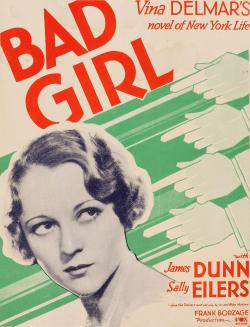
Producer: Frank Borzage. Copyright 18 July 1931 by Fox Film Corp. New York opening at the Roxy, 14 August 1931. 8,046 feet. 89 minutes.
SYNOPSIS: A year in the lives of two young married people in New York's tenements. The movie has considerably changed both the plot and the title character of the stage play. "Bad Girl" is now a totally incorrect title. There is no "bad girl" in the picture.
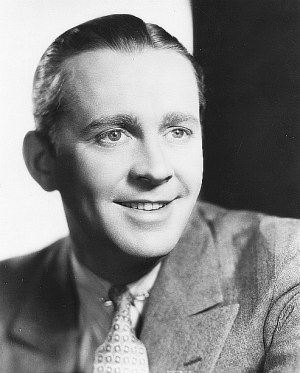
NOTES: Feature film debut of Broadway stage star, James Dunn. (He had previously appeared in five movie shorts).
The Academy of Motion Picture Arts and Sciences selected Frank Borzage for Best Directing (defeating King Vidor's The Champ, and Josef von Sternberg's Shanghai Express), and Edwin Burke for Adapted Screenplay (defeating Sidney Howard's Arrowsmith, and Percy Heath and Samuel Hoffenstein's Dr Jekyll and Mr Hyde).
Bad Girl was also nominated for Best Picture (defeated by Grand Hotel), and was placed 4th in The Film Daily poll of U.S. film critics (after Cimarron, Street Scene and Skippy). It was selected by The New York Times as one of the Ten Best Pictures of 1931. The stage play opened on Broadway at the Hudson on 2 October 1930 and ran a very moderately successful 85 performances. Sylvia Sidney played the title role, while Paul Kelly did the husband. Marion Gering directed.
COMMENT: Frank Borzage was not only Hollywood's king of romance, but a superlative craftsman who could play on the strings of an audience's emotions like a master violinist. His own temperament echoed the image of a confirmed sentimentalist. A quiet man, Borzage (pronounced "Bore-zaig/ie", the "zaig" rhymes with "plague") never raised his voice on the set and never drew attention to himself. Untutored visitors always assumed he was a script clerk or continuity assistant.
Yet any critic who writes a book on Romance in the Cinema will always place Borzage's name at the top of the list. He really believed in what he was doing. In fact, he persisted in his adoration for Romance even when it was out of fashion. In this instance, of course, the movie struck a timely chord with Depression audiences.
Oddly, In the free-and-easy, pre-censorship Hollywood world of the early pre-code 1930s, Borzage and his very clever scriptwriters Edwin Burke and Rudolf Sieber cleaned up Delmar's play, changing characters and plot to an enormous extent, even though there was absolutely no pressure on them to do so. They succeeded in making Bad Girl far more romantic, if almost equally realistic. In fact, it's not the romance that seems artificial, but the occasional comic relief. In the stage play, the heroine, a little Bronx stenographer (Sylvia Sidney), is an unwed mother who is forced to marry a petty racketeer (Paul Kelly), whom she tries to reform.
The film "version" bears only one vague relationship to the stage play, namely the fact that two young people get married and settle down in a New York apartment. Otherwise, it is completely different in every respect. Mordaunt Hall in his review in The New York Times even goes so far as to state that the "only adverse criticism" he could make of Bad Girl was "its strangely unsuitable title." He was being sarcastic, of course. He knew perfectly well how the title came about. He continues: "However, that is of small importance, for many a poor picture has boasted a good title."
This must-see movie, is now available on a 10/10 Fox DVD set. In fact, I'd like to give this movie 10/10 also, but that deceptive title might annoy some people.


 Enjoy unlimited movies and shows
 Download your favorite content to watch offline
 Simple interface & smooth performance





















'%3e%3cpath%20id='Vector'%20d='M17.3996%2025.7999C17.3996%2025.9838%2017.3634%2026.1658%2017.293%2026.3357C17.2227%2026.5055%2017.1196%2026.6598%2016.9896%2026.7899C16.8596%2026.9199%2016.7052%2027.023%2016.5354%2027.0933C16.3655%2027.1637%2016.1835%2027.1999%2015.9996%2027.1999C15.8158%2027.1999%2015.6337%2027.1637%2015.4639%2027.0933C15.294%2027.023%2015.1397%2026.9199%2015.0097%2026.7899C14.8797%2026.6598%2014.7765%2026.5055%2014.7062%2026.3357C14.6358%2026.1658%2014.5996%2025.9838%2014.5996%2025.7999C14.5996%2025.4286%2014.7471%2025.0725%2015.0097%2024.81C15.2722%2024.5474%2015.6283%2024.3999%2015.9996%2024.3999C16.3709%2024.3999%2016.727%2024.5474%2016.9896%2024.81C17.2521%2025.0725%2017.3996%2025.4286%2017.3996%2025.7999Z'%20fill='white'/%3e%3cpath%20id='Union'%20fill-rule='evenodd'%20clip-rule='evenodd'%20d='M8.5%204H23.5C24.0523%204%2024.5%204.44772%2024.5%205V21.5H7.5V5C7.5%204.44772%207.94772%204%208.5%204ZM5.5%2022.5V5C5.5%203.34315%206.84315%202%208.5%202H23.5C25.1569%202%2026.5%203.34315%2026.5%205V22.5V27C26.5%2028.6569%2025.1569%2030%2023.5%2030H8.5C6.84315%2030%205.5%2028.6569%205.5%2027V22.5ZM24.5%2023.5V27C24.5%2027.5523%2024.0523%2028%2023.5%2028H8.5C7.94772%2028%207.5%2027.5523%207.5%2027V23.5H24.5Z'%20fill='white'/%3e%3cpath%20id='Union_2'%20fill-rule='evenodd'%20clip-rule='evenodd'%20d='M17%209C17%208.44772%2016.5523%208%2016%208C15.4477%208%2015%208.44772%2015%209V13.8258L13.1508%2012.2407C12.7315%2011.8813%2012.1002%2011.9299%2011.7408%2012.3492C11.3813%2012.7685%2011.4299%2013.3998%2011.8492%2013.7593L15.345%2016.7556C15.5205%2016.9079%2015.7495%2017%2016%2017C16.2506%2017%2016.4796%2016.9079%2016.6551%2016.7556L20.1508%2013.7593C20.5701%2013.3998%2020.6187%2012.7685%2020.2593%2012.3492C19.8999%2011.9299%2019.2686%2011.8813%2018.8492%2012.2407L17%2013.8258V9Z'%20fill='white'/%3e%3c/g%3e%3c/svg%3e)