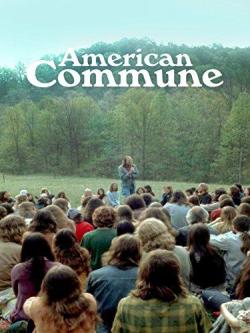
In 1970, 1,500 hippies and their guru Stephen Gaskin founded a commune in rural Tennessee. Members forked over their savings, grew their own food, delivered their babies at home and built a self-sufficient society. Raised in this alternative community by a Jewish mother from Beverly Hills and a Puerto Rican father from the Bronx, filmmakers and sisters Rena and Nadine return for the first time since leaving in 1985. Finally ready to face the past after years of hiding their upbringing, they chart the rise and fall of America's largest utopian socialist experiment and their own family tree. The nascent idealism of a community destroyed, in part, by its own success is reflected in the personal story of a family unit split apart by differences. American Commune finds inspiration in failure, humor in deprivation and, most surprisingly, that communal values are alive and well in the next generation.
More
6.8 /10
277 people rated
American Commune
2013
R
1 h 30 m
United States
Documentary
In 1970, 1,500 hippies and their guru Stephen Gaskin founded a commune in rural Tennessee. Members forked over their savings, grew their own food, delivered their babies at home and built a self-sufficient society. Raised in this alternative community by a Jewish mother from Beverly Hills and a Puerto Rican father from the Bronx, filmmakers and sisters Rena and Nadine return for the first time since leaving in 1985. Finally ready to face the past after years of hiding their upbringing, they chart the rise and fall of America's largest utopian socialist experiment and their own family tree. The nascent idealism of a community destroyed, in part, by its own success is reflected in the personal story of a family unit split apart by differences. American Commune finds inspiration in failure, humor in deprivation and, most surprisingly, that communal values are alive and well in the next generation.
More
6.8 /10
277 people rated
Watch Online
Watch in App
Episodes
Top Cast
User Review
Episodes
Top Cast
User Review
Episodes
film
lklk
Netflix
Plex
Top Cast(2)
Rena Mundo Croshere
Self
Nadine Mundo
Self
User Review
DONBIGG
29/05/2023 17:53
source: American Commune
Naiss mh
22/05/2023 16:01
Bumped into this doc in a random way, decided to give it a try and was captivated.
Amazing original footage, great editing, love the narration, the details and the fact that they stay focused on the concept: the rise and fall of the "Farm" is presented, but what stays on the foreground is the sisters' story.
The story of 2 sisters who go back to their childhood "hometown" to make peace with the past is nothing new, but what makes the difference is that their hometown is a hippy utopia commune based on a farm. If you are into that era you should watch it just for the original footage that is so candid and unfiltered... no social media at that time so people were being themselves while being filmed, not acting in a way to feed the algorithm.
Love the interviews: convincing the sister's parents, past members of the commune, the commune leader to talk on camera is fantastic and what elevates this doc to a higher level than most other productions.
Conflicts abound and it's what kept me interested. Hippies and "modern society", husband and wife, parents and children, commune members and the Federal Government, commune members and the commune leadership.
No spoilers but: it is smartly edited. Questions arise in a natural way, which is what keeps me watching to get an answer. Good balance of exposition and "show dont tell: the sisters recalling their past and watching the trajectory of what happened.
Great production!
- - -
some takeaways about the utopian commune lifestyle:
sacrificing personal well-being (and your family's harmony) for a "greater good" leads to burnout.
Having no privacy, no private property, no money, limited personal decision making is not healthy.
open door policy is a recipe for disaster: without vetting and assigning roles to people who want to join the "club" you'll attract unstable people who just want to take without giving. They will make the environment toxic. The Amish could teach them a thing or two.
Hierarchy and a system to keep those in power in check are needed. When you have large number of people leadership plays a critical role but its ability to make decisions must be contained. Not only power can lead to those "ego trips" they were preaching about but you can make fatal mistakes and ruin many people lives. (e.g. In the doc: going to guatemala, having ambulance in NYC)
Titumeni Titu Chirwa
21/05/2023 16:00
I kept meaning to watch American Commune because I'm interested in intentional communities. I actually didn't like one of the sisters at first - I believe her name is Nadine, rather than Rena - because she expressed such embarrassment of her hippie parents and life on a commune, and I thought "what a shallow person, her upbringing apparently didn't affect her enough" but later in the documentary a big reveal is that in their middle school years/early teens, Rena and Nadine were relocated to their upper middle class grandparents' home in Los Angeles. I can see how at that age it would not only be a culture shock, but instill an extreme sense of shame and alienation in the world of LA and Santa Monica in the 1980s and early 90s. In fact, I found myself relating to the sisters more and more, since I too lived in LA as a young adult (though not in my teens) after spending the first 10 years of my life on a rural dirt road in a log cabin in West Virginia. I admitted to myself that I had developed some of the same defense mechanisms, and felt a similar sense of confusion about my identity until I was about 35 years old because of it. And I didn't even grow up on a commune. So it must have been a real struggle for them.
The commune itself is so deeply fascinating, I want to learn more about it. I couldn't believe how much charity work they did and still continue to do, that The Farm still makes an impact on the world at large. I am disappointed that they were not able to make it work, and transform into a different kind of working intentional community. There is an intentional community nearby the original farm, but it reeked of capitalism to me. There must be something in between the two extremes.
What was incredibly moving was to see the outpouring of love and financial support Nadine received while suffering from cancer, given by former members of the commune. Just a really amazing documentary to watch, I highly recommend it.
I do wonder though as a former vegan, how they were all so healthy on a strict whole foods plant-based vegan diet without any B12 supplements. It seems strange to me that so many healthy children were born and raised vegan without supplementation. Maybe I'm missing something, maybe they did take vitamins, because their diet mainly seemed to consist of soy beans, grains, vegetables, fruits, a little bit of sugar, tortillas, and soy milk, all produced on the farm.
EDIT: I looked up The Farm and The New Farm Vegetarian Cookbook (the original Farm Vegetarian Cookbook published in 1975) shows that B12 supplementation came from nutritional yeast. I should have known, but I was very curious about it.
فاتي🇲🇦❤️
21/05/2023 16:00
The 2 young women that produced this documentary did a fantastic job of putting together their own opinions, talents, memories, grief, and history with interviews and archive footage to show us and explain to us this attempt at utopia in the 70s.
It might be awesome if people could actually live like the leader desired, but it's asking a lot to require vows of poverty, and rules about divisions of labor, contribution, housing and diet that defy human nature.
Since this video is from 2013, I'd love to see a follow-up to explore how these young peoples opinions may or may not have changed through the years about their experience.
merryriana
21/05/2023 16:00
I've seen several recent documentaries (and some fiction as well) about dangerous cults and their charismatic yet utterly deranged leaders (for example, Branch Davidians' David Koresh and NXIVM's Keith Raniere), so it was with no small amount of joy and relief that I watched this 10-year-old doc about "The Farm," a benign commune started by approximately 300 '60s hippies in the Haight-Ashbury neighborhood of San Francisco that crossed the U. S. to settle in rural Tennessee and actually flourished for a number of years. With nearly 1,500 members at its 1970s peak, and proudly self-sustaining, it became the largest, longest-lasting commune in American history. The "intentional community" *did* adhere to some New Testament Christian principles from the Book of Acts, and *was* led by a so-called Spiritual Teacher, Stephen Gaskin and his wife, Ina Mae (described as the "mother of authentic midwifery"). But the sort of evil one so often finds in the cults of religious zealotry is notably absent here, as nobody claims to be an omnipotent prophet or returning Son of God. I saw no evidence whatsoever of any sexual abuse or other forms of psychological/physiological torture. Just a lot of people genuinely concerned with each other's welfare and dedicated to the mutual support of one another. Ultimately, this "utopia" couldn't survive Gaskin's universal open door welcoming policy, as eventually way more people desperate for significant support were arriving than those capable of providing others' support. Kinda sad, I'd say. I rate this one 8/10.
laetitiaky
21/05/2023 16:00
I love documentaries that take me back to places, events and people I remember, this is one of those films that does just that.
Because I lived in San Francisco in the 1970's I could relate to these folks, although I was not part of this group, but knew of them. They had departed just prior to my arrival, but they didn't take all of the "free love" young revolutionaries. The look of these young people was so much a part of the Haight scene, I remember the look, the styles, the faces so very well. The Farm hippies could have been any of us, and they were.
I was worried this was going to be a sour sort of trash the Farm kinda of film, it wasn't. Were there problem, of course, but it was a much better place to be than New York City or Chicago, that's for sure.
I was also worried the leader Stephan Gaskin was going to turn out like so many "spiritual" leaders of the day did. He had all the draw, power etc. to uproot young people and take them off to distant places, so what happens? Well we all know the Farm was not Guyana, thank the universe, but you really do need to watch the film to find out what happens.
It is worth your time.
Marie-Émilie🌼
21/05/2023 16:00
I don't want to have spoilers because this documentary will surprise you and that is a nice benefit to experience along with the large amount of information it provides.
What my wife, daughter and I liked was that the documentary shared the personal experiences of the two sisters and their parents and of a few others. That helped draw you in. It also did a good job outlining the hopes, aspirations and motives of the people who established the commune. Let me just say that they had good intentions in establishing this commune.
Having some knowledge of this commune I think the Mundo sisters left out some important details such as sanitation and hygiene problems, health and disease issues related to sanitation and to the huge consumption of soybeans and other plant material. They failed to mention the numerous wives their leader had and they skimmed over the underlying religious/spiritual tenets that led to hypocrisy.
I wanted to give the documentary a 10 out of 10 but I think in just an additional 15 minutes the sisters could have given a more thorough presentation. Still, it was a very captivating and very well directed and written documentary.
I highly recommend it.
Tolou Anne Mireille
21/05/2023 16:00
I had friends who lived at The Farm, and I wanted to go there myself back in the 70s, but never could, for various reasons. This documentary confirmed what I already knew; TheFarm created a highly functional community. They had infrastructure (they were totally self-sufficient at one point). They had moral codes. They had a functional economy. They had a spiritual life. It was true social utopia, and I suspect the reason it fell into a capitalist model is because the young people left. Beautiful film. I've always wondered what happened to the kids who were born there.
5 santim
21/05/2023 16:00
A Beautiful American story. Thank goodness there were no doomsday prophecies, sexual abuses or other cult like behaviors. Just good old American right wing reactionary government intervention dismantling of hippie commune. The Farm should sue the government for a infringement of civil rights, forcing banks to call loans and hike up interest rates surely caused financial woes that tore organization apart. Sweet movie about sweet honest people. Give people a chance.
Jessica Abetcha
21/05/2023 16:00
This is a privileged view inside an oft-critiqued but little studied historical movement, the "60s commune". (Most of which actually happened in the 70s, but "60s" is shorthand for hippy counterculture. Most of which also happened in the 70s.)
The angle is unique: two children of America's largest and most successful commune return to the scene of the crime as adults to revisit their early years, reconnect with happy memories, and make peace with some of the resentment they still feel about their unorthodox childhood. This is a rare, balanced treatment of the subject, from the perspective of younger participants not caught up in the ideology of their parents' generation, but who took the same wild ride all the same.
That alone makes this a valuable document. Most of what's available about communes was either produced by Baby Boomers on a nostalgia (or vengeance) kick, or by academics who take a cool, remote stance. This is a once-in-a-lifetime chance to get real authority on the subject, both factual and emotional, from filmmakers who are simultaneously insiders and outsiders.
I'm from that era -- not a Baby Boomer, but a member of the next generation (X). I knew both the Boomers in their still-hip phase, and the criticism of them from my parent's 50s generation and the culture at large. (A view I somewhat held myself, at the time.) I was a teenager during the heyday of the commune, and had school friends who lived in communal circumstances. Much of what I saw in this movie reminded me of what I experienced of their home lives, positive and negative.
Now that I'm old I've become an armchair scholar of the commune movement, inspired partly by those memories of my youth, and never pass up source material on it. American Commune is the best commune doc I've seen. Given its unique origins, it's unlikely to be excelled.
User Review
DONBIGG
29/05/2023 17:53
source: American Commune
Naiss mh
22/05/2023 16:01
Bumped into this doc in a random way, decided to give it a try and was captivated.
Amazing original footage, great editing, love the narration, the details and the fact that they stay focused on the concept: the rise and fall of the "Farm" is presented, but what stays on the foreground is the sisters' story.
The story of 2 sisters who go back to their childhood "hometown" to make peace with the past is nothing new, but what makes the difference is that their hometown is a hippy utopia commune based on a farm. If you are into that era you should watch it just for the original footage that is so candid and unfiltered... no social media at that time so people were being themselves while being filmed, not acting in a way to feed the algorithm.
Love the interviews: convincing the sister's parents, past members of the commune, the commune leader to talk on camera is fantastic and what elevates this doc to a higher level than most other productions.
Conflicts abound and it's what kept me interested. Hippies and "modern society", husband and wife, parents and children, commune members and the Federal Government, commune members and the commune leadership.
No spoilers but: it is smartly edited. Questions arise in a natural way, which is what keeps me watching to get an answer. Good balance of exposition and "show dont tell: the sisters recalling their past and watching the trajectory of what happened.
Great production!
- - -
some takeaways about the utopian commune lifestyle:
sacrificing personal well-being (and your family's harmony) for a "greater good" leads to burnout.
Having no privacy, no private property, no money, limited personal decision making is not healthy.
open door policy is a recipe for disaster: without vetting and assigning roles to people who want to join the "club" you'll attract unstable people who just want to take without giving. They will make the environment toxic. The Amish could teach them a thing or two.
Hierarchy and a system to keep those in power in check are needed. When you have large number of people leadership plays a critical role but its ability to make decisions must be contained. Not only power can lead to those "ego trips" they were preaching about but you can make fatal mistakes and ruin many people lives. (e.g. In the doc: going to guatemala, having ambulance in NYC)
Titumeni Titu Chirwa
21/05/2023 16:00
I kept meaning to watch American Commune because I'm interested in intentional communities. I actually didn't like one of the sisters at first - I believe her name is Nadine, rather than Rena - because she expressed such embarrassment of her hippie parents and life on a commune, and I thought "what a shallow person, her upbringing apparently didn't affect her enough" but later in the documentary a big reveal is that in their middle school years/early teens, Rena and Nadine were relocated to their upper middle class grandparents' home in Los Angeles. I can see how at that age it would not only be a culture shock, but instill an extreme sense of shame and alienation in the world of LA and Santa Monica in the 1980s and early 90s. In fact, I found myself relating to the sisters more and more, since I too lived in LA as a young adult (though not in my teens) after spending the first 10 years of my life on a rural dirt road in a log cabin in West Virginia. I admitted to myself that I had developed some of the same defense mechanisms, and felt a similar sense of confusion about my identity until I was about 35 years old because of it. And I didn't even grow up on a commune. So it must have been a real struggle for them.
The commune itself is so deeply fascinating, I want to learn more about it. I couldn't believe how much charity work they did and still continue to do, that The Farm still makes an impact on the world at large. I am disappointed that they were not able to make it work, and transform into a different kind of working intentional community. There is an intentional community nearby the original farm, but it reeked of capitalism to me. There must be something in between the two extremes.
What was incredibly moving was to see the outpouring of love and financial support Nadine received while suffering from cancer, given by former members of the commune. Just a really amazing documentary to watch, I highly recommend it.
I do wonder though as a former vegan, how they were all so healthy on a strict whole foods plant-based vegan diet without any B12 supplements. It seems strange to me that so many healthy children were born and raised vegan without supplementation. Maybe I'm missing something, maybe they did take vitamins, because their diet mainly seemed to consist of soy beans, grains, vegetables, fruits, a little bit of sugar, tortillas, and soy milk, all produced on the farm.
EDIT: I looked up The Farm and The New Farm Vegetarian Cookbook (the original Farm Vegetarian Cookbook published in 1975) shows that B12 supplementation came from nutritional yeast. I should have known, but I was very curious about it.
فاتي🇲🇦❤️
21/05/2023 16:00
The 2 young women that produced this documentary did a fantastic job of putting together their own opinions, talents, memories, grief, and history with interviews and archive footage to show us and explain to us this attempt at utopia in the 70s.
It might be awesome if people could actually live like the leader desired, but it's asking a lot to require vows of poverty, and rules about divisions of labor, contribution, housing and diet that defy human nature.
Since this video is from 2013, I'd love to see a follow-up to explore how these young peoples opinions may or may not have changed through the years about their experience.
merryriana
21/05/2023 16:00
I've seen several recent documentaries (and some fiction as well) about dangerous cults and their charismatic yet utterly deranged leaders (for example, Branch Davidians' David Koresh and NXIVM's Keith Raniere), so it was with no small amount of joy and relief that I watched this 10-year-old doc about "The Farm," a benign commune started by approximately 300 '60s hippies in the Haight-Ashbury neighborhood of San Francisco that crossed the U. S. to settle in rural Tennessee and actually flourished for a number of years. With nearly 1,500 members at its 1970s peak, and proudly self-sustaining, it became the largest, longest-lasting commune in American history. The "intentional community" *did* adhere to some New Testament Christian principles from the Book of Acts, and *was* led by a so-called Spiritual Teacher, Stephen Gaskin and his wife, Ina Mae (described as the "mother of authentic midwifery"). But the sort of evil one so often finds in the cults of religious zealotry is notably absent here, as nobody claims to be an omnipotent prophet or returning Son of God. I saw no evidence whatsoever of any sexual abuse or other forms of psychological/physiological torture. Just a lot of people genuinely concerned with each other's welfare and dedicated to the mutual support of one another. Ultimately, this "utopia" couldn't survive Gaskin's universal open door welcoming policy, as eventually way more people desperate for significant support were arriving than those capable of providing others' support. Kinda sad, I'd say. I rate this one 8/10.
laetitiaky
21/05/2023 16:00
I love documentaries that take me back to places, events and people I remember, this is one of those films that does just that.
Because I lived in San Francisco in the 1970's I could relate to these folks, although I was not part of this group, but knew of them. They had departed just prior to my arrival, but they didn't take all of the "free love" young revolutionaries. The look of these young people was so much a part of the Haight scene, I remember the look, the styles, the faces so very well. The Farm hippies could have been any of us, and they were.
I was worried this was going to be a sour sort of trash the Farm kinda of film, it wasn't. Were there problem, of course, but it was a much better place to be than New York City or Chicago, that's for sure.
I was also worried the leader Stephan Gaskin was going to turn out like so many "spiritual" leaders of the day did. He had all the draw, power etc. to uproot young people and take them off to distant places, so what happens? Well we all know the Farm was not Guyana, thank the universe, but you really do need to watch the film to find out what happens.
It is worth your time.
Marie-Émilie🌼
21/05/2023 16:00
I don't want to have spoilers because this documentary will surprise you and that is a nice benefit to experience along with the large amount of information it provides.
What my wife, daughter and I liked was that the documentary shared the personal experiences of the two sisters and their parents and of a few others. That helped draw you in. It also did a good job outlining the hopes, aspirations and motives of the people who established the commune. Let me just say that they had good intentions in establishing this commune.
Having some knowledge of this commune I think the Mundo sisters left out some important details such as sanitation and hygiene problems, health and disease issues related to sanitation and to the huge consumption of soybeans and other plant material. They failed to mention the numerous wives their leader had and they skimmed over the underlying religious/spiritual tenets that led to hypocrisy.
I wanted to give the documentary a 10 out of 10 but I think in just an additional 15 minutes the sisters could have given a more thorough presentation. Still, it was a very captivating and very well directed and written documentary.
I highly recommend it.
Tolou Anne Mireille
21/05/2023 16:00
I had friends who lived at The Farm, and I wanted to go there myself back in the 70s, but never could, for various reasons. This documentary confirmed what I already knew; TheFarm created a highly functional community. They had infrastructure (they were totally self-sufficient at one point). They had moral codes. They had a functional economy. They had a spiritual life. It was true social utopia, and I suspect the reason it fell into a capitalist model is because the young people left. Beautiful film. I've always wondered what happened to the kids who were born there.
5 santim
21/05/2023 16:00
A Beautiful American story. Thank goodness there were no doomsday prophecies, sexual abuses or other cult like behaviors. Just good old American right wing reactionary government intervention dismantling of hippie commune. The Farm should sue the government for a infringement of civil rights, forcing banks to call loans and hike up interest rates surely caused financial woes that tore organization apart. Sweet movie about sweet honest people. Give people a chance.
Jessica Abetcha
21/05/2023 16:00
This is a privileged view inside an oft-critiqued but little studied historical movement, the "60s commune". (Most of which actually happened in the 70s, but "60s" is shorthand for hippy counterculture. Most of which also happened in the 70s.)
The angle is unique: two children of America's largest and most successful commune return to the scene of the crime as adults to revisit their early years, reconnect with happy memories, and make peace with some of the resentment they still feel about their unorthodox childhood. This is a rare, balanced treatment of the subject, from the perspective of younger participants not caught up in the ideology of their parents' generation, but who took the same wild ride all the same.
That alone makes this a valuable document. Most of what's available about communes was either produced by Baby Boomers on a nostalgia (or vengeance) kick, or by academics who take a cool, remote stance. This is a once-in-a-lifetime chance to get real authority on the subject, both factual and emotional, from filmmakers who are simultaneously insiders and outsiders.
I'm from that era -- not a Baby Boomer, but a member of the next generation (X). I knew both the Boomers in their still-hip phase, and the criticism of them from my parent's 50s generation and the culture at large. (A view I somewhat held myself, at the time.) I was a teenager during the heyday of the commune, and had school friends who lived in communal circumstances. Much of what I saw in this movie reminded me of what I experienced of their home lives, positive and negative.
Now that I'm old I've become an armchair scholar of the commune movement, inspired partly by those memories of my youth, and never pass up source material on it. American Commune is the best commune doc I've seen. Given its unique origins, it's unlikely to be excelled.
Disclaimer: All videos and pictures on MovieBox are from the Internet, and their copyrights belong to the original creators. We only provide webpage services and do not store, record, or upload any content.


 Enjoy unlimited movies and shows
 Download your favorite content to watch offline
 Simple interface & smooth performance




'%3e%3cpath%20id='Vector'%20d='M17.3996%2025.7999C17.3996%2025.9838%2017.3634%2026.1658%2017.293%2026.3357C17.2227%2026.5055%2017.1196%2026.6598%2016.9896%2026.7899C16.8596%2026.9199%2016.7052%2027.023%2016.5354%2027.0933C16.3655%2027.1637%2016.1835%2027.1999%2015.9996%2027.1999C15.8158%2027.1999%2015.6337%2027.1637%2015.4639%2027.0933C15.294%2027.023%2015.1397%2026.9199%2015.0097%2026.7899C14.8797%2026.6598%2014.7765%2026.5055%2014.7062%2026.3357C14.6358%2026.1658%2014.5996%2025.9838%2014.5996%2025.7999C14.5996%2025.4286%2014.7471%2025.0725%2015.0097%2024.81C15.2722%2024.5474%2015.6283%2024.3999%2015.9996%2024.3999C16.3709%2024.3999%2016.727%2024.5474%2016.9896%2024.81C17.2521%2025.0725%2017.3996%2025.4286%2017.3996%2025.7999Z'%20fill='white'/%3e%3cpath%20id='Union'%20fill-rule='evenodd'%20clip-rule='evenodd'%20d='M8.5%204H23.5C24.0523%204%2024.5%204.44772%2024.5%205V21.5H7.5V5C7.5%204.44772%207.94772%204%208.5%204ZM5.5%2022.5V5C5.5%203.34315%206.84315%202%208.5%202H23.5C25.1569%202%2026.5%203.34315%2026.5%205V22.5V27C26.5%2028.6569%2025.1569%2030%2023.5%2030H8.5C6.84315%2030%205.5%2028.6569%205.5%2027V22.5ZM24.5%2023.5V27C24.5%2027.5523%2024.0523%2028%2023.5%2028H8.5C7.94772%2028%207.5%2027.5523%207.5%2027V23.5H24.5Z'%20fill='white'/%3e%3cpath%20id='Union_2'%20fill-rule='evenodd'%20clip-rule='evenodd'%20d='M17%209C17%208.44772%2016.5523%208%2016%208C15.4477%208%2015%208.44772%2015%209V13.8258L13.1508%2012.2407C12.7315%2011.8813%2012.1002%2011.9299%2011.7408%2012.3492C11.3813%2012.7685%2011.4299%2013.3998%2011.8492%2013.7593L15.345%2016.7556C15.5205%2016.9079%2015.7495%2017%2016%2017C16.2506%2017%2016.4796%2016.9079%2016.6551%2016.7556L20.1508%2013.7593C20.5701%2013.3998%2020.6187%2012.7685%2020.2593%2012.3492C19.8999%2011.9299%2019.2686%2011.8813%2018.8492%2012.2407L17%2013.8258V9Z'%20fill='white'/%3e%3c/g%3e%3c/svg%3e)