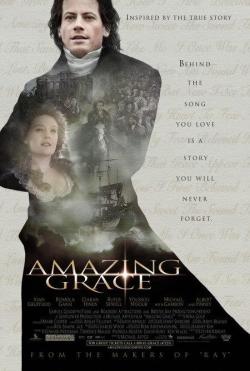
I wanted to like this, I really did. The reason was largely because I am in the midst of Apted's "7-up" series and I thought if anyone could look into the history of class in England with insight, it would be him. Also, everyone wants to feel good about a story when society becomes more moral. The evidence we see in our lives is that we are descending from a peak, and anything that revitalizes our faith in society is desired. And the stuffy British aristocracy is such a set stereotype that we were predisposed to root for this.
And I do admit I cried, but then again I cry at the end of nearly everything. There were some extremely well done sets that convey some notion of the period, and I assume they were accurate. And the muse that saves the world by bucking up the crusader? Well, she's a pretty redhead, prepared to support and encourage him, as her only apparent reason for life.
So let's talk first about what worked for me. In short, it was the idea that a complex time, multiple forces and all sorts of politics could be abstracted and simplified in a way that was comprehensible and true. After all, most intelligent people see and somewhat appreciate both sides of most public controversies. But slavery is so, so very vile that no one will allow it to be cast in other than absolute black and white. (Never mind that no matter how you define it, there are more people enslaved today than when these events occurred.)
(Only child * is like this in having absolutely no defenders today but scads and scads of practitioners.)
Such a movie is essentially a romantic story, a story about the true path and fighting for it. It is, as well, a high school movie, with a message about being true to yourself. That's what it is, a standard form blown up to envelope slavery. Its disguised a bit by how time is sliced up, but that's what it is, an ordinary form competently made by skilled if not inspired craftsmen. Boy gets girl, finds self through doubts and changes the world.
But then I found out more about the events and this film. The story in the movie makes it sound as if our hero really does abolish slavery. He doesn't, just the slave trade. As it happens, his reason for being against the trade had more to do with saving the Christian souls of the traders than helping the enslaved. In fact, he opposed actually freeing them as he found them repulsive and racially incapable of living on their own. He thought the best English society could do was to show them God, before either sending them back to Africa or eventually with much education creating a new peasant class below the virtually enslaved whites in England at that level.
So it is no surprise when you discover who is behind this film, a radical Christian billionaire named Philip Anschutz. And it should be no surprise that proceeds go to missions to bring brown people to Jesus.
So there's a sort of meta-movie here. The real Wilberforce was a complex, interesting character, but someone not wholly admirable. He acts in the name of God, and probably thinks he speaks to God. He makes changes in society to save their souls. Just like Anschutz, who funds organizations to promote creationism, define civil rights away from gays, and fund right wing politicians opposed to the Muslim threat while building a "Media Research Council." That council's mission is to promote what many would see as Christian propaganda (like "Narnia"), and indeed I saw this in a Regal theater.
That chain is the largest in the US and its head is a similar evangelical, who shares this goal.
Ted's Evaluation -- 1 of 3: You can find something better to do with this part of your life.


 Enjoy unlimited movies and shows
 Download your favorite content to watch offline
 Simple interface & smooth performance




























'%3e%3cpath%20id='Vector'%20d='M17.3996%2025.7999C17.3996%2025.9838%2017.3634%2026.1658%2017.293%2026.3357C17.2227%2026.5055%2017.1196%2026.6598%2016.9896%2026.7899C16.8596%2026.9199%2016.7052%2027.023%2016.5354%2027.0933C16.3655%2027.1637%2016.1835%2027.1999%2015.9996%2027.1999C15.8158%2027.1999%2015.6337%2027.1637%2015.4639%2027.0933C15.294%2027.023%2015.1397%2026.9199%2015.0097%2026.7899C14.8797%2026.6598%2014.7765%2026.5055%2014.7062%2026.3357C14.6358%2026.1658%2014.5996%2025.9838%2014.5996%2025.7999C14.5996%2025.4286%2014.7471%2025.0725%2015.0097%2024.81C15.2722%2024.5474%2015.6283%2024.3999%2015.9996%2024.3999C16.3709%2024.3999%2016.727%2024.5474%2016.9896%2024.81C17.2521%2025.0725%2017.3996%2025.4286%2017.3996%2025.7999Z'%20fill='white'/%3e%3cpath%20id='Union'%20fill-rule='evenodd'%20clip-rule='evenodd'%20d='M8.5%204H23.5C24.0523%204%2024.5%204.44772%2024.5%205V21.5H7.5V5C7.5%204.44772%207.94772%204%208.5%204ZM5.5%2022.5V5C5.5%203.34315%206.84315%202%208.5%202H23.5C25.1569%202%2026.5%203.34315%2026.5%205V22.5V27C26.5%2028.6569%2025.1569%2030%2023.5%2030H8.5C6.84315%2030%205.5%2028.6569%205.5%2027V22.5ZM24.5%2023.5V27C24.5%2027.5523%2024.0523%2028%2023.5%2028H8.5C7.94772%2028%207.5%2027.5523%207.5%2027V23.5H24.5Z'%20fill='white'/%3e%3cpath%20id='Union_2'%20fill-rule='evenodd'%20clip-rule='evenodd'%20d='M17%209C17%208.44772%2016.5523%208%2016%208C15.4477%208%2015%208.44772%2015%209V13.8258L13.1508%2012.2407C12.7315%2011.8813%2012.1002%2011.9299%2011.7408%2012.3492C11.3813%2012.7685%2011.4299%2013.3998%2011.8492%2013.7593L15.345%2016.7556C15.5205%2016.9079%2015.7495%2017%2016%2017C16.2506%2017%2016.4796%2016.9079%2016.6551%2016.7556L20.1508%2013.7593C20.5701%2013.3998%2020.6187%2012.7685%2020.2593%2012.3492C19.8999%2011.9299%2019.2686%2011.8813%2018.8492%2012.2407L17%2013.8258V9Z'%20fill='white'/%3e%3c/g%3e%3c/svg%3e)