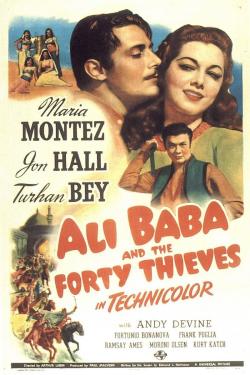
Producer: Paul Malvern. Copyright 31 December 1943 by Universal Pictures Co., Inc. New York release at the Palace: 15 March 1944. U.S. release: 14 January 1944. U.K. release: 13 March 1944. Australian release: 14 August 1944. Sydney release at the State: 9 August 1944. 10 reels. 87 minutes.
SYNOPSIS: The patriots of old Bagdad, under the leadership of Ali Baba Junior, throw off the Mongol yoke.
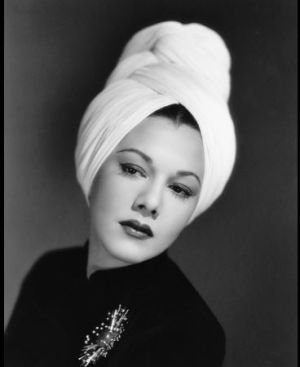
COMMENT: Maria Montez was a unique personality. Fortunately, Universal soon realized this. For her 9th film, "Arabian Nights", the studio opened its door to three-step Technicolor for the first time. The experiment was such a success there followed White Savage, Ali Baba, Cobra Woman, Gypsy Wildcat, Sudan and Pirates of Monterey in rapid succession. Ali Baba is one of the best of these — a carefully crafted, expansive production that does full justice to her talents and her appeal.
Filmed on a fairly lavish scale, with vast sets and on-location lensing with lots of colorfully costumed extras milling around, "Ali Baba" features plenty of action, directed at a nifty pace with agreeable camera angles and an occasionally (yet very effective) fluid camera style, underscored by loads of Universal-type "B" music. It all adds up to a movie buff's — and especially a Maria Montez buff's — delight.
Maria also has the opportunity to do her famous impersonating-her- servant-girl turn as well as her usual royal princess bit. My one and only criticism is that the plot prevents her making an early entrance. We have to wait almost two whole reels!
Quite apart from Miss Montez, the superb sets and superlative exquisite color photography make Ali Baba a visual delight.
Oddly enough, the cave itself with its obvious paper-mâché opening rocks and its disappointing lack of all the interior opulence we might expect, is the one real let-down. All other sets are as richly dressed as are the opulent costumes, while the attractive presence of Miss Montez herself is made even more entrancing by skillful make-up, costuming and hair styles. And all are rapturously, ravishingly photographed in rich, pastel-toned colors.
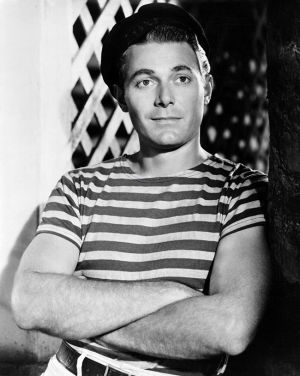
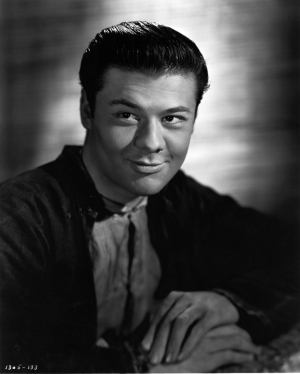
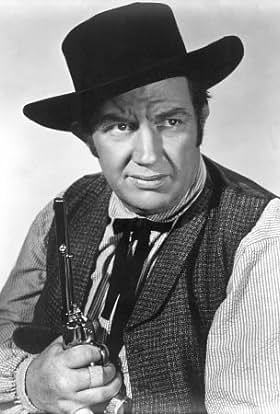
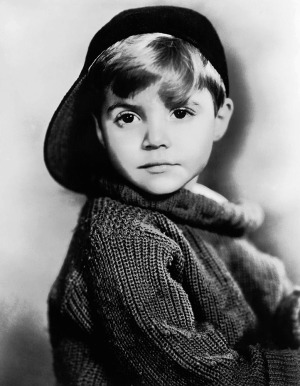
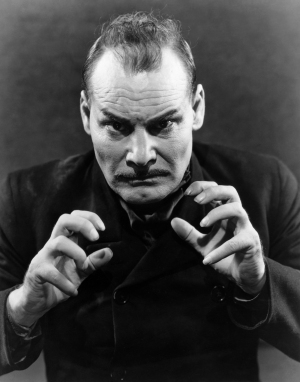
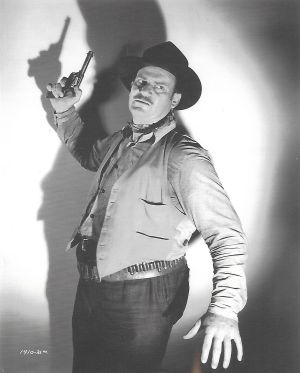
The support players are not much — Mr. Hall is obviously too mature for his part, and he's a second-rate swashbuckler at that; Frank Puglia and Kurt Katch are hardly the most crafty or charismatic pair of villains; Andy Devine is a most unlikely thief (though at least we are spared his customary over-indulgence in low comedy relief); Turhan Bey makes a lackluster accomplice. But at least they don't detract too much attention from Miss Montez! (It is the juveniles who keep us waiting — though Master Beckett and Miss Duguay are presentable enough. Their footage was re-used in its entirety in the 1965 remake.)
Stylishly directed by Universal contract director Arthur Lubin, this tale is now long on action, short on romance.
In fact, Edmund L. Hartmann's script makes considerable changes in the original story, turning it into a routine desert adventure. Still, it is a spirited enough tale, directed with dash in vivid color against sumptuous sets, and zestfully played by a grand cast. Maria Montez makes a queenly heroine, Jon Hall a vigorous hero, Kurt Katch a wonderfully sinister villain, while Andy Devine and Chris- Pin Martin provide some mildly amusing comic relief.


 Enjoy unlimited movies and shows
 Download your favorite content to watch offline
 Simple interface & smooth performance
















'%3e%3cpath%20id='Vector'%20d='M17.3996%2025.7999C17.3996%2025.9838%2017.3634%2026.1658%2017.293%2026.3357C17.2227%2026.5055%2017.1196%2026.6598%2016.9896%2026.7899C16.8596%2026.9199%2016.7052%2027.023%2016.5354%2027.0933C16.3655%2027.1637%2016.1835%2027.1999%2015.9996%2027.1999C15.8158%2027.1999%2015.6337%2027.1637%2015.4639%2027.0933C15.294%2027.023%2015.1397%2026.9199%2015.0097%2026.7899C14.8797%2026.6598%2014.7765%2026.5055%2014.7062%2026.3357C14.6358%2026.1658%2014.5996%2025.9838%2014.5996%2025.7999C14.5996%2025.4286%2014.7471%2025.0725%2015.0097%2024.81C15.2722%2024.5474%2015.6283%2024.3999%2015.9996%2024.3999C16.3709%2024.3999%2016.727%2024.5474%2016.9896%2024.81C17.2521%2025.0725%2017.3996%2025.4286%2017.3996%2025.7999Z'%20fill='white'/%3e%3cpath%20id='Union'%20fill-rule='evenodd'%20clip-rule='evenodd'%20d='M8.5%204H23.5C24.0523%204%2024.5%204.44772%2024.5%205V21.5H7.5V5C7.5%204.44772%207.94772%204%208.5%204ZM5.5%2022.5V5C5.5%203.34315%206.84315%202%208.5%202H23.5C25.1569%202%2026.5%203.34315%2026.5%205V22.5V27C26.5%2028.6569%2025.1569%2030%2023.5%2030H8.5C6.84315%2030%205.5%2028.6569%205.5%2027V22.5ZM24.5%2023.5V27C24.5%2027.5523%2024.0523%2028%2023.5%2028H8.5C7.94772%2028%207.5%2027.5523%207.5%2027V23.5H24.5Z'%20fill='white'/%3e%3cpath%20id='Union_2'%20fill-rule='evenodd'%20clip-rule='evenodd'%20d='M17%209C17%208.44772%2016.5523%208%2016%208C15.4477%208%2015%208.44772%2015%209V13.8258L13.1508%2012.2407C12.7315%2011.8813%2012.1002%2011.9299%2011.7408%2012.3492C11.3813%2012.7685%2011.4299%2013.3998%2011.8492%2013.7593L15.345%2016.7556C15.5205%2016.9079%2015.7495%2017%2016%2017C16.2506%2017%2016.4796%2016.9079%2016.6551%2016.7556L20.1508%2013.7593C20.5701%2013.3998%2020.6187%2012.7685%2020.2593%2012.3492C19.8999%2011.9299%2019.2686%2011.8813%2018.8492%2012.2407L17%2013.8258V9Z'%20fill='white'/%3e%3c/g%3e%3c/svg%3e)