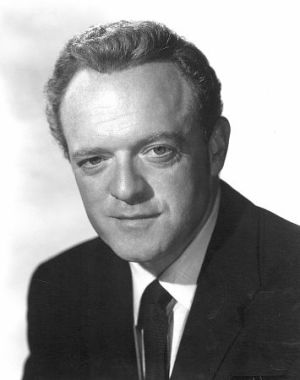
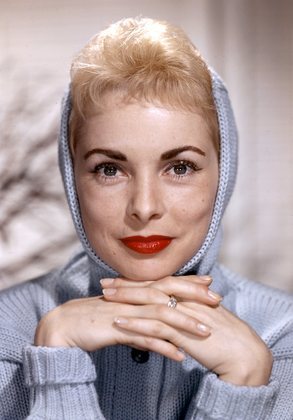
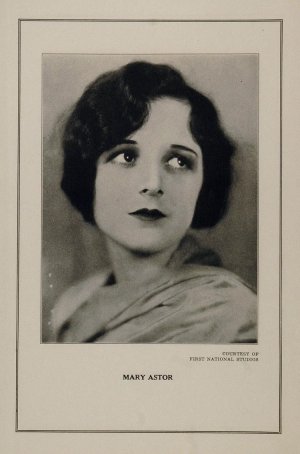
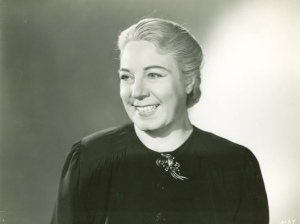
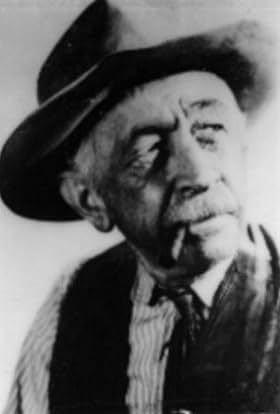
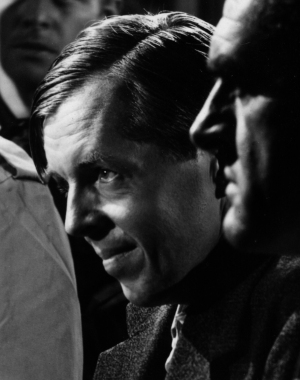
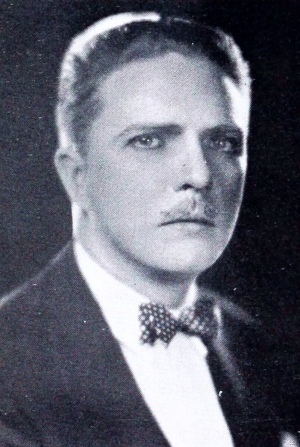
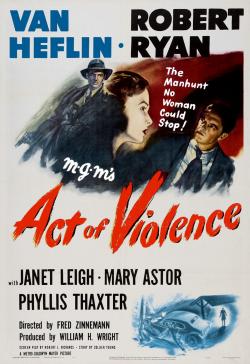
The 'act of violence' of the title is contemplated, not carried out. This is therefore not a violent film, despite the title. The film is a brilliant and thoughtful attempt to deal with serious issues of post-war trauma, betrayal, and revenge. The women in the film are the helpless spectators of the acting-out of a postscript to a war of which they had no direct knowledge. Beautiful and talented Janet Leigh, aged only 21, is the adoring wife of Van Heflin, who delivers one of his finest performances as a man whose past has caught up with him in the most menacing way possible: as Robert Ryan with a gun in his hand deciding that van Heflin must pay for what he did when they were in the Nazi prison camp together. These situations existed in real life, and did not have to be invented. Fred Zinnemann, the director, was freshly back from Germany where he had just finished shooting 'The Search' (1948) on location amidst the rubble and ruins of the war. The aftermath of the war was his obsession at that time, followed after this by 'The Men', which also dealt with veterans. I knew Fred very well for a while, and he was a deep thinker, a man with a profound conscience and sense of social responsibility to inform and enlighten the public. He was an Austrian Jew, and his first film experience was with the German film 'Menschen am Sonntag' ('People on Sunday')(1930), which is an astonishing, bold, and mesmerising documentary film of social observation mixed with avant garde. Fred told me he had trained as a violinist when young in Vienna. He was a thinker and a complete highbrow (hence his ability to direct 'A Man for All Seasons' so well), but one who was devoted to public communication. I had the highest possible opinion of Fred as a person and as a creative artist. He was so gentle that he was able to tease sensitive performances out of anybody. He had some rough times in his career, but that is another story. With 'High Noon' (1952), Fred achieved recognition as one of the world's leading film directors, recognition which should have come to him earlier. Certainly this film, in which every frame is perfect, the script is well-honed, and the editing and construction without flaw, together with its spectacular performances (Mary Astor harrowingly convincing as a prostitute!) and Robert Ryan at his most grimly determined and menacing, where we come to realize that his need for vengeance is purely idealistic and not personal, shows clearly what a master Fred Zinnemann already was. This is not 'just a noir film'; it is a Fred Zinnemann film in the noir genre, which is something else again. It should not be missed by connoisseurs who want to see how a dark thriller can be genuinely profound in a social and psychological sense. Fred's wish was not just to make a good thriller, but to explore the depths of what that thriller represented in every respect. Since film noir was a genre which came into existence as the result of the aftermath of the war, this film is central to understanding the genre as a whole, and if you haven't seen it, you can never properly understand the genre. This and 'Force of Evil' are probably the two key noir films, the most profound of them all.


 Enjoy unlimited movies and shows
 Download your favorite content to watch offline
 Simple interface & smooth performance

















'%3e%3cpath%20id='Vector'%20d='M17.3996%2025.7999C17.3996%2025.9838%2017.3634%2026.1658%2017.293%2026.3357C17.2227%2026.5055%2017.1196%2026.6598%2016.9896%2026.7899C16.8596%2026.9199%2016.7052%2027.023%2016.5354%2027.0933C16.3655%2027.1637%2016.1835%2027.1999%2015.9996%2027.1999C15.8158%2027.1999%2015.6337%2027.1637%2015.4639%2027.0933C15.294%2027.023%2015.1397%2026.9199%2015.0097%2026.7899C14.8797%2026.6598%2014.7765%2026.5055%2014.7062%2026.3357C14.6358%2026.1658%2014.5996%2025.9838%2014.5996%2025.7999C14.5996%2025.4286%2014.7471%2025.0725%2015.0097%2024.81C15.2722%2024.5474%2015.6283%2024.3999%2015.9996%2024.3999C16.3709%2024.3999%2016.727%2024.5474%2016.9896%2024.81C17.2521%2025.0725%2017.3996%2025.4286%2017.3996%2025.7999Z'%20fill='white'/%3e%3cpath%20id='Union'%20fill-rule='evenodd'%20clip-rule='evenodd'%20d='M8.5%204H23.5C24.0523%204%2024.5%204.44772%2024.5%205V21.5H7.5V5C7.5%204.44772%207.94772%204%208.5%204ZM5.5%2022.5V5C5.5%203.34315%206.84315%202%208.5%202H23.5C25.1569%202%2026.5%203.34315%2026.5%205V22.5V27C26.5%2028.6569%2025.1569%2030%2023.5%2030H8.5C6.84315%2030%205.5%2028.6569%205.5%2027V22.5ZM24.5%2023.5V27C24.5%2027.5523%2024.0523%2028%2023.5%2028H8.5C7.94772%2028%207.5%2027.5523%207.5%2027V23.5H24.5Z'%20fill='white'/%3e%3cpath%20id='Union_2'%20fill-rule='evenodd'%20clip-rule='evenodd'%20d='M17%209C17%208.44772%2016.5523%208%2016%208C15.4477%208%2015%208.44772%2015%209V13.8258L13.1508%2012.2407C12.7315%2011.8813%2012.1002%2011.9299%2011.7408%2012.3492C11.3813%2012.7685%2011.4299%2013.3998%2011.8492%2013.7593L15.345%2016.7556C15.5205%2016.9079%2015.7495%2017%2016%2017C16.2506%2017%2016.4796%2016.9079%2016.6551%2016.7556L20.1508%2013.7593C20.5701%2013.3998%2020.6187%2012.7685%2020.2593%2012.3492C19.8999%2011.9299%2019.2686%2011.8813%2018.8492%2012.2407L17%2013.8258V9Z'%20fill='white'/%3e%3c/g%3e%3c/svg%3e)