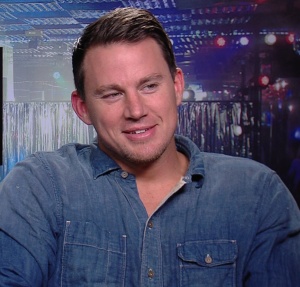
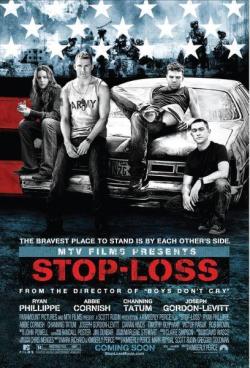
As a big fan of Kimberly Peirce's "Boys Don't Cry," I went to a sneak preview of "Stop-Loss" with positive expectations. However, despite its good intentions, this film is a muddled mess. It cobbles together a narrative that feels false and arbitrary given the particular group of soldiers the story focuses on. A group of lifelong friends from a small Texas town (which is itself portrayed in about as clichéd as an outsider's imagination of a Texas small-town could be) come back and all suffer shell-shock and trauma, as one might expect. However, Ryan Phillippe's character, expecting to be finished with his duty, reacts to the news that he is being "Stop-Lossed" (sent back on another tour of duty) by instantly breaking from every fiber of his upbringing. In about 90 seconds, he is a different man, rebellious, ready to run. Soon he is picking fights and wobbling dangerously close to uncontrollable Rambo territory even as we are supposed to believe that he has an unassailably correct belief that he shouldn't be forced to go back no matter what the military says. Unfortunately Phillippe (who had seemed to be becoming a better actor in 2007's "Breach") tips his hand here and reveals his limited range (not to mention a horrifically fake sounding Texas twang). Phillippe's equally unbalanced yet more ra-ra lifelong bud is played with an even more limited range of emotions by former (though-should-probably-have-stayed-a) model Channing Tatum, who admittedly does have the good sense to avoid even attempting a Southern accent here. Even poor Joseph Gordon Levitt, who has proved himself an able and promising young actor in several recent films), is reduced to seeming tinny and unconvincing here.
The paper-thin story sends Phillippe uselessly careening across the U.S. accompanied by his best friend's fiancée, an unconvincing device that accomplishes little. There are also lots of badly executed sequences of these fugitives driving and hiding, not to mention loads of clunky, repetitive dialogue that never gets us to the soul of these men who are supposedly suffering. In an example of unbridled directorial excess, the story even gets broken up several times by jarring, wholly unnecessary 'soldier videos' that supposedly mimic those created by the boots on the ground, but which look more professional than many music videos today and feel really inauthentic. Plus, they yank us out of the story again and again, and after awhile, it's hard to go back into it.
The ending is doubly unsatisfying in that, after forcing these characters to do fairly extreme things that their real-life counterparts would not do, and after making it very clear that we are supposed to be viewing Phillippe as the beleaguered hero on a quest to right a wrong no matter what the consequences, the movie turns on its heels and abandons all that in a flash. The characters and the movie end up where they started, and the audience, who has been shoe-horned into viewing Phillippe's rebellion and journey as something to root for, are abandoned. The director has forced us to slog along on this narrative road for two hours, and as an emotional viewing experience, the ending (even if it is supposed to say something about the inassailability of the military machine) pulls the trap door on us.
The director was present at a Q&A after the film, and she spoke about how she created these characters after talking to a lot of different real-life soldiers back from Iraq & Afghanistan. The film really feels like that -- and not in a good way. It is a patchwork of observations about the shell-shock of returning home without any real commitment to one set of lives. Peirce's "soldiers" are overstuffed amalgams who drink and yell and fight and shoot and even cry, but don't breathe.


 Nikmati film dan acara tanpa batas
 Download konten favorit untuk ditonton offline
 Tampilan mudah, lancar dipakai




'%3e%3cpath%20id='Vector'%20d='M17.3996%2025.7999C17.3996%2025.9838%2017.3634%2026.1658%2017.293%2026.3357C17.2227%2026.5055%2017.1196%2026.6598%2016.9896%2026.7899C16.8596%2026.9199%2016.7052%2027.023%2016.5354%2027.0933C16.3655%2027.1637%2016.1835%2027.1999%2015.9996%2027.1999C15.8158%2027.1999%2015.6337%2027.1637%2015.4639%2027.0933C15.294%2027.023%2015.1397%2026.9199%2015.0097%2026.7899C14.8797%2026.6598%2014.7765%2026.5055%2014.7062%2026.3357C14.6358%2026.1658%2014.5996%2025.9838%2014.5996%2025.7999C14.5996%2025.4286%2014.7471%2025.0725%2015.0097%2024.81C15.2722%2024.5474%2015.6283%2024.3999%2015.9996%2024.3999C16.3709%2024.3999%2016.727%2024.5474%2016.9896%2024.81C17.2521%2025.0725%2017.3996%2025.4286%2017.3996%2025.7999Z'%20fill='white'/%3e%3cpath%20id='Union'%20fill-rule='evenodd'%20clip-rule='evenodd'%20d='M8.5%204H23.5C24.0523%204%2024.5%204.44772%2024.5%205V21.5H7.5V5C7.5%204.44772%207.94772%204%208.5%204ZM5.5%2022.5V5C5.5%203.34315%206.84315%202%208.5%202H23.5C25.1569%202%2026.5%203.34315%2026.5%205V22.5V27C26.5%2028.6569%2025.1569%2030%2023.5%2030H8.5C6.84315%2030%205.5%2028.6569%205.5%2027V22.5ZM24.5%2023.5V27C24.5%2027.5523%2024.0523%2028%2023.5%2028H8.5C7.94772%2028%207.5%2027.5523%207.5%2027V23.5H24.5Z'%20fill='white'/%3e%3cpath%20id='Union_2'%20fill-rule='evenodd'%20clip-rule='evenodd'%20d='M17%209C17%208.44772%2016.5523%208%2016%208C15.4477%208%2015%208.44772%2015%209V13.8258L13.1508%2012.2407C12.7315%2011.8813%2012.1002%2011.9299%2011.7408%2012.3492C11.3813%2012.7685%2011.4299%2013.3998%2011.8492%2013.7593L15.345%2016.7556C15.5205%2016.9079%2015.7495%2017%2016%2017C16.2506%2017%2016.4796%2016.9079%2016.6551%2016.7556L20.1508%2013.7593C20.5701%2013.3998%2020.6187%2012.7685%2020.2593%2012.3492C19.8999%2011.9299%2019.2686%2011.8813%2018.8492%2012.2407L17%2013.8258V9Z'%20fill='white'/%3e%3c/g%3e%3c/svg%3e)