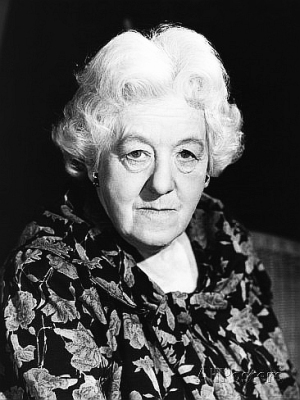
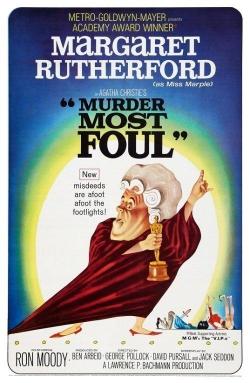
Despite my later comments below I very much like this film and indeed all the Margaret Rutherford/Miss Marple canon. They are well acted and directed and time has certainly lent a nostalgic, black and white enchantment to the view with their depiction of a cosy, tea and cakes England which never actually existed but which we like to imagine did. And the murders, while hardly cosy, are interesting too. Indeed, and if one forgets such inconveniences as Agatha Christie's 'real' Miss Marple, on their own merits all four films, while hardly classics of the cinema, are most enjoyable and an excellent way of passing the famous wet Sunday afternoon.
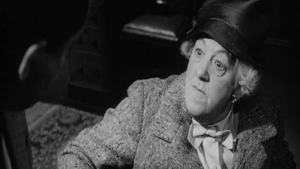
However, although none include the words 'Miss Marple' in their titles, they are all marketed as featuring her, presumably for fairly obvious commercial reasons, and thus I think there is a case for invoking the Trades Descriptions Act as they bear precious little resemblance to the Marple world of the books, viz:- 1. Margaret Rutherford was a brilliant actress and good in this role but she was physically so unlike Agatha Christie's description of Miss Marple that it is difficult to take her characterisation seriously. Miss Marple is variously described in the books as fluffy, delicate and, I believe, like Dresden porcelain and those words, ungallant though it must sound, cannot possibly be applied to Miss Rutherford. I believe that Mrs Christie shared this view.
2. Only one of the films is based on a true Marple story (Murder She Said - 4.50 from Paddington). Two are actually Poirot stories and the other has no Christie connection at all. (The ITV Marple is guilty of much the same).
3. Miss Marple has been moved from St. Mary Mead to Milchester. If there is a point to this it escapes me.
4. The famous Marple method of solving cases by comparing them with past events and characters from her village has unforgivably been ditched completely.
5. Jim Stringer appears in all four films but in none of Christie's stories. Of course the reason for this was to provide a role for Miss Rutherford's husband, Stringer Davis, who, she insisted, must be cast in any film she was in. (To digress slightly, while I much admire and respect the couple's devotion to each other, I feel that this was wrong. Although it probably does not apply in the Marple films, the character having been created specifically to provide a role for him alone, if Mr Davis was the best available for a particular part he would have got it anyway - if not it unfairly deprived another actor). His part here is in any case not really essential, being largely confined to fetching and carrying and acting as a sounding board for Miss Marple's thoughts, all of which could have been accomplished by other means.
6. Perhaps slightly irrelevant but it still irritates me - despite all the help he receives from Miss Marple, even gaining promotion on the strength of it at one point, Inspector Craddock persists in regarding her as an interfering old busybody who should stop bothering him. With that kind of stupidity he should be back on the beat at least.
This is of course all a matter of opinion and I have already seen the view that any story is open to interpretation in any way. I agree with this to an extent but it depends,IMHO, on how far it can go before it makes a nonsense of the piece in question. For example Shakespeare in modern dress can be quite valid except in the historical plays (they simply did not wear suits, jeans and T shirts in 1483). And if Miss Marple can solve a Poirot case how long before we see Iago whispering in Hamlet's ear? Or Dr Watson chronicling the adventures of Sexton Blake? Just one more comment, of no relevance whatever to the above. Did you know that Margaret Rutherford is an anagram of Target for Murder? Well, almost. There's a rogue A,H and R which I can't fit in anywhere. Any (printable) suggestions?


 Nikmati film dan acara tanpa batas
 Download konten favorit untuk ditonton offline
 Tampilan mudah, lancar dipakai




















'%3e%3cpath%20id='Vector'%20d='M17.3996%2025.7999C17.3996%2025.9838%2017.3634%2026.1658%2017.293%2026.3357C17.2227%2026.5055%2017.1196%2026.6598%2016.9896%2026.7899C16.8596%2026.9199%2016.7052%2027.023%2016.5354%2027.0933C16.3655%2027.1637%2016.1835%2027.1999%2015.9996%2027.1999C15.8158%2027.1999%2015.6337%2027.1637%2015.4639%2027.0933C15.294%2027.023%2015.1397%2026.9199%2015.0097%2026.7899C14.8797%2026.6598%2014.7765%2026.5055%2014.7062%2026.3357C14.6358%2026.1658%2014.5996%2025.9838%2014.5996%2025.7999C14.5996%2025.4286%2014.7471%2025.0725%2015.0097%2024.81C15.2722%2024.5474%2015.6283%2024.3999%2015.9996%2024.3999C16.3709%2024.3999%2016.727%2024.5474%2016.9896%2024.81C17.2521%2025.0725%2017.3996%2025.4286%2017.3996%2025.7999Z'%20fill='white'/%3e%3cpath%20id='Union'%20fill-rule='evenodd'%20clip-rule='evenodd'%20d='M8.5%204H23.5C24.0523%204%2024.5%204.44772%2024.5%205V21.5H7.5V5C7.5%204.44772%207.94772%204%208.5%204ZM5.5%2022.5V5C5.5%203.34315%206.84315%202%208.5%202H23.5C25.1569%202%2026.5%203.34315%2026.5%205V22.5V27C26.5%2028.6569%2025.1569%2030%2023.5%2030H8.5C6.84315%2030%205.5%2028.6569%205.5%2027V22.5ZM24.5%2023.5V27C24.5%2027.5523%2024.0523%2028%2023.5%2028H8.5C7.94772%2028%207.5%2027.5523%207.5%2027V23.5H24.5Z'%20fill='white'/%3e%3cpath%20id='Union_2'%20fill-rule='evenodd'%20clip-rule='evenodd'%20d='M17%209C17%208.44772%2016.5523%208%2016%208C15.4477%208%2015%208.44772%2015%209V13.8258L13.1508%2012.2407C12.7315%2011.8813%2012.1002%2011.9299%2011.7408%2012.3492C11.3813%2012.7685%2011.4299%2013.3998%2011.8492%2013.7593L15.345%2016.7556C15.5205%2016.9079%2015.7495%2017%2016%2017C16.2506%2017%2016.4796%2016.9079%2016.6551%2016.7556L20.1508%2013.7593C20.5701%2013.3998%2020.6187%2012.7685%2020.2593%2012.3492C19.8999%2011.9299%2019.2686%2011.8813%2018.8492%2012.2407L17%2013.8258V9Z'%20fill='white'/%3e%3c/g%3e%3c/svg%3e)