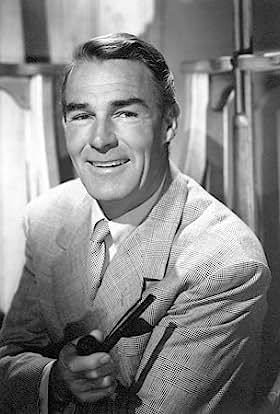
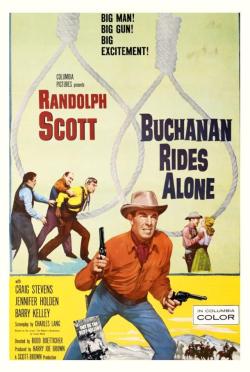
The grand run of Randolph Scott-Budd Boetticher westerns stumbles a bit in this serio-comic outing featuring a town of villains who get more than they bargained for when they tangle with a man named Buchanan they underestimate to their grief.
Buchanan (Scott) rides into Agry Town, on the border between California and Mexico, looking to make tracks to his West Texas home. But the Agrys are tough customers who rile easily. Buchanan finds himself facing the brunt of their nastiness after saving a Mexican from their brand of vigilante justice.
Scott does a lot of smiling here, more than any of his other Boetticher-directed vehicles, of a piece with the more amiable if still dangerous mood of the film. The comedy is established early when we see Scott take stock of his new surroundings. Everyone in Agry Town is fairly corrupt and mean of spirit, particularly the three Agry brothers who control the town.
"Ain't there anybody in this town who ain't an Agry?" Buchanan marvels.
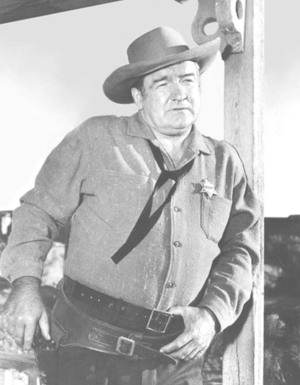
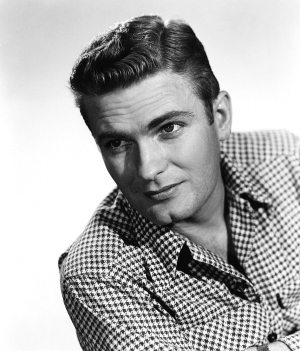
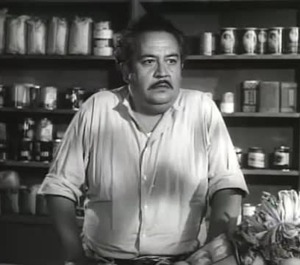
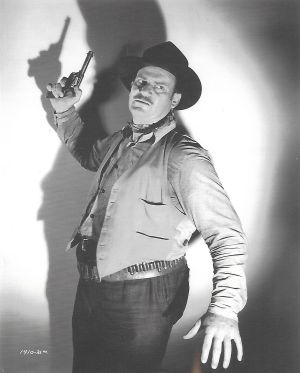
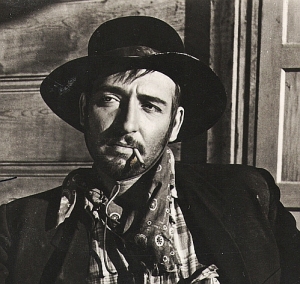
No one cares about the boy whom the Mexican kills, "it was inevitable" is all the father cares to say, and you see he's right. But since the kid was an Agry, it doesn't matter he was up to no good. They decide to lynch the Mexican quick, not to mention Buchanan for helping him. Buchanan, it turns out, was carrying $2,000 that the fat sheriff, Lew Agry (Barry Kelley) wants for himself. Lew's fatter brother, Amos (Peter Whitney), is sore because he wants a bigger share of the loot, but Lew enlists his help to double-cross town boss Simon Agry, the dead man's father, out of money he hopes to extort from the Mexican's rich dad.
Them Agrys themselves don't have much going for them other than sordidness. The westerns Scott made with director Boetticher usually had fascinating villains in them, ruthless men of character and sand, who made these adventures memorable. Here, the only interesting characters are played by Craig Stevens, as the one Agry honcho who looks like he eats a salad now and then, and L. Q. Jones as a gunman who cottons to Buchanan because he's from West Texas, too.
It's wrong to dock a movie because it's not "Ride Lonesome" or "Seven Men From Now;" few are in that class. "Buchanan Rides Alone" does have its moments, mostly comic, like a trial scene where Buchanan amuses the jury with the story of his ramrod livelihood or a scene where Jones offers some heartfelt words over the corpse of an ex-partner who probably shouldn't have stole from him so often.
Buchanan has a scene where he's trying to get his money back from the sheriff, who tells him it's in a safe. Shoot me, the sheriff says, and you won't get your money.
"You know something, sheriff, it just might be worth it," Buchanan replies.
But like julian-er-allen says in a January 2013 review here, this is "very much the poor relation" in the Scott-Boetticher clan, more so than the oft-criticized "Decision At Sundown" which has style and passion missing here. Scott seems stiff and awkward too often, and the story stagnates into a series of captures and escapes. There's an especially ridiculous section in the last half-hour where Buchanan and his friends leave some bad guys with their horses and guns. It's hard to care as much as you should when the hero himself doesn't seem too swift.
The ending is a right hash of a good idea, centering on a bag of money which really shouldn't matter as much as it is made to here. The point may be that corruption corrupts everyone, even the good guys, but it's so underplayed it doesn't connect to anything. It just drags.
Add to that a television-western set design even Lucian Ballard's lenswork can't save and generic musical underscoring, and you have a disappointing example that even great filmmakers and actors have their off days. "Buchanan" is kind of fun, in a low-key way, but it's nothing like what you have a right to expect from this team.


 Nikmati film dan acara tanpa batas
 Download konten favorit untuk ditonton offline
 Tampilan mudah, lancar dipakai
















'%3e%3cpath%20id='Vector'%20d='M17.3996%2025.7999C17.3996%2025.9838%2017.3634%2026.1658%2017.293%2026.3357C17.2227%2026.5055%2017.1196%2026.6598%2016.9896%2026.7899C16.8596%2026.9199%2016.7052%2027.023%2016.5354%2027.0933C16.3655%2027.1637%2016.1835%2027.1999%2015.9996%2027.1999C15.8158%2027.1999%2015.6337%2027.1637%2015.4639%2027.0933C15.294%2027.023%2015.1397%2026.9199%2015.0097%2026.7899C14.8797%2026.6598%2014.7765%2026.5055%2014.7062%2026.3357C14.6358%2026.1658%2014.5996%2025.9838%2014.5996%2025.7999C14.5996%2025.4286%2014.7471%2025.0725%2015.0097%2024.81C15.2722%2024.5474%2015.6283%2024.3999%2015.9996%2024.3999C16.3709%2024.3999%2016.727%2024.5474%2016.9896%2024.81C17.2521%2025.0725%2017.3996%2025.4286%2017.3996%2025.7999Z'%20fill='white'/%3e%3cpath%20id='Union'%20fill-rule='evenodd'%20clip-rule='evenodd'%20d='M8.5%204H23.5C24.0523%204%2024.5%204.44772%2024.5%205V21.5H7.5V5C7.5%204.44772%207.94772%204%208.5%204ZM5.5%2022.5V5C5.5%203.34315%206.84315%202%208.5%202H23.5C25.1569%202%2026.5%203.34315%2026.5%205V22.5V27C26.5%2028.6569%2025.1569%2030%2023.5%2030H8.5C6.84315%2030%205.5%2028.6569%205.5%2027V22.5ZM24.5%2023.5V27C24.5%2027.5523%2024.0523%2028%2023.5%2028H8.5C7.94772%2028%207.5%2027.5523%207.5%2027V23.5H24.5Z'%20fill='white'/%3e%3cpath%20id='Union_2'%20fill-rule='evenodd'%20clip-rule='evenodd'%20d='M17%209C17%208.44772%2016.5523%208%2016%208C15.4477%208%2015%208.44772%2015%209V13.8258L13.1508%2012.2407C12.7315%2011.8813%2012.1002%2011.9299%2011.7408%2012.3492C11.3813%2012.7685%2011.4299%2013.3998%2011.8492%2013.7593L15.345%2016.7556C15.5205%2016.9079%2015.7495%2017%2016%2017C16.2506%2017%2016.4796%2016.9079%2016.6551%2016.7556L20.1508%2013.7593C20.5701%2013.3998%2020.6187%2012.7685%2020.2593%2012.3492C19.8999%2011.9299%2019.2686%2011.8813%2018.8492%2012.2407L17%2013.8258V9Z'%20fill='white'/%3e%3c/g%3e%3c/svg%3e)