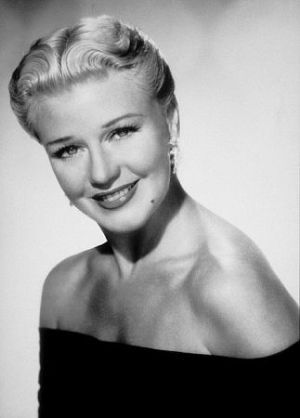
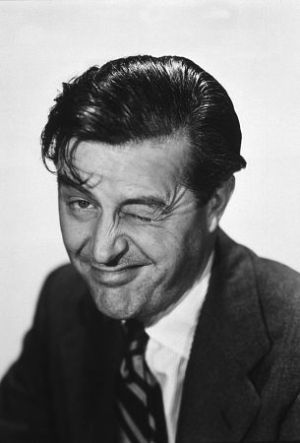
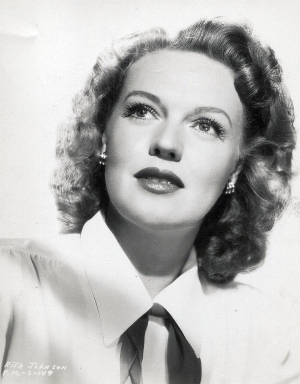
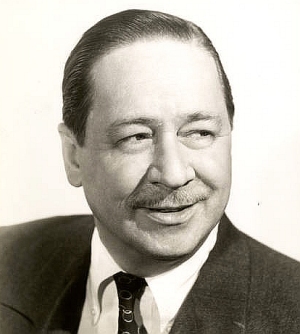
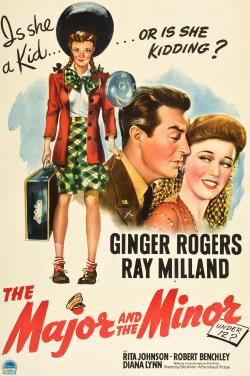
It would be nice to be able to say that 'The Major and the Minor' is one of those great debut films of the early 1940s, of the same vintage as 'Citizen Kane' and 'The Maltese Falcon'. The truth is, despite being thoroughly amiable, frequently risque, and always clever, Wilder's first film is simply not funny enough. Perhaps the fault lies in the casting - is Ginger Rogers to wisecrackingly knowing to fully exploit such a perverse role? Is the film's perversity too lightly handled?
i think the problem is the recurring Wilder problem, that of too many words. One is left breathless, but a little oppressed, at the continuous barrage of gags, wisecracks, puns, sarcasms that fitfully hit their target. It is significant that the film's funniest sequence, when the cadet Susan has hoodwinked returns to his abandoned post lost in music, in the presence of his superiors, is a purely visual one, depending on resources other than the word: expectation, incongruity, physical humour. It is more eloquent of all Wilder's themes - the limits on humanity under authoritarian systems; the generation and gender gap; the transformative power or otherwise of art - than a hundred perfectly honed jokes.
Still, the film is notable in that it serves as a fully formed statement of intent. Or rather; there have always been two impulses in Wilder - the ironic, yet enchanting, adult fairy tale, and the corrosively bitter melodrama, which, in its most hysterical form tended towards a Gothic melodrama not too far from the first. 'Major' is pure fairy tale - Susan is transformed (there is an elaborate scene of metamorphosis, appropriately, at a train station) from a failed woman into a wildly popular young girl; she steals the handsome prince from a grasping shrew; she spends a fairy-tale three days in an enchanted space, where normality, order, hierarchy are all suspended or overturned; she even chooses to reveal herself wearing an 'Arabian Nights'-like costume.
Susan's 'time-transference' allows her to become a subversive sprite, although an earlier tussle with Osborne (the immortal Robert Benchley) suggests that she is not the sort of person to simply take things as she finds them. But the idea that a little girl can disrupt a rigidly ordered military base on the eve of war IS subversive, culminating in the glorious switchboard sequence. She does more than this - she changes the status quo - a hick girl who has blown all her prospects is able to infiltrate the military elite and overturn an arranged marriage, a deliberately conceived continuance of tradition. She takes Kirby out of this crippling environment, out of an enchanted land and the witch that would keep him there, even though she herself has magical powers that allow her to change appearance and age at will.
She uncovers the sexual neurosis at the heart of the military project, rightly comparing the Fall of France to a sexual violation, but also suggesting that the mechanised disciplining of human beings only leads to the kind of physical repression that is betrayed by physical symptoms like Kirby's dodgy eye. When Susan leans against an erect cannon, trying to ward off pubescent boys for whom military advances are sexual advances, we know what's happening, especially as she met Kirby on a derailed train, that Freudian engine, which, along with Susan's disguise as a female caricature, prefigures Wilder's masterpiece, 'Some Like It Hot', and which, when the relationship is finally sorted out, and about to be consummated, is so at a train station.
There is a melancholy twist to this fairy tale - Susan gets her prince at the moment he leaves, perhaps never to return, like the millions of men soon to be mobilised in the war effort. Wilder's portrait of Pamela audaciously suggests that not every woman will selflessly stand by her man, pointing to the misogyny of film noir and its treacherous women.


 बिना रुकावट फिल्में और शो देखें
 अपना पसंदीदा कंटेंट डाउनलोड करो ताकि ऑफ़लाइन देख सको
 सिंपल इंटरफ़ेस & स्मूथ परफॉर्मेंस




'%3e%3cpath%20id='Vector'%20d='M17.3996%2025.7999C17.3996%2025.9838%2017.3634%2026.1658%2017.293%2026.3357C17.2227%2026.5055%2017.1196%2026.6598%2016.9896%2026.7899C16.8596%2026.9199%2016.7052%2027.023%2016.5354%2027.0933C16.3655%2027.1637%2016.1835%2027.1999%2015.9996%2027.1999C15.8158%2027.1999%2015.6337%2027.1637%2015.4639%2027.0933C15.294%2027.023%2015.1397%2026.9199%2015.0097%2026.7899C14.8797%2026.6598%2014.7765%2026.5055%2014.7062%2026.3357C14.6358%2026.1658%2014.5996%2025.9838%2014.5996%2025.7999C14.5996%2025.4286%2014.7471%2025.0725%2015.0097%2024.81C15.2722%2024.5474%2015.6283%2024.3999%2015.9996%2024.3999C16.3709%2024.3999%2016.727%2024.5474%2016.9896%2024.81C17.2521%2025.0725%2017.3996%2025.4286%2017.3996%2025.7999Z'%20fill='white'/%3e%3cpath%20id='Union'%20fill-rule='evenodd'%20clip-rule='evenodd'%20d='M8.5%204H23.5C24.0523%204%2024.5%204.44772%2024.5%205V21.5H7.5V5C7.5%204.44772%207.94772%204%208.5%204ZM5.5%2022.5V5C5.5%203.34315%206.84315%202%208.5%202H23.5C25.1569%202%2026.5%203.34315%2026.5%205V22.5V27C26.5%2028.6569%2025.1569%2030%2023.5%2030H8.5C6.84315%2030%205.5%2028.6569%205.5%2027V22.5ZM24.5%2023.5V27C24.5%2027.5523%2024.0523%2028%2023.5%2028H8.5C7.94772%2028%207.5%2027.5523%207.5%2027V23.5H24.5Z'%20fill='white'/%3e%3cpath%20id='Union_2'%20fill-rule='evenodd'%20clip-rule='evenodd'%20d='M17%209C17%208.44772%2016.5523%208%2016%208C15.4477%208%2015%208.44772%2015%209V13.8258L13.1508%2012.2407C12.7315%2011.8813%2012.1002%2011.9299%2011.7408%2012.3492C11.3813%2012.7685%2011.4299%2013.3998%2011.8492%2013.7593L15.345%2016.7556C15.5205%2016.9079%2015.7495%2017%2016%2017C16.2506%2017%2016.4796%2016.9079%2016.6551%2016.7556L20.1508%2013.7593C20.5701%2013.3998%2020.6187%2012.7685%2020.2593%2012.3492C19.8999%2011.9299%2019.2686%2011.8813%2018.8492%2012.2407L17%2013.8258V9Z'%20fill='white'/%3e%3c/g%3e%3c/svg%3e)