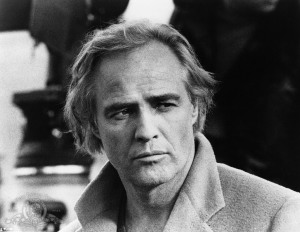
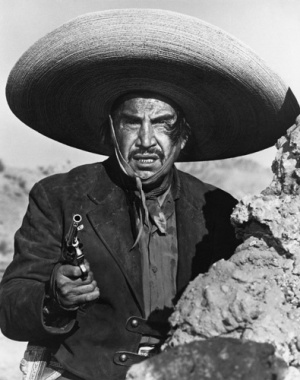
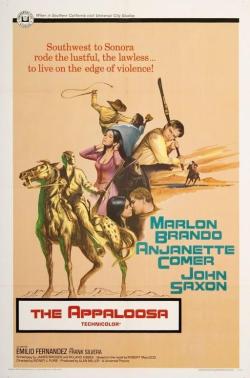
Today I have seen for the first time THE APPALOOSA and it is some western, bizarre and oblique and striking, played by one the very few extraordinary actors ever, and a strange hallmark as wellmade in '66, I believe, it looks like an original, rough, sharp and uncanny revisionist western taken over by Brando once more ;it reminded me of that western directed by Brando himself, several years before Appaloosa. Which one is better? I can not say that, as it's long since I have seen ONE EYED
. And can they truly be compared? These movies exists only around Brando; and Hopkins explained well that they are iconic movies, movies enlivened by Brando's iconic presence (--and whims, and antics, if you like
--), egotistical performances meant to startle and to amaze. The script is smashed, and if Appaloosa is indeed powerfully dramatic, it's because of Brando's guts. Acts of courage, of egotism, a narcissistic cinema unfortunately sabotaged or denied by the '60s Hollywood industry; come to think of it, Gabin, Grant and others were accorded what Brando needed tooa celebratory cinema intended to exploit an actor's unusual energy and iconic glow. This is Brando exploitation. Movies like this one are designed as cultfilms, and this seems their primary significance. On a large scale, this was done in the generous era of cinemathe era of true stardom. Gabin, Bogart, Garboand, before them, the true stars of the silent cinema, fully benefited from this. Brando, like Newman, came too late, when the cult meant a rather small niche and such a strategy was possible only in the B cinema (see the Bronson file, or the Italian genre actors
).
Here, as the gringo ,Brando is (again) largerthanlife; the theme of the humiliated and wronged man can be superficially traced through some famous westerns, like LARAMIE and that already mentioned above ONE EYED
,but is it any good? I think not; aside from a superficial resemblance, the scene is new each time it's used by another director from a different movie.
Another aspectBrando's role as Matteo, the gringo, is a standout because of Brando's own line of rough and fancy realismif you will only accept such an expression. In the final duel, Brando uses with the same delighted nonchalance his obvious clumsinesshe used his hands in a bizarre way, and this somehow boosts his character, enhances if not the realism, then the attractiveness of a scene.
When we avidly watch Brando are we really in for realism (performing credibly average unobtrusive people)? Brando always strivesif he did it at allto play interesting, dashing, intriguing charactersnot pedestrians. First of all, a realist performance presupposes a realist script and realist intentions. Brando naturally enjoys to fascinate and to startle. He offers highvoltage fancy. Of course his beautifully made characters are realbecause he created them, not because they are realistic to a grand degree. Was he ever required realism? Whose realism, or, realism according to whom? In his westerns too, he is not trying to give realistic performances (the way Duvall, Costner, Eastwood, Hackman, Caan, with the adequate scripts and parts, triedand largely succeeded too). Dean, Nicholson, De Niro and maybe even Clift aimed sometimes at achieving realist performances; not Brando, not Pacino, who characteristically subordinate the parts to their energies and personalities and even playfulness.
Gabin was seldom realist in his performances; and he was seldom solicited, required to be realist.
Some mistake a certain intensity for realism; but, first of all, let us inquire if a certain movie or script requires or at least admits realism, and to what degree.


 बिना रुकावट फिल्में और शो देखें
 अपना पसंदीदा कंटेंट डाउनलोड करो ताकि ऑफ़लाइन देख सको
 सिंपल इंटरफ़ेस & स्मूथ परफॉर्मेंस


















'%3e%3cpath%20id='Vector'%20d='M17.3996%2025.7999C17.3996%2025.9838%2017.3634%2026.1658%2017.293%2026.3357C17.2227%2026.5055%2017.1196%2026.6598%2016.9896%2026.7899C16.8596%2026.9199%2016.7052%2027.023%2016.5354%2027.0933C16.3655%2027.1637%2016.1835%2027.1999%2015.9996%2027.1999C15.8158%2027.1999%2015.6337%2027.1637%2015.4639%2027.0933C15.294%2027.023%2015.1397%2026.9199%2015.0097%2026.7899C14.8797%2026.6598%2014.7765%2026.5055%2014.7062%2026.3357C14.6358%2026.1658%2014.5996%2025.9838%2014.5996%2025.7999C14.5996%2025.4286%2014.7471%2025.0725%2015.0097%2024.81C15.2722%2024.5474%2015.6283%2024.3999%2015.9996%2024.3999C16.3709%2024.3999%2016.727%2024.5474%2016.9896%2024.81C17.2521%2025.0725%2017.3996%2025.4286%2017.3996%2025.7999Z'%20fill='white'/%3e%3cpath%20id='Union'%20fill-rule='evenodd'%20clip-rule='evenodd'%20d='M8.5%204H23.5C24.0523%204%2024.5%204.44772%2024.5%205V21.5H7.5V5C7.5%204.44772%207.94772%204%208.5%204ZM5.5%2022.5V5C5.5%203.34315%206.84315%202%208.5%202H23.5C25.1569%202%2026.5%203.34315%2026.5%205V22.5V27C26.5%2028.6569%2025.1569%2030%2023.5%2030H8.5C6.84315%2030%205.5%2028.6569%205.5%2027V22.5ZM24.5%2023.5V27C24.5%2027.5523%2024.0523%2028%2023.5%2028H8.5C7.94772%2028%207.5%2027.5523%207.5%2027V23.5H24.5Z'%20fill='white'/%3e%3cpath%20id='Union_2'%20fill-rule='evenodd'%20clip-rule='evenodd'%20d='M17%209C17%208.44772%2016.5523%208%2016%208C15.4477%208%2015%208.44772%2015%209V13.8258L13.1508%2012.2407C12.7315%2011.8813%2012.1002%2011.9299%2011.7408%2012.3492C11.3813%2012.7685%2011.4299%2013.3998%2011.8492%2013.7593L15.345%2016.7556C15.5205%2016.9079%2015.7495%2017%2016%2017C16.2506%2017%2016.4796%2016.9079%2016.6551%2016.7556L20.1508%2013.7593C20.5701%2013.3998%2020.6187%2012.7685%2020.2593%2012.3492C19.8999%2011.9299%2019.2686%2011.8813%2018.8492%2012.2407L17%2013.8258V9Z'%20fill='white'/%3e%3c/g%3e%3c/svg%3e)