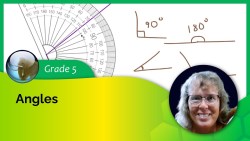
We review what an angle is: it consists of a vertex and two rays which are the sides of the angle. I show how to measure angles, and go through some basic terms (right angle, straight angle, acute angle, obtuse angle, reflex angle). Lastly, we draw a triangle with two given angles. Math Mammoth Grade 5 curriculum: Estimate angles - online practice
More
0 /10
0 people rated
Geometry - 5th grade
2024
R
1 h 5 m
Royaume-Uni
Math
We review what an angle is: it consists of a vertex and two rays which are the sides of the angle. I show how to measure angles, and go through some basic terms (right angle, straight angle, acute angle, obtuse angle, reflex angle). Lastly, we draw a triangle with two given angles. Math Mammoth Grade 5 curriculum: Estimate angles - online practice
More
0 /10
0 people rated
Regarder en ligne
Dans l’appli
Épisodes
Meilleurs acteurs
Avis des utilisateurs
Épisodes
Meilleurs acteurs
Avis des utilisateurs
Épisodes
film
lklk
Netflix
Plex
Avis des utilisateurs
Observateur
22/10/2025 20:50
Volume (how much space something takes) is measured in CUBIC units - which are simply little cubes. If the edges those cubes are 1 inch each, we have one cubic inch. If they are 1 cm each, we have a one cubic centimeter, and so on. Then we look at the volume of a rectangular prism (box in common language). I show using actual blocks that we can find the total volume by first figuring out how many blocks are in the bottom row, and then multiplying that by the height, or how many layers of blocks there are. This then leads us to the familiar formula for the volume of a rectangular prism: simply multiply the three dimensions (width, depth, height, or could also be called length, width, height).
user1408244541258
22/10/2025 20:50
Volume (how much space something takes) is measured in CUBIC units - which are simply little cubes. If the edges those cubes are 1 inch each, we have one cubic inch. If they are 1 cm each, we have a one cubic centimeter, and so on. Then we look at the volume of a rectangular prism (box in common language). I show using actual blocks that we can find the total volume by first figuring out how many blocks are in the bottom row, and then multiplying that by the height, or how many layers of blocks there are. This then leads us to the familiar formula for the volume of a rectangular prism: simply multiply the three dimensions (width, depth, height, or could also be called length, width, height).
Asmi Bhandari
22/10/2025 20:50
I go through and solve two geometry problems here. The first one involves finding the area of a frame. I show two methods for that. The second asks us to find both the area and the perimeter of a rectangular shape (polygon), when some of the side lengths are not known. We also need to divide the shape into several rectangles to find its area. Both problems are good and somewhat challenging for 5th-6th grade level - great for practicing problem solving.
Siwat Chotchaicharin
22/10/2025 20:50
I go through and solve two geometry problems here. The first one involves finding the area of a frame. I show two methods for that. The second asks us to find both the area and the perimeter of a rectangular shape (polygon), when some of the side lengths are not known. We also need to divide the shape into several rectangles to find its area. Both problems are good and somewhat challenging for 5th-6th grade level - great for practicing problem solving.
Roro_Ał219💕
22/10/2025 20:50
We classify a bunch of triangles as either acute, right, or obtuse (classification by angles), and as either scalene, isosceles, or equilateral (classification by sides). Then we tackle two drawing problems that concern triangles. Drawing is at the heart of what geometry is all about and it is both a hands-on activity, which students like, and also requires geometric reasoning about the attributes. This lesson is meant for 5th grade and onward. Check out also my free books and worksheets at
एलिशा रुम्बा तामाङ
22/10/2025 20:50
We classify a bunch of triangles as either acute, right, or obtuse (classification by angles), and as either scalene, isosceles, or equilateral (classification by sides). Then we tackle two drawing problems that concern triangles. Drawing is at the heart of what geometry is all about and it is both a hands-on activity, which students like, and also requires geometric reasoning about the attributes. This lesson is meant for 5th grade and onward. Check out also my free books and worksheets at
Jolie Maria
22/10/2025 20:50
Do you know the seven types of quadrilaterals? We look at the quadrilaterals "family tree", first with only four types of quadrilaterals (to keep it simple), and then we add the rest. The completed family includes the kite, the trapezoid, the parallelogram, the rhombus, the rectangle, and the square. A scalene quadrilateral would form its own branch, so is not included. The family tree helps us to solve questions such as if a parallelogram is also a kite, or if a rectangle is trapezoid. This family tree uses this definition for a trapezoid: a trapezoid is a quadrilateral with AT LEAST one pair of parallel sides. That way, it can have "children" in the family tree - the parallelogram, the rhombus, the rectangle, and the square, which all also have at least one pair of parallel sides (in reality 2, but they fit the definition). This geometry lesson is intended for 5th grade level and onward. Check out also my free books and worksheets at
limakatso1988
22/10/2025 20:50
Do you know the seven types of quadrilaterals? We look at the quadrilaterals "family tree", first with only four types of quadrilaterals (to keep it simple), and then we add the rest. The completed family includes the kite, the trapezoid, the parallelogram, the rhombus, the rectangle, and the square. A scalene quadrilateral would form its own branch, so is not included. The family tree helps us to solve questions such as if a parallelogram is also a kite, or if a rectangle is trapezoid. This family tree uses this definition for a trapezoid: a trapezoid is a quadrilateral with AT LEAST one pair of parallel sides. That way, it can have "children" in the family tree - the parallelogram, the rhombus, the rectangle, and the square, which all also have at least one pair of parallel sides (in reality 2, but they fit the definition). This geometry lesson is intended for 5th grade level and onward. Check out also my free books and worksheets at
A.K.M ✪
22/10/2025 20:50
In this lesson, we go through definitions of the various quadrilaterals and how we mark congruent sides and parallel sides in drawings. Then, we solve two problems. The latter asks you to draw a parallelogram with 5 cm and 8 cm sides. Can you draw several different kinds? The first part of this lesson is here: Math Mammoth Grade 5 curriculum
mo_abdelrahman
22/10/2025 20:50
In this lesson, we go through definitions of the various quadrilaterals and how we mark congruent sides and parallel sides in drawings. Then, we solve two problems. The latter asks you to draw a parallelogram with 5 cm and 8 cm sides. Can you draw several different kinds? The first part of this lesson is here: Math Mammoth Grade 5 curriculum
Avis des utilisateurs
Observateur
22/10/2025 20:50
Volume (how much space something takes) is measured in CUBIC units - which are simply little cubes. If the edges those cubes are 1 inch each, we have one cubic inch. If they are 1 cm each, we have a one cubic centimeter, and so on. Then we look at the volume of a rectangular prism (box in common language). I show using actual blocks that we can find the total volume by first figuring out how many blocks are in the bottom row, and then multiplying that by the height, or how many layers of blocks there are. This then leads us to the familiar formula for the volume of a rectangular prism: simply multiply the three dimensions (width, depth, height, or could also be called length, width, height).
user1408244541258
22/10/2025 20:50
Volume (how much space something takes) is measured in CUBIC units - which are simply little cubes. If the edges those cubes are 1 inch each, we have one cubic inch. If they are 1 cm each, we have a one cubic centimeter, and so on. Then we look at the volume of a rectangular prism (box in common language). I show using actual blocks that we can find the total volume by first figuring out how many blocks are in the bottom row, and then multiplying that by the height, or how many layers of blocks there are. This then leads us to the familiar formula for the volume of a rectangular prism: simply multiply the three dimensions (width, depth, height, or could also be called length, width, height).
Asmi Bhandari
22/10/2025 20:50
I go through and solve two geometry problems here. The first one involves finding the area of a frame. I show two methods for that. The second asks us to find both the area and the perimeter of a rectangular shape (polygon), when some of the side lengths are not known. We also need to divide the shape into several rectangles to find its area. Both problems are good and somewhat challenging for 5th-6th grade level - great for practicing problem solving.
Siwat Chotchaicharin
22/10/2025 20:50
I go through and solve two geometry problems here. The first one involves finding the area of a frame. I show two methods for that. The second asks us to find both the area and the perimeter of a rectangular shape (polygon), when some of the side lengths are not known. We also need to divide the shape into several rectangles to find its area. Both problems are good and somewhat challenging for 5th-6th grade level - great for practicing problem solving.
Roro_Ał219💕
22/10/2025 20:50
We classify a bunch of triangles as either acute, right, or obtuse (classification by angles), and as either scalene, isosceles, or equilateral (classification by sides). Then we tackle two drawing problems that concern triangles. Drawing is at the heart of what geometry is all about and it is both a hands-on activity, which students like, and also requires geometric reasoning about the attributes. This lesson is meant for 5th grade and onward. Check out also my free books and worksheets at
एलिशा रुम्बा तामाङ
22/10/2025 20:50
We classify a bunch of triangles as either acute, right, or obtuse (classification by angles), and as either scalene, isosceles, or equilateral (classification by sides). Then we tackle two drawing problems that concern triangles. Drawing is at the heart of what geometry is all about and it is both a hands-on activity, which students like, and also requires geometric reasoning about the attributes. This lesson is meant for 5th grade and onward. Check out also my free books and worksheets at
Jolie Maria
22/10/2025 20:50
Do you know the seven types of quadrilaterals? We look at the quadrilaterals "family tree", first with only four types of quadrilaterals (to keep it simple), and then we add the rest. The completed family includes the kite, the trapezoid, the parallelogram, the rhombus, the rectangle, and the square. A scalene quadrilateral would form its own branch, so is not included. The family tree helps us to solve questions such as if a parallelogram is also a kite, or if a rectangle is trapezoid. This family tree uses this definition for a trapezoid: a trapezoid is a quadrilateral with AT LEAST one pair of parallel sides. That way, it can have "children" in the family tree - the parallelogram, the rhombus, the rectangle, and the square, which all also have at least one pair of parallel sides (in reality 2, but they fit the definition). This geometry lesson is intended for 5th grade level and onward. Check out also my free books and worksheets at
limakatso1988
22/10/2025 20:50
Do you know the seven types of quadrilaterals? We look at the quadrilaterals "family tree", first with only four types of quadrilaterals (to keep it simple), and then we add the rest. The completed family includes the kite, the trapezoid, the parallelogram, the rhombus, the rectangle, and the square. A scalene quadrilateral would form its own branch, so is not included. The family tree helps us to solve questions such as if a parallelogram is also a kite, or if a rectangle is trapezoid. This family tree uses this definition for a trapezoid: a trapezoid is a quadrilateral with AT LEAST one pair of parallel sides. That way, it can have "children" in the family tree - the parallelogram, the rhombus, the rectangle, and the square, which all also have at least one pair of parallel sides (in reality 2, but they fit the definition). This geometry lesson is intended for 5th grade level and onward. Check out also my free books and worksheets at
A.K.M ✪
22/10/2025 20:50
In this lesson, we go through definitions of the various quadrilaterals and how we mark congruent sides and parallel sides in drawings. Then, we solve two problems. The latter asks you to draw a parallelogram with 5 cm and 8 cm sides. Can you draw several different kinds? The first part of this lesson is here: Math Mammoth Grade 5 curriculum
mo_abdelrahman
22/10/2025 20:50
In this lesson, we go through definitions of the various quadrilaterals and how we mark congruent sides and parallel sides in drawings. Then, we solve two problems. The latter asks you to draw a parallelogram with 5 cm and 8 cm sides. Can you draw several different kinds? The first part of this lesson is here: Math Mammoth Grade 5 curriculum
Disclaimer: All videos and pictures on MovieBox are from the Internet, and their copyrights belong to the original creators. We only provide webpage services and do not store, record, or upload any content.


 Profitez de films et séries sans limite
 Téléchargez vos contenus favoris pour regarder hors ligne
 Interface simple et utilisation fluide




'%3e%3cpath%20id='Vector'%20d='M17.3996%2025.7999C17.3996%2025.9838%2017.3634%2026.1658%2017.293%2026.3357C17.2227%2026.5055%2017.1196%2026.6598%2016.9896%2026.7899C16.8596%2026.9199%2016.7052%2027.023%2016.5354%2027.0933C16.3655%2027.1637%2016.1835%2027.1999%2015.9996%2027.1999C15.8158%2027.1999%2015.6337%2027.1637%2015.4639%2027.0933C15.294%2027.023%2015.1397%2026.9199%2015.0097%2026.7899C14.8797%2026.6598%2014.7765%2026.5055%2014.7062%2026.3357C14.6358%2026.1658%2014.5996%2025.9838%2014.5996%2025.7999C14.5996%2025.4286%2014.7471%2025.0725%2015.0097%2024.81C15.2722%2024.5474%2015.6283%2024.3999%2015.9996%2024.3999C16.3709%2024.3999%2016.727%2024.5474%2016.9896%2024.81C17.2521%2025.0725%2017.3996%2025.4286%2017.3996%2025.7999Z'%20fill='white'/%3e%3cpath%20id='Union'%20fill-rule='evenodd'%20clip-rule='evenodd'%20d='M8.5%204H23.5C24.0523%204%2024.5%204.44772%2024.5%205V21.5H7.5V5C7.5%204.44772%207.94772%204%208.5%204ZM5.5%2022.5V5C5.5%203.34315%206.84315%202%208.5%202H23.5C25.1569%202%2026.5%203.34315%2026.5%205V22.5V27C26.5%2028.6569%2025.1569%2030%2023.5%2030H8.5C6.84315%2030%205.5%2028.6569%205.5%2027V22.5ZM24.5%2023.5V27C24.5%2027.5523%2024.0523%2028%2023.5%2028H8.5C7.94772%2028%207.5%2027.5523%207.5%2027V23.5H24.5Z'%20fill='white'/%3e%3cpath%20id='Union_2'%20fill-rule='evenodd'%20clip-rule='evenodd'%20d='M17%209C17%208.44772%2016.5523%208%2016%208C15.4477%208%2015%208.44772%2015%209V13.8258L13.1508%2012.2407C12.7315%2011.8813%2012.1002%2011.9299%2011.7408%2012.3492C11.3813%2012.7685%2011.4299%2013.3998%2011.8492%2013.7593L15.345%2016.7556C15.5205%2016.9079%2015.7495%2017%2016%2017C16.2506%2017%2016.4796%2016.9079%2016.6551%2016.7556L20.1508%2013.7593C20.5701%2013.3998%2020.6187%2012.7685%2020.2593%2012.3492C19.8999%2011.9299%2019.2686%2011.8813%2018.8492%2012.2407L17%2013.8258V9Z'%20fill='white'/%3e%3c/g%3e%3c/svg%3e)