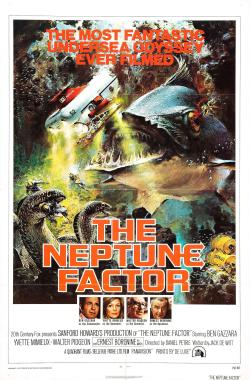
Produced during the early swell of the 1970's disaster movie cycle, this Canadian-made adventure film combines elements from that genre along with a little sci-fi. An undersea research lab investigating the cause of earthquakes gets some firsthand data when a tremor rocks the ocean floor, sending the lab careening into a deep crevice. On the surface, doctors Pidgeon and Mimieux, along with divers Borgnine and Rhodes, attempt to locate the lab along with its three inhabitants, one of whom is Mimieux's boyfriend. With time running out (the lab only has seven days worth of life support) and with no clues to the lab's whereabouts, they call in Gazzara, who operates a special deep water sub called Neptune. With considerable difficulty and conflict, they discover that the lab has slipped far beneath the normal realm of exploration, meaning the Neptune must go to places heretofore never witnessed by man. Once there, they find that the deepest recesses of the ocean contain massive, over-sized fish and sea life thanks to the warmth emitted from volcanic fissures, creatures which severely obstruct the crew's chances of retrieving the men they're searching for! Pidgeon is far beyond the peak of his talents here, often seeming befuddled and dispassionate, despite his inherent likability from decades of prior screen triumphs. Borgnine is markedly heavier than he was just one year earlier in "The Poseidon Adventure", though his stunt double is notably more slender. His performance is almost reserved in contrast to some of his more bombastic portrayals and he doesn't embarrass himself (even if he is not the first person who comes to mind as a deep sea diver!) Mimieux is attractive, but hasn't got much to do besides look worried, stunned and dazed. Gazzara is horribly miscast and gives a stoic, wooden performance topped off with an atrocious Atlanta, GA accent. Rhodes is another one without a lot to do, but he retains his likable persona. The film has been roundly criticized from its release to the present for its effects concerning the "giant" fish (actually regular sea life projected UP CLOSE against the portals of the Neptune) and that aspect of the film is definitely preposterous and poorly handled. However, there is still considerable tension and some otherwise fine miniature work and underwater photography. Another issue is the amount of light and clarity of the water at these murky depths and the premise that men can simply emerge from their vessels and scuba dive in pressures that intense. One thing that robs the film of emotional impact is the fact that the audience barely gets to meet the trapped technicians before they disappear and their plight is never shown through the duration of the film. Also, the finale is rushed and rather poorly handled. Continuity is an issue as well. Mimieux appears in a different wash and wear outfit nearly every time she appears, even in the same day. It's a miracle her clothes don't change within scenes. (Note the way she and Pidgeon seem to wear the same outfits whenever they're on deck, no matter which day it is.) More unbelievable than the giant fish is the presumption that Borgnine can shimmy in and out of his (oddly ragged considering how new everything else is!) scuba suit in the time allotted. A scene between Mimieux and Borgnine, which may have illuminated her relationship with the missing doctor and added a little more emotional depth to the story, was cut prior to release. Still, there's something endearing about the clean, bright sets, the earnest performers, the mysterious and unusual aspects of the storyline and the mostly effective effects. Though it can be a bit tedious at times, it should be a reasonably pleasant viewing for fans of the stars or for fans of 70's disaster flicks. Mimieux and Borgnine would reunite a few years later in "The Black Hole."


 Mag-enjoy sa walang hanggang pelikula at palabas
 I-download ang paborito mong palabas para panoorin offline
 Simpleng disenyo at maayos na takbo




'%3e%3cpath%20id='Vector'%20d='M17.3996%2025.7999C17.3996%2025.9838%2017.3634%2026.1658%2017.293%2026.3357C17.2227%2026.5055%2017.1196%2026.6598%2016.9896%2026.7899C16.8596%2026.9199%2016.7052%2027.023%2016.5354%2027.0933C16.3655%2027.1637%2016.1835%2027.1999%2015.9996%2027.1999C15.8158%2027.1999%2015.6337%2027.1637%2015.4639%2027.0933C15.294%2027.023%2015.1397%2026.9199%2015.0097%2026.7899C14.8797%2026.6598%2014.7765%2026.5055%2014.7062%2026.3357C14.6358%2026.1658%2014.5996%2025.9838%2014.5996%2025.7999C14.5996%2025.4286%2014.7471%2025.0725%2015.0097%2024.81C15.2722%2024.5474%2015.6283%2024.3999%2015.9996%2024.3999C16.3709%2024.3999%2016.727%2024.5474%2016.9896%2024.81C17.2521%2025.0725%2017.3996%2025.4286%2017.3996%2025.7999Z'%20fill='white'/%3e%3cpath%20id='Union'%20fill-rule='evenodd'%20clip-rule='evenodd'%20d='M8.5%204H23.5C24.0523%204%2024.5%204.44772%2024.5%205V21.5H7.5V5C7.5%204.44772%207.94772%204%208.5%204ZM5.5%2022.5V5C5.5%203.34315%206.84315%202%208.5%202H23.5C25.1569%202%2026.5%203.34315%2026.5%205V22.5V27C26.5%2028.6569%2025.1569%2030%2023.5%2030H8.5C6.84315%2030%205.5%2028.6569%205.5%2027V22.5ZM24.5%2023.5V27C24.5%2027.5523%2024.0523%2028%2023.5%2028H8.5C7.94772%2028%207.5%2027.5523%207.5%2027V23.5H24.5Z'%20fill='white'/%3e%3cpath%20id='Union_2'%20fill-rule='evenodd'%20clip-rule='evenodd'%20d='M17%209C17%208.44772%2016.5523%208%2016%208C15.4477%208%2015%208.44772%2015%209V13.8258L13.1508%2012.2407C12.7315%2011.8813%2012.1002%2011.9299%2011.7408%2012.3492C11.3813%2012.7685%2011.4299%2013.3998%2011.8492%2013.7593L15.345%2016.7556C15.5205%2016.9079%2015.7495%2017%2016%2017C16.2506%2017%2016.4796%2016.9079%2016.6551%2016.7556L20.1508%2013.7593C20.5701%2013.3998%2020.6187%2012.7685%2020.2593%2012.3492C19.8999%2011.9299%2019.2686%2011.8813%2018.8492%2012.2407L17%2013.8258V9Z'%20fill='white'/%3e%3c/g%3e%3c/svg%3e)