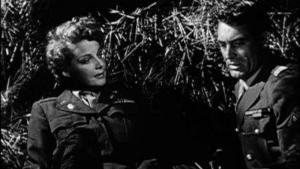
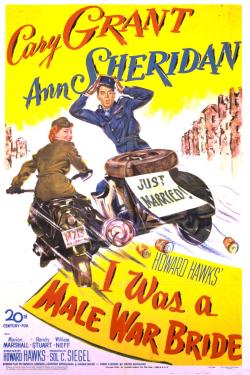
This isn't Hawks' funniest comedy or his most meaningful, but it's clever and amusing, and gets moreso as it moves along.
The repartee isn't as consistently as witty as in some of Hawks' other comedies, a pale shade of what goes on in, say, "Bringing Up Baby," or "Monkey Business." Some of it sounds adolescent. Grant finds himself in humiliating situations and people giggle at him and ask, "What are you doing up there, Henry?" Several times someone remarks, "Poor Henry." And it doesn't help much that the Germany we see is pretty much blasted by the war.
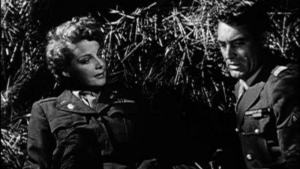
The dust of former explosions seems to hang in the air. It may be Heidelberg but without the Philosophenweg, and there is no Student Prince. Grant is no Henri Rochard and it's hard to laugh when he stumbles over the pronunciation of "Massachussetts" or mistakes "hitch" for "itch." The situations themselves vary in their comedic value. Again, some are silly, as when Grant and Sheridan are about to go over a waterfall. And some are straight out of Laurel and Hardy, as when Grant climbs a pole at night to read the sign at the top and the sign says, "Wet Paint."
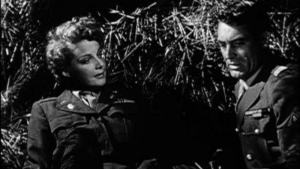
But that's about the extent of the qualifications. This is an enjoyable comedy. It starts off a bit slowly but by the climax it has reached the top of the pole. Sheridan is always a likable, unpretentious actress. But absolutely nobody could carry off a movie like this except Cary Grant. He was the best light comedian of his time and here he's at the top of his form. The gags thrown at him are sometimes ridiculous -- the business of the protruding hands when he's trying to sleep in an awkward position -- but he pulls it all off with no loss of dignity. If you want a thought experiment to demonstrate what I mean, try imagining this movie with John Wayne (another Hawks favorite) in the principal role.
And the gags ARE often amusing, sometimes very amusing. The plot picks up speed after Grant and Sheridan are married. Grant wanders the streets in a state that in the anthropological study of ritual is called "liminal". He is a male war bride, caught between two legitimate statuses, unable to fully occupy either of them. And you have to hand to to not only Grant but Hawks for tackling a comedy about bureaucratic red tape. An unpromising prospect if there ever was one. Hawks brings to every scene his usual flair for improvisational sounding crazy exchanges, even if they don't measure up to his best. Nobody but Hawks would toss in Sheridan's confusing Grant before their marriage with some mock misunderstanding about the Chinese tea-drinking ceremony. And nobody would bother to have one of the characters say, "Good luck to you." There's a confident, relaxed quality in the movie which can only be blamed on Grant and Hawks.
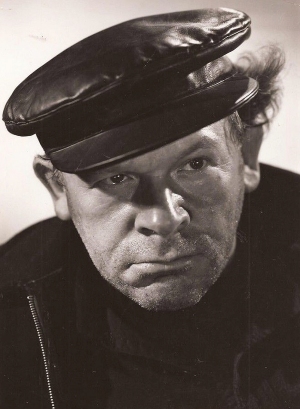
Probably the funniest scene is towards the end, as the couple attempt to board a ship for the USA. Kenneth Toby as the sailor, "Red," only has a few scenes with Grant but they are as funny as anything Hawks has put on screen.
Grant: "The army understood and they passed me." Toby: "Oh, the army understood and they passed you. You hear that, Joe? The army understood and they passed him. This is the NAVY, Bud." And Toby's final line, after Grant's gender has been discovered, "Come on. Come along, Flo," while crooking his finger at Grant.


 Mag-enjoy sa walang hanggang pelikula at palabas
 I-download ang paborito mong palabas para panoorin offline
 Simpleng disenyo at maayos na takbo




'%3e%3cpath%20id='Vector'%20d='M17.3996%2025.7999C17.3996%2025.9838%2017.3634%2026.1658%2017.293%2026.3357C17.2227%2026.5055%2017.1196%2026.6598%2016.9896%2026.7899C16.8596%2026.9199%2016.7052%2027.023%2016.5354%2027.0933C16.3655%2027.1637%2016.1835%2027.1999%2015.9996%2027.1999C15.8158%2027.1999%2015.6337%2027.1637%2015.4639%2027.0933C15.294%2027.023%2015.1397%2026.9199%2015.0097%2026.7899C14.8797%2026.6598%2014.7765%2026.5055%2014.7062%2026.3357C14.6358%2026.1658%2014.5996%2025.9838%2014.5996%2025.7999C14.5996%2025.4286%2014.7471%2025.0725%2015.0097%2024.81C15.2722%2024.5474%2015.6283%2024.3999%2015.9996%2024.3999C16.3709%2024.3999%2016.727%2024.5474%2016.9896%2024.81C17.2521%2025.0725%2017.3996%2025.4286%2017.3996%2025.7999Z'%20fill='white'/%3e%3cpath%20id='Union'%20fill-rule='evenodd'%20clip-rule='evenodd'%20d='M8.5%204H23.5C24.0523%204%2024.5%204.44772%2024.5%205V21.5H7.5V5C7.5%204.44772%207.94772%204%208.5%204ZM5.5%2022.5V5C5.5%203.34315%206.84315%202%208.5%202H23.5C25.1569%202%2026.5%203.34315%2026.5%205V22.5V27C26.5%2028.6569%2025.1569%2030%2023.5%2030H8.5C6.84315%2030%205.5%2028.6569%205.5%2027V22.5ZM24.5%2023.5V27C24.5%2027.5523%2024.0523%2028%2023.5%2028H8.5C7.94772%2028%207.5%2027.5523%207.5%2027V23.5H24.5Z'%20fill='white'/%3e%3cpath%20id='Union_2'%20fill-rule='evenodd'%20clip-rule='evenodd'%20d='M17%209C17%208.44772%2016.5523%208%2016%208C15.4477%208%2015%208.44772%2015%209V13.8258L13.1508%2012.2407C12.7315%2011.8813%2012.1002%2011.9299%2011.7408%2012.3492C11.3813%2012.7685%2011.4299%2013.3998%2011.8492%2013.7593L15.345%2016.7556C15.5205%2016.9079%2015.7495%2017%2016%2017C16.2506%2017%2016.4796%2016.9079%2016.6551%2016.7556L20.1508%2013.7593C20.5701%2013.3998%2020.6187%2012.7685%2020.2593%2012.3492C19.8999%2011.9299%2019.2686%2011.8813%2018.8492%2012.2407L17%2013.8258V9Z'%20fill='white'/%3e%3c/g%3e%3c/svg%3e)