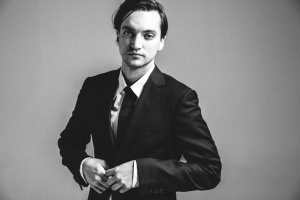
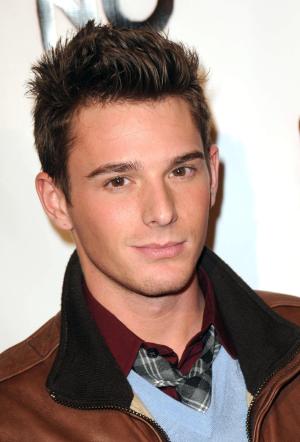
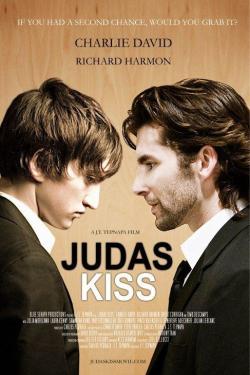
Or the time-traveler's mid-life crisis, could be another title, just to consciously echo the film it obviously borrows after. And where in that film family values bend time, here it, huh, is self-respect one supposes; just throw in towards the end a huge moon bending over younger-and-older-version of the lead character self-hugging, and then you verge into ludicrous "The Fountain" territory. That is as bad as it gets - oh, no, actually not: with its Scrooge-like moral tale time-shift, Dickens comes, has to come to mind, no? Only here, with the film's nauseating badness, dissonances deliver Dickens' name as dick ends. Why should Brent Corrigan be here, otherwise, with his faux-puppy eyelooks? He seriously stands out from the other cast, with his all-American sincerity in the eye, poor débutante. Richard Harmon, now, seriously, has looks that could have helped the film, if one could stop and consider he has some facial affinity with both Robert Pattinson and Christopher Eccleston; for me he was the only true stand-out in this unsubtle mess. I will pass on Charlie David.
So why is this film that bad? Redemption, love, forgiveness, blah blah blah, I do not really care what a film's theme is, given some true effort beyond respectful premises; bad realization does not purge the cliché-ridden intention.
The film suffers - no, make that drowns six fathoms deep - from the aimless, stupid gratification of watching the failed director go to the festival who has sex with a youngster who, hello! we are soon to discover is his younger self. Now this is new territory: time bending/traveling self-incest. The effect is as bland as watching the Peters (identical) twins having sex in "Taboo". But this at least was *, that is, did not have to be consistent on a narrative level, to put it that way - for tell me after such a beginning, what kind of consistency you're looking for? With a dead-end start, good luck to you.
And then there is one question of the logical order. For a sci-fi film to succeed, and give your own example here, it somehow must be strong on the logic line; despite the science and the fiction, the better it is thought through, the better it titillates. So the obvious question is, who was the judge the first time round when the director was his young self? The film has its only interesting moment here, though by obfuscating, by failing to address this question. Ms Dean says that due to clauses of matriculation, the film cannot enter into competition, so goodbye to our question. Yet its empty place stays on. What is this doubly denied place, who fails to occupy it? And the answer is the Name of the Father, which doubly alienated means in clinical terms madness. The plot opts for the once-more-molestation-cliché, as if that takes care to explain anything, instead of exposing the badness of "Judas Kiss".
The Christian Association of America should sue the makers of this film for taking the name of our Traitor, Judas Iscariot, in vain on their poster and the film! May it be banned and burn in hell, amen to that! And, remember, folks, when Oscar Wilde visited America, he saw in a saloon the sign "Do not shoot the pianist, he's doing his best", upon which he reflected in awe that bad art merits the penalty of death. May we re-enact that in our cinematically permissive societies.- That would also mean love and redemption taken seriously, polemically, not in a deluded, new-age, soft-* manner, unless you want to have sex with yourself.


 Mag-enjoy sa walang hanggang pelikula at palabas
 I-download ang paborito mong palabas para panoorin offline
 Simpleng disenyo at maayos na takbo

























'%3e%3cpath%20id='Vector'%20d='M17.3996%2025.7999C17.3996%2025.9838%2017.3634%2026.1658%2017.293%2026.3357C17.2227%2026.5055%2017.1196%2026.6598%2016.9896%2026.7899C16.8596%2026.9199%2016.7052%2027.023%2016.5354%2027.0933C16.3655%2027.1637%2016.1835%2027.1999%2015.9996%2027.1999C15.8158%2027.1999%2015.6337%2027.1637%2015.4639%2027.0933C15.294%2027.023%2015.1397%2026.9199%2015.0097%2026.7899C14.8797%2026.6598%2014.7765%2026.5055%2014.7062%2026.3357C14.6358%2026.1658%2014.5996%2025.9838%2014.5996%2025.7999C14.5996%2025.4286%2014.7471%2025.0725%2015.0097%2024.81C15.2722%2024.5474%2015.6283%2024.3999%2015.9996%2024.3999C16.3709%2024.3999%2016.727%2024.5474%2016.9896%2024.81C17.2521%2025.0725%2017.3996%2025.4286%2017.3996%2025.7999Z'%20fill='white'/%3e%3cpath%20id='Union'%20fill-rule='evenodd'%20clip-rule='evenodd'%20d='M8.5%204H23.5C24.0523%204%2024.5%204.44772%2024.5%205V21.5H7.5V5C7.5%204.44772%207.94772%204%208.5%204ZM5.5%2022.5V5C5.5%203.34315%206.84315%202%208.5%202H23.5C25.1569%202%2026.5%203.34315%2026.5%205V22.5V27C26.5%2028.6569%2025.1569%2030%2023.5%2030H8.5C6.84315%2030%205.5%2028.6569%205.5%2027V22.5ZM24.5%2023.5V27C24.5%2027.5523%2024.0523%2028%2023.5%2028H8.5C7.94772%2028%207.5%2027.5523%207.5%2027V23.5H24.5Z'%20fill='white'/%3e%3cpath%20id='Union_2'%20fill-rule='evenodd'%20clip-rule='evenodd'%20d='M17%209C17%208.44772%2016.5523%208%2016%208C15.4477%208%2015%208.44772%2015%209V13.8258L13.1508%2012.2407C12.7315%2011.8813%2012.1002%2011.9299%2011.7408%2012.3492C11.3813%2012.7685%2011.4299%2013.3998%2011.8492%2013.7593L15.345%2016.7556C15.5205%2016.9079%2015.7495%2017%2016%2017C16.2506%2017%2016.4796%2016.9079%2016.6551%2016.7556L20.1508%2013.7593C20.5701%2013.3998%2020.6187%2012.7685%2020.2593%2012.3492C19.8999%2011.9299%2019.2686%2011.8813%2018.8492%2012.2407L17%2013.8258V9Z'%20fill='white'/%3e%3c/g%3e%3c/svg%3e)