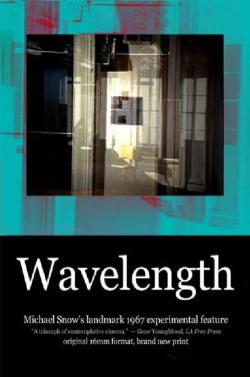
This is one of the most famous conceptual films ever made, and yet it's surprising how little the descriptions of it actually fit. It is most commonly discussed as "a single zoom", partially because of Snow's own description of it, whereas it's obviously and significantly several cuts with various camera effects added in for good measure. It's discussed as having a strange mix of sounds in its soundtrack, but the sounds are actually pretty isolated and easy to distinguish, from the whistling sine wave increasing in pitch to the glass breaking, Strawberry Fields Forever, sirens only at the end, and a line of dialog. It's also discussed as minimalistic, but there's actually a lot going on. Finally, and most importantly, it's a lot easier to watch than most people make it out to be.
In a New York loft, Michael Snow sets up a camera in the corner and, over a series of hundreds of cuts over two days, slowly zooms in to a picture of waves on the wall while putting in color gels, fiddling with exposure, staging a narrative scene (almost in real time), and playing with cuts and super-impositions. In his own words, it's as long as it is because he didn't have any money to make it longer, and one aside to the whole "continuous zoom" theme is that the zoom is at absolutely no point in the movie continuous, but protracted (there's a significant difference).
It's interesting to people in the way it plays with expectations (what does an audience want from a film?), the way it plays with narrative (by the time we've zoomed all the way in, the actions on the set are really mysterious), in the way that memory plays with our experience of the film (some sections seem to go faster than others because less is going on... it is possible to sleep through segments of the film and not miss anything), and some even discuss it in terms of discomfort (the sine wave is annoying to people, I guess, and after all the anxiety involved in getting to the end, the picture is, in theory, a purposeful let-down). A lot of people discuss it in terms of filmic space, and how by the time the movie ends, the camera has opened up to an entirely different space than the loft.
The thing is, I knew about pretty much all of this before I had ever seen the film (this happens sometimes when you're a film student; I also had pretty much "seen" A bout de soufflé a dozen times before actually watching the movie), and as a concept film, it's the concept itself that matters over the actual experience of it. Whereas it is still an important film, it is a famous film, and it is a heavily discussed film, "seeing it" is not all that important, and since it's a rare film, it's also not really worth tracking down. I think it should be made available on DVD so that it can lose a bit of its romantic mystery, but since it's also the type of film that's a "film" and must be seen projected as film, putting it on DVD can offend the people who enjoy it as a "film". You see the problem we're dealing with, here?
Anyway, if you've heard of Wavelength, you probably already know all about it, and if you don't, you're not reading this. It is eternally for an audience of avant-garde enthusiasts and film theorists (and, well, let's face it, the occasional pretentious jerk, though Snow doesn't strike me as one himself), and will maintain that audience for decades to come.
--PolarisDiB


 استمتع بأفلام وبرامج بلا حدود
 حمل ما تحب وشاهد بدون إنترنت
 واجهة بسيطة وأداء سلس




'%3e%3cpath%20id='Vector'%20d='M17.3996%2025.7999C17.3996%2025.9838%2017.3634%2026.1658%2017.293%2026.3357C17.2227%2026.5055%2017.1196%2026.6598%2016.9896%2026.7899C16.8596%2026.9199%2016.7052%2027.023%2016.5354%2027.0933C16.3655%2027.1637%2016.1835%2027.1999%2015.9996%2027.1999C15.8158%2027.1999%2015.6337%2027.1637%2015.4639%2027.0933C15.294%2027.023%2015.1397%2026.9199%2015.0097%2026.7899C14.8797%2026.6598%2014.7765%2026.5055%2014.7062%2026.3357C14.6358%2026.1658%2014.5996%2025.9838%2014.5996%2025.7999C14.5996%2025.4286%2014.7471%2025.0725%2015.0097%2024.81C15.2722%2024.5474%2015.6283%2024.3999%2015.9996%2024.3999C16.3709%2024.3999%2016.727%2024.5474%2016.9896%2024.81C17.2521%2025.0725%2017.3996%2025.4286%2017.3996%2025.7999Z'%20fill='white'/%3e%3cpath%20id='Union'%20fill-rule='evenodd'%20clip-rule='evenodd'%20d='M8.5%204H23.5C24.0523%204%2024.5%204.44772%2024.5%205V21.5H7.5V5C7.5%204.44772%207.94772%204%208.5%204ZM5.5%2022.5V5C5.5%203.34315%206.84315%202%208.5%202H23.5C25.1569%202%2026.5%203.34315%2026.5%205V22.5V27C26.5%2028.6569%2025.1569%2030%2023.5%2030H8.5C6.84315%2030%205.5%2028.6569%205.5%2027V22.5ZM24.5%2023.5V27C24.5%2027.5523%2024.0523%2028%2023.5%2028H8.5C7.94772%2028%207.5%2027.5523%207.5%2027V23.5H24.5Z'%20fill='white'/%3e%3cpath%20id='Union_2'%20fill-rule='evenodd'%20clip-rule='evenodd'%20d='M17%209C17%208.44772%2016.5523%208%2016%208C15.4477%208%2015%208.44772%2015%209V13.8258L13.1508%2012.2407C12.7315%2011.8813%2012.1002%2011.9299%2011.7408%2012.3492C11.3813%2012.7685%2011.4299%2013.3998%2011.8492%2013.7593L15.345%2016.7556C15.5205%2016.9079%2015.7495%2017%2016%2017C16.2506%2017%2016.4796%2016.9079%2016.6551%2016.7556L20.1508%2013.7593C20.5701%2013.3998%2020.6187%2012.7685%2020.2593%2012.3492C19.8999%2011.9299%2019.2686%2011.8813%2018.8492%2012.2407L17%2013.8258V9Z'%20fill='white'/%3e%3c/g%3e%3c/svg%3e)