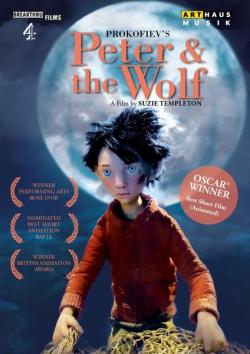
For a young boy, unhappiness can be a natural state. Peter and his aged grandfather live in a scrabbly old farmhouse on the edge of a forbidding Russian forest. The grandfather has built a wooden fence around the dirt yard and forbids Peter to go into the forest, where dangerous things lurk, like wolves. Peter hates this. All Peter has for a friend is a scruffy, long-necked duck. When he goes into town two hunters bully him. Still, Peter is a good kid. He helps a bird with an injured wing fly again with the help of a balloon. He sneaks out and plays on the iced pond, skittering and sliding and joined by the duck. He accepts his grandfather's fat, fat cat as a creature perhaps not to like, but not to hurt. Peter even manages to catch the dangerous, hungry and mangy wolf in his net. Peter stops his grandfather from shooting the wolf. When he and his grandfather take it to town, Peter is a hero. But it's not to last. Those hunters show up to taunt and bully the wolf. Peter stops them with his net. Then, Peter...and at this point you need to see this stop-action animation short film.
The director, Suzie Templeton, changes some of Sergei Prokofiev's storyline, as well as ditching all the narrative. There's no dialogue, just the music and silence. She gives a conclusion that is unexpected, brave and touching. This is particularly so when we figure out that there are lessons to be learned, especially since there are bullies in this world, and good friends can die. Cats eat birds, wolves eat ducks, bullies hurt any they want who are weaker than they.
This new look at Prokofiev's symphony for children runs less than 30 minutes. Over the years, the narrative, in my opinion, had become a boring old aunt who stays too long when she visits. There doesn't seem to have been a celebrity who hasn't wanted to prove his or her love for the kiddies, score some publicity and make a few bucks by doing the narrative. We're talking everyone from Arthur Godfrey to John Gielgud, Boris Karloff to Paul Hogan, Sean Connery to Mia Farrow, George Raft to William Buckley. That's just starters. Without the narrative, and with Templeton's visual style, we wind up concentrating on the story. That means we wind up concentrating on this kid who starts out unhappy and who winds up teaching us all a thing or two.
The extras are worth watching, including the discussion of the development of the film by the director and how the stop-action animation stuff was worked. And, of course, you'll learn which musical instruments go with which characters. This Peter and the Wolf won the 2008 Academy Award for Animated Short Film. It's a thoughtful, delightful film.


 استمتع بأفلام وبرامج بلا حدود
 حمل ما تحب وشاهد بدون إنترنت
 واجهة بسيطة وأداء سلس
















'%3e%3cpath%20id='Vector'%20d='M17.3996%2025.7999C17.3996%2025.9838%2017.3634%2026.1658%2017.293%2026.3357C17.2227%2026.5055%2017.1196%2026.6598%2016.9896%2026.7899C16.8596%2026.9199%2016.7052%2027.023%2016.5354%2027.0933C16.3655%2027.1637%2016.1835%2027.1999%2015.9996%2027.1999C15.8158%2027.1999%2015.6337%2027.1637%2015.4639%2027.0933C15.294%2027.023%2015.1397%2026.9199%2015.0097%2026.7899C14.8797%2026.6598%2014.7765%2026.5055%2014.7062%2026.3357C14.6358%2026.1658%2014.5996%2025.9838%2014.5996%2025.7999C14.5996%2025.4286%2014.7471%2025.0725%2015.0097%2024.81C15.2722%2024.5474%2015.6283%2024.3999%2015.9996%2024.3999C16.3709%2024.3999%2016.727%2024.5474%2016.9896%2024.81C17.2521%2025.0725%2017.3996%2025.4286%2017.3996%2025.7999Z'%20fill='white'/%3e%3cpath%20id='Union'%20fill-rule='evenodd'%20clip-rule='evenodd'%20d='M8.5%204H23.5C24.0523%204%2024.5%204.44772%2024.5%205V21.5H7.5V5C7.5%204.44772%207.94772%204%208.5%204ZM5.5%2022.5V5C5.5%203.34315%206.84315%202%208.5%202H23.5C25.1569%202%2026.5%203.34315%2026.5%205V22.5V27C26.5%2028.6569%2025.1569%2030%2023.5%2030H8.5C6.84315%2030%205.5%2028.6569%205.5%2027V22.5ZM24.5%2023.5V27C24.5%2027.5523%2024.0523%2028%2023.5%2028H8.5C7.94772%2028%207.5%2027.5523%207.5%2027V23.5H24.5Z'%20fill='white'/%3e%3cpath%20id='Union_2'%20fill-rule='evenodd'%20clip-rule='evenodd'%20d='M17%209C17%208.44772%2016.5523%208%2016%208C15.4477%208%2015%208.44772%2015%209V13.8258L13.1508%2012.2407C12.7315%2011.8813%2012.1002%2011.9299%2011.7408%2012.3492C11.3813%2012.7685%2011.4299%2013.3998%2011.8492%2013.7593L15.345%2016.7556C15.5205%2016.9079%2015.7495%2017%2016%2017C16.2506%2017%2016.4796%2016.9079%2016.6551%2016.7556L20.1508%2013.7593C20.5701%2013.3998%2020.6187%2012.7685%2020.2593%2012.3492C19.8999%2011.9299%2019.2686%2011.8813%2018.8492%2012.2407L17%2013.8258V9Z'%20fill='white'/%3e%3c/g%3e%3c/svg%3e)