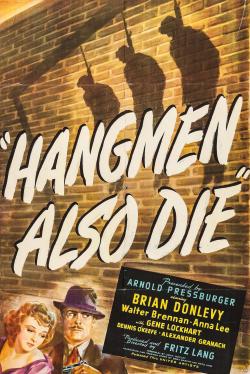
Under the name 'Bert', Brecht teamed up with director Fritz Lang to craft this cunning and ultimately suspenseful tale that borders more than consciously on propaganda, but for all the right reasons considering the period. It wasn't a period piece but something urgent of the time and place- not to mention a stark battle cry from Lang, who fled Germany in 1934 following a calling from Goebbels to become the propaganda filmmaker of the 30s- and it stands still as one of those under-seen pieces where loyalties and betrayals and double-crosses and vendettas are all abound, and the truth is something tricky and twisty on either side.
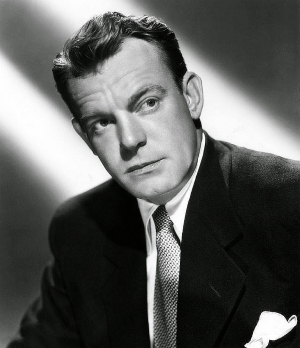
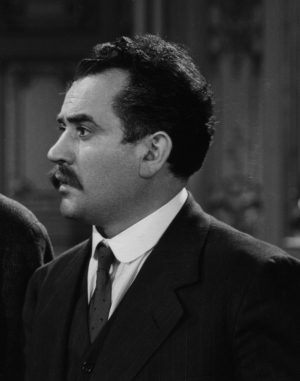
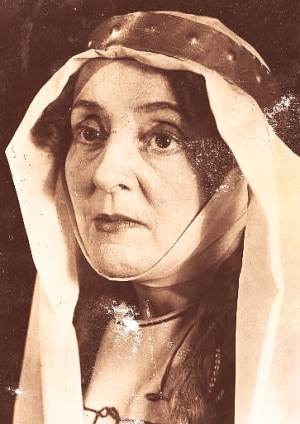
The main plot concerns the dramatized story of Reinhard Heydrich, the "hangman", who is then put on by the Nazis as a figure of the past to haunt the Czech people: the assassin MUST be found. The assassin is Dr. Franticek Svoboda, aka Karel Vanek, who may also have another alias, and is well played by Donelvy, who hides with a Czech professor (Brennan) via a chance meeting weeks before with Nasha (Anna). Once he escapes following a curfew that night, many people are rounded up- hundreds- to be executed by the Nazis if the assassin isn't taken in. Anna's family is questioned, her father on the list of those to soon be killed, but what of Svoboda (and the resistance, or the cruel Nazis at the gestapo for that matter)? I
t's a typical Langian procedural in the very tense and exacting sense, and it's a lot of tense fun and there's always a sense of danger with how the characters cross one another in one scene to the next (I loved when Vanek comes back to Anna after the first night, she's mad at him, but this is right after she's been questioned by cruel Gruber, performed by Granach as half caricature and half power-hungry monster, and there is a wire to her apartment, only to have him feed her lines through index cards).
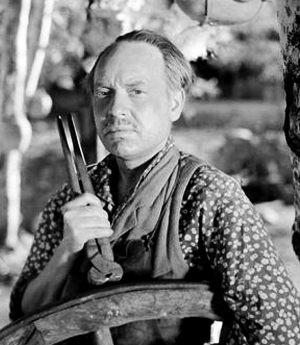
It's just as intense as a more modern espionage thriller, only Lang has the upper-hand at crafting it with an equal hand of social indictment (like M or Fury, the people in the Czech city have a role to play in what happens, and there's great scenes of small mobs going crazy like in the movie theater) and of a more general grilling of the sadistic Nazis. There's not much room to make them very three-dimensional, however Hangmen Also Die! features the Nazis performed not in very simplistic ways. Maybe my favorite is the traitor- a Nazi collaborator played by the large Gene Lockhart who can go from being happy-go-lucky to frantic and pushy on a dime, and is the total puppet of the sneaky inspector Gruber, who is funniest when trying to get back to sleep following a night of frivolity with some girls.
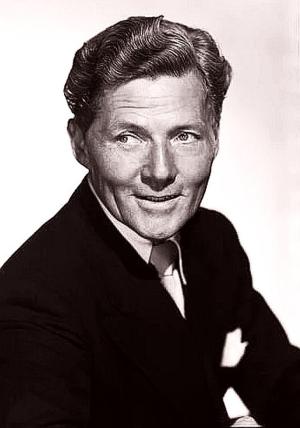
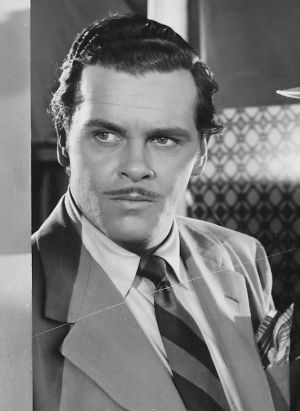
The storyline isn't completely free of a few heavy lines of dialog, and the whole sub-plot involving the 'is she seeing someone else' thinking for Jan Horak (O'Keefe, best at looking stone-faced in semi-shock) who is the fiancé of Nasha is the least effective of the lot. But what is here is a striking example of balancing real thrills (it's hard not to be on the edge of your seat in the last fifteen to twenty minutes, mostly as characters talk if not in tense cat-and-mouse theatrics) and a great message at hand. Lang makes this a story meant to pull people into action- the film ends with "NOT" and then super-imposed "THE END"- and like with M, there's many a moment when the common-folk, like a maid or a taxi driver or butler, become the real heroes in saying who was where or what one did at a given time.
And of course Lang is also totally on top of his game at crafting this with many images of sadistic shadows (watch as Nasha is prisoner and a guard comes into a second shot in silhouette) and enclosing angles.


 استمتع بأفلام وبرامج بلا حدود
 حمل ما تحب وشاهد بدون إنترنت
 واجهة بسيطة وأداء سلس
















'%3e%3cpath%20id='Vector'%20d='M17.3996%2025.7999C17.3996%2025.9838%2017.3634%2026.1658%2017.293%2026.3357C17.2227%2026.5055%2017.1196%2026.6598%2016.9896%2026.7899C16.8596%2026.9199%2016.7052%2027.023%2016.5354%2027.0933C16.3655%2027.1637%2016.1835%2027.1999%2015.9996%2027.1999C15.8158%2027.1999%2015.6337%2027.1637%2015.4639%2027.0933C15.294%2027.023%2015.1397%2026.9199%2015.0097%2026.7899C14.8797%2026.6598%2014.7765%2026.5055%2014.7062%2026.3357C14.6358%2026.1658%2014.5996%2025.9838%2014.5996%2025.7999C14.5996%2025.4286%2014.7471%2025.0725%2015.0097%2024.81C15.2722%2024.5474%2015.6283%2024.3999%2015.9996%2024.3999C16.3709%2024.3999%2016.727%2024.5474%2016.9896%2024.81C17.2521%2025.0725%2017.3996%2025.4286%2017.3996%2025.7999Z'%20fill='white'/%3e%3cpath%20id='Union'%20fill-rule='evenodd'%20clip-rule='evenodd'%20d='M8.5%204H23.5C24.0523%204%2024.5%204.44772%2024.5%205V21.5H7.5V5C7.5%204.44772%207.94772%204%208.5%204ZM5.5%2022.5V5C5.5%203.34315%206.84315%202%208.5%202H23.5C25.1569%202%2026.5%203.34315%2026.5%205V22.5V27C26.5%2028.6569%2025.1569%2030%2023.5%2030H8.5C6.84315%2030%205.5%2028.6569%205.5%2027V22.5ZM24.5%2023.5V27C24.5%2027.5523%2024.0523%2028%2023.5%2028H8.5C7.94772%2028%207.5%2027.5523%207.5%2027V23.5H24.5Z'%20fill='white'/%3e%3cpath%20id='Union_2'%20fill-rule='evenodd'%20clip-rule='evenodd'%20d='M17%209C17%208.44772%2016.5523%208%2016%208C15.4477%208%2015%208.44772%2015%209V13.8258L13.1508%2012.2407C12.7315%2011.8813%2012.1002%2011.9299%2011.7408%2012.3492C11.3813%2012.7685%2011.4299%2013.3998%2011.8492%2013.7593L15.345%2016.7556C15.5205%2016.9079%2015.7495%2017%2016%2017C16.2506%2017%2016.4796%2016.9079%2016.6551%2016.7556L20.1508%2013.7593C20.5701%2013.3998%2020.6187%2012.7685%2020.2593%2012.3492C19.8999%2011.9299%2019.2686%2011.8813%2018.8492%2012.2407L17%2013.8258V9Z'%20fill='white'/%3e%3c/g%3e%3c/svg%3e)