Before I start, I should declare my bias up front; I have never understood the appeal of smoking. Granted, I didn't grow up during the time when it was made to look cool in the movies, but I don't think it looks glamorous or stylish or any of that. I can understand how some people will drink too much in that many alcoholic beverages actually taste good(I hope no one sees this as an endorsement of alcoholism, because it isn't), but cigarettes don't even taste good; it's just smoke. I've always liked this routine I once heard where a comedian talked about smokers and their attitudes:
"Smoking doesn't affect me, I can still exercise," they say. Then you walk up a flight of stairs with them, and all of a sudden they turn into Darth Vader(heavy breathing). Meanwhile, there's Yoda on the railing going, "Stunt your growth, it will."
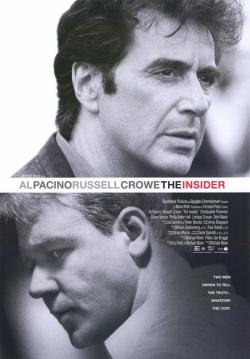
All that is to say I was predisposed to liking THE INSIDER before I even saw it, since it goes after the tobacco industry(anybody who thinks legalized drugs would improve things should consider how the tobacco industry has handled its own legalized drug). But if that was all it did, it wouldn't be a complete movie. Instead, THE INSIDER, and Michael Mann, also make this an indictment of the news industry, which is more concerned with industry than news, and a complex character study of two men.
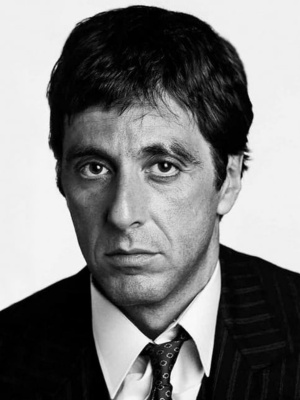
Admittedly, there are a few facts fudged here. The most surprising thing is an omission; I'm not entirely clear on this, but wasn't one of the CBS executives related to someone at Brown & Williamson? Also, while it's not true the movie gives credit to Lowell Bergman(Al Pacino) for manipulating a Wall Street Journal story(he merely gives them the other side of the story they were about to print), it doesn't give the paper enough credit for its own investigation(as Bergman in the movie points out, the Journal is not exactly known for going after big corporations).
Still, this is a powerful movie. One thing, as I said before, which makes it powerful is how it also goes after CBS, and in particular CBS News, for caving in to the possibility of a lawsuit(not a lawsuit, just the possibility of one). And while Mike Wallace has criticized the film(though he has retracted that somewhat), the fact of the matter is if he had made a stink about it, CBS might not have caved in so easily. And yet the film doesn't portray him as a bad guy, just someone who doesn't know if he has the fight left in him.
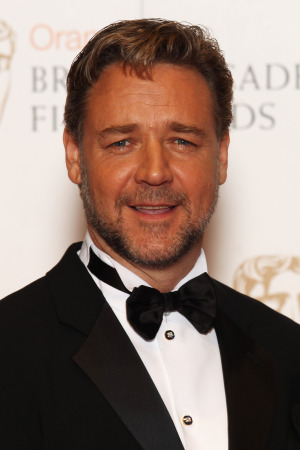
And as a character study, of course, it's riveting. Some people think this film is a departure for Mann from his usual crime dramas. But Mann has also made films about flawed heroes(MANHUNTER, THE LAST OF THE MOHICANS), which Jeffrey Wigand certainly is, and like the characters in Mann's more famous films(THIEF, HEAT), Wigand is a man good at his job, but not good at expressing his feelings, and backed into a stand he didn't know he was going to have to take. Russell Crowe has not always played characters with simmering intensity(think of PROOF, THE SUM OF US, or THE QUICK AND THE DEAD), but as L.A. CONFIDENTIAL showed, he's masterful at playing them, and shows it again here. He walks like a man defeated at the beginning, when he's fired, and you can feel the longing he has just for things to be normal again. But you can also see the intelligence and the man who refuses to be pushed around by anybody, whether it be the tobacco company or Bergman. Pacino is also quite good as Bergman, playing not a hero, but someone who also is pushed into a stand he didn't think he'd have to take.
Oh yeah, and as usual for a Mann film, this looks incredible. Just as ALL THE PRESIDENTS MEN(which this is being compared to) director Alan J. Pakula and cameraman Gordon Willis was able to visualize the creepiness of Watergate, here Mann and his cameraman, Dante Spinotti, emphasize how there's no black and white here by showing the gray areas visually. All in all, this is a great film.


 استمتع بأفلام وبرامج بلا حدود
 حمل ما تحب وشاهد بدون إنترنت
 واجهة بسيطة وأداء سلس




'%3e%3cpath%20id='Vector'%20d='M17.3996%2025.7999C17.3996%2025.9838%2017.3634%2026.1658%2017.293%2026.3357C17.2227%2026.5055%2017.1196%2026.6598%2016.9896%2026.7899C16.8596%2026.9199%2016.7052%2027.023%2016.5354%2027.0933C16.3655%2027.1637%2016.1835%2027.1999%2015.9996%2027.1999C15.8158%2027.1999%2015.6337%2027.1637%2015.4639%2027.0933C15.294%2027.023%2015.1397%2026.9199%2015.0097%2026.7899C14.8797%2026.6598%2014.7765%2026.5055%2014.7062%2026.3357C14.6358%2026.1658%2014.5996%2025.9838%2014.5996%2025.7999C14.5996%2025.4286%2014.7471%2025.0725%2015.0097%2024.81C15.2722%2024.5474%2015.6283%2024.3999%2015.9996%2024.3999C16.3709%2024.3999%2016.727%2024.5474%2016.9896%2024.81C17.2521%2025.0725%2017.3996%2025.4286%2017.3996%2025.7999Z'%20fill='white'/%3e%3cpath%20id='Union'%20fill-rule='evenodd'%20clip-rule='evenodd'%20d='M8.5%204H23.5C24.0523%204%2024.5%204.44772%2024.5%205V21.5H7.5V5C7.5%204.44772%207.94772%204%208.5%204ZM5.5%2022.5V5C5.5%203.34315%206.84315%202%208.5%202H23.5C25.1569%202%2026.5%203.34315%2026.5%205V22.5V27C26.5%2028.6569%2025.1569%2030%2023.5%2030H8.5C6.84315%2030%205.5%2028.6569%205.5%2027V22.5ZM24.5%2023.5V27C24.5%2027.5523%2024.0523%2028%2023.5%2028H8.5C7.94772%2028%207.5%2027.5523%207.5%2027V23.5H24.5Z'%20fill='white'/%3e%3cpath%20id='Union_2'%20fill-rule='evenodd'%20clip-rule='evenodd'%20d='M17%209C17%208.44772%2016.5523%208%2016%208C15.4477%208%2015%208.44772%2015%209V13.8258L13.1508%2012.2407C12.7315%2011.8813%2012.1002%2011.9299%2011.7408%2012.3492C11.3813%2012.7685%2011.4299%2013.3998%2011.8492%2013.7593L15.345%2016.7556C15.5205%2016.9079%2015.7495%2017%2016%2017C16.2506%2017%2016.4796%2016.9079%2016.6551%2016.7556L20.1508%2013.7593C20.5701%2013.3998%2020.6187%2012.7685%2020.2593%2012.3492C19.8999%2011.9299%2019.2686%2011.8813%2018.8492%2012.2407L17%2013.8258V9Z'%20fill='white'/%3e%3c/g%3e%3c/svg%3e)